
Venetian Blinds in South Africa: Aluminium, Wood and Premium Options Compared
A tilt of the wrist and the whole room changes. Morning light lands where you want it. Glare disappears from your screen. The neighbour’s view stops at the slat. No other blind gives you that level of precise, quiet control over how a room feels.
What are the best venetian blinds in South Africa?
- Aluminium venetian blinds are the most practical choice for bathrooms, kitchens and coastal homes, moisture-proof, easy to wipe clean, and the most affordable option
- Aluwood venetian blinds combine an aluminium core with a timber-look finish, offering the warmth of wood without moisture risk
- Real wood venetian blinds deliver the richest finish and finest engineering but are not suited to coastal or high-humidity rooms
- Plaswood venetian blinds are the best choice for high-moisture rooms where real wood would warp. They look like timber but won’t
- Coastal homes need aluminium or Plaswood slats with stainless-steel or polymer components. Timber warps in salt-air conditions
- Custom Blinds supplies venetian blinds in aluminium, aluwood, Plaswood, real wood and bamboo, all made to measure
Order made-to-measure venetian blinds online or call 076 022 8410.
TLDR
Aluminium venetians handle moisture, heat and salt. The go-to for bathrooms, kitchens and the coast. Aluwood gives you the timber look without the risk. Real wood is for dry rooms where finish matters most. Custom Blinds supplies all three tiers, with direct access to Hunter Douglas premium ranges through Blindquip, a supplier relationship that goes back to 2010. shop venetian blinds online or call Duncan for guidance.
The Venetian Difference
Every other blind is binary. Open or closed, light or dark. A venetian blind gives you everything in between. That is why architects still specify them, interior designers still reach for them, and homeowners who fit them rarely go back to anything else.
Directed Light
Tilt slats to bounce light onto the ceiling, across a wall, or away from your desk. You control where it lands.
Graded Privacy
Angled slats block the view in while still letting air and light through. Full privacy without a dark room.
Airflow
Open slats let a breeze move through the room even when the blind is down. Rollers and shutters cannot do this.
Clean Lines
Horizontal slats sit flush in the window frame. No fabric pooling, no swaying, no bulk. Just clean architecture.
“People always ask which blind is best. I ask them what annoys them most about their window right now. If they say glare on one side and no privacy on the other. That is a venetian. Nothing else gives you that kind of directional control.”Duncan, Custom Blinds. 20 years experience across the Garden Route
What materials are venetian blinds made from in South Africa?
Every venetian blind works the same way: horizontal slats on a ladder string, tilted by a wand or cord. The difference is what those slats are made from. That single decision determines where the blind can go, how long it lasts, and what it costs.
In South Africa, five materials cover the full range: aluminium, aluwood, Plaswood (synthetic), real wood and bamboo. Each has a job it does well and conditions it cannot handle. The comparison table below maps material to situation so you can narrow your choice before you measure.
| Feature | Aluminium | Aluwood | Plaswood | Real Wood | Bamboo |
|---|---|---|---|---|---|
| Moisture resistance | Excellent | Very good | Excellent | Poor | Moderate |
| Coastal suitability | Yes | Yes | Yes | No | No |
| Timber appearance | No | Yes, realistic grain | Basic | Yes, genuine | Yes, natural |
| Slat widths | 25 mm / 50 mm | 25 mm / 50 mm | 50 mm | 50 mm | 50 mm |
| Weight | Light | Medium | Medium | Heavy | Light-medium |
| Best for | Bathrooms, kitchens, offices, coast | Living rooms, bedrooms, any climate | Bathrooms, rentals, coast | Dry living rooms, studies | Living rooms, bedrooms (inland) |
| Price tier | Entry | Mid | Entry-mid | Premium | Mid |
Why are aluminium venetian blinds the most popular choice?
Aluminium venetians are the most widely installed venetian blind in South Africa, and for good reason. The slats do not absorb moisture, do not warp in heat, and do not corrode in standard coastal conditions. They wipe clean with a damp cloth. They cost less than any other venetian material.
Available in 25 mm slats for a streamlined look or 50 mm slats for wider windows and a bolder profile. The 25 mm option suits standard residential windows, home offices and compact bathrooms. The 50 mm suits larger openings where narrow slats would look fussy.
Colour range is broad: whites, creams, metallics, charcoals and timber-look finishes. The coating is baked on, not painted, so it resists chipping and fading under South African UV. For kitchens with a cooktop nearby, aluminium handles heat and steam that would damage fabric or wood. For privacy with airflow, no other material at this price point comes close.
What are aluwood venetian blinds and who are they for?
Aluwood solves a common dilemma: you want the warmth of timber but the room gets humid, or the house is on the coast, or the budget does not stretch to real wood. An aluwood slat is aluminium at its core with a PVC timber-grain wrap bonded to the surface. It looks like wood. It feels more substantial than plain aluminium. It handles moisture without flinching.
Available in 25 mm and 50 mm slat widths, with finishes ranging from whitewash and blonde oak through to walnut and mahogany. The grain pattern is printed, but from normal viewing distance the effect is convincing. Guests rarely notice the difference until you tell them.
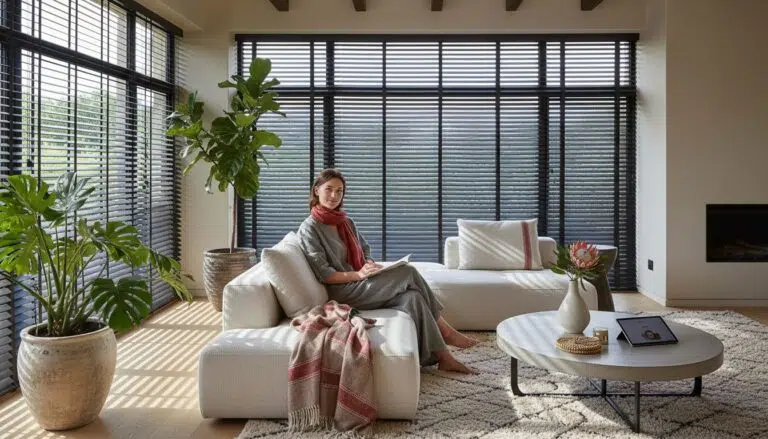
Aluwood is the most versatile venetian option in the Custom Blinds range. It works in every room, every climate, every budget bracket between entry aluminium and premium timber. For bedrooms where you want warmth without worry, or living rooms on the Garden Route coast, aluwood is the recommendation Duncan makes most often.
When should you choose real wood venetian blinds?
Nothing replicates the weight, grain and warmth of genuine timber slats. Real wood venetian blinds sit in the premium tier for a reason. The material is heavier, the finish is richer, and the engineering tolerances are tighter. When they catch the light, you see actual wood grain rather than a printed pattern.
The trade-off is moisture. Timber expands and contracts with humidity. In a bathroom, a kitchen with regular steam, or a coastal room without climate control, real wood slats will eventually bow, crack or delaminate. This is not a defect. It is the nature of the material. Specify real wood for studies, formal lounges, dry bedrooms and interior rooms where humidity stays below 60 percent.
This is where the Blindquip and Hunter Douglas relationship matters most. Premium timber venetians from Hunter Douglas use kiln-dried hardwood, precision-routed slat profiles and multi-coat lacquer finishes that resist UV yellowing. The ladder strings are engineered to distribute weight evenly so wide blinds hang straight over years of use. These are not details you see on a spec sheet from a general online retailer. They are details you notice after five years of daily use, when the blind still operates smoothly and the finish still looks right.
Which venetian blind material suits each room?
Bathroom. Aluminium or Plaswood, full stop. Steam, splashing water and high humidity rule out timber and bamboo. Aluminium 25 mm slats in white or silver suit most bathroom windows. Plaswood offers a thicker, woodgrain look if the bathroom has a more designed finish. Both wipe clean and resist mould.
Kitchen. Aluminium handles cooking steam, grease splatter and the temperature swings near a cooktop. The 50 mm aluminium in a metallic or charcoal finish pairs well with modern kitchen joinery. Aluwood works in kitchens that sit further from the stove. An open-plan dining area with a kitchen behind it, for example.
Bedroom. Aluwood or real wood, depending on climate and budget. The wider 50 mm slat creates a calmer, less busy visual than 25 mm. For full blockout, pair a venetian with a roller blind behind it. The venetian handles daytime light control and privacy, the roller handles sleep.
Home office. Venetians are the natural choice for offices because they redirect glare off screens without darkening the room. Aluminium 25 mm in a neutral finish keeps the look professional. Aluwood adds warmth to a dedicated study. Tilt the slats upward to bounce light onto the ceiling, even illumination with no glare on the monitor.
Your Moat
Which venetian blinds handle South African coastal conditions?
Salt air is the single biggest factor in blind failure on the South African coast. It penetrates joinery, corrodes steel components, accelerates UV damage and creates the kind of persistent humidity that warps timber. If you live within five kilometres of the ocean (George, Knysna, Plettenberg Bay, Mossel Bay, Sedgefield, anywhere on the Garden Route), your venetian blind specification needs to account for this from day one.
The rules are simple. Aluminium slats with powder-coated finish resist salt corrosion. Stainless-steel or polymer headrail brackets will not rust. Synthetic or aluminium-core ladder strings outlast cotton. Avoid painted steel components, untreated timber and any blind sold without a coastal-specific material note.
Custom Blinds specifies coastal-grade materials as standard for every Garden Route installation. This is not an upgrade or an add-on. It is how we build. After 8,000+ installations since 2010, we have seen what fails at the coast and what lasts. That firsthand knowledge goes into every venetian blind we supply, whether you order online for delivery anywhere in South Africa or book a home consultation with Duncan locally.
Every Custom Blinds venetian for the Garden Route uses coastal-grade components as standard: aluminium or Plaswood slats, polymer brackets, UV-stable coatings. No upgrades needed.
“I have pulled out venetians from a Knysna home that were three years old and the headrail brackets had rusted through. Cheap steel in a salt environment. We stopped using those components in 2012 and have not looked back.”Duncan, Custom Blinds. 8,000+ installations since 2010
The Premium Tier
What Hunter Douglas venetian blinds are available through Custom Blinds?
Hunter Douglas is the world’s largest manufacturer of window coverings. Their venetian blinds are engineered to tolerances that mass-market producers do not attempt: precision-profiled slats that close flush without light gaps, spring-return tilt mechanisms that hold position without drift, and lacquer finishes tested to resist UV degradation for a decade of South African sun.
You cannot buy Hunter Douglas direct. Distribution runs through authorised agents, and in South Africa, that means Blindquip. Custom Blinds has been a Blindquip agent since 2010, the longest-standing partnership on the Garden Route. That relationship gives us direct access to the full Hunter Douglas and Luxaflex venetian range, including premium timber blinds, specialist finishes and wide-span engineering that general online retailers simply cannot source.
Does a Hunter Douglas venetian cost more than an entry-level aluminium? Yes. The difference is in the engineering. A standard aluminium venetian works well for five to eight years. A Hunter Douglas timber or aluminium venetian, properly specified and installed, works well for fifteen. The tilt mechanism stays smooth. The finish does not yellow. The slats do not bow. That is what premium means in practice, not a label, but a measurable difference in how long the blind performs before it needs replacing.
If you are furnishing a high-end home, a guesthouse, a boutique lodge or any property where the finish needs to hold up to scrutiny and daily use, the Hunter Douglas range through Blindquip is where you should start. Visit our Blindquip Knysna or Blindquip George pages for local consultation, or browse the Blindquip range online.
How much do venetian blinds cost in South Africa?
Venetian blind prices depend on material, slat width, window size and operating mechanism. The table below gives a general guide based on a standard 1200 mm x 1500 mm window (the most common residential size in South Africa. All Custom Blinds venetians are made to your exact measurements, so your price will be calculated to your specific window when you use the online shop.
| Material | Price Range (standard window) | Best Value For |
|---|---|---|
| Aluminium 25 mm | Entry tier, most affordable venetian option | Bathrooms, kitchens, offices, rentals |
| Aluminium 50 mm | Entry-mid tier | Larger windows, bold modern look |
| Aluwood 25/50 mm | Mid tier | Living rooms, bedrooms, coastal timber look |
| Plaswood 50 mm | Entry-mid tier | Bathrooms, holiday homes, coastal rentals |
| Real wood 50 mm | Premium tier | Formal lounges, studies, high-end finishes |
| Hunter Douglas / Luxaflex | Premium-plus tier | Lodges, boutique properties, long-term investment |
For an exact price on any venetian blind, measure your window following the measuring guide, then enter your dimensions on the relevant shop page. The price calculates instantly. See our venetian blind pricing guide for a full cost breakdown by material. For Garden Route clients, Duncan can measure on site. book a consultation.
Why Custom Blinds
How does Custom Blinds handle venetian blind consultation and installation?
Installations
Since 2010 across the Garden Route and nationally online. Homes, lodges, restaurants and offices.
Years as Blindquip Agent
The longest-standing Hunter Douglas and Luxaflex partnership on the Garden Route. Direct access to premium ranges.
Point of Contact
No subcontractors. No handovers. From first message to final installation. One team. About Custom Blinds.
→
→
→
The privacy question
Which Way Should Venetian Blinds Tilt for Privacy?
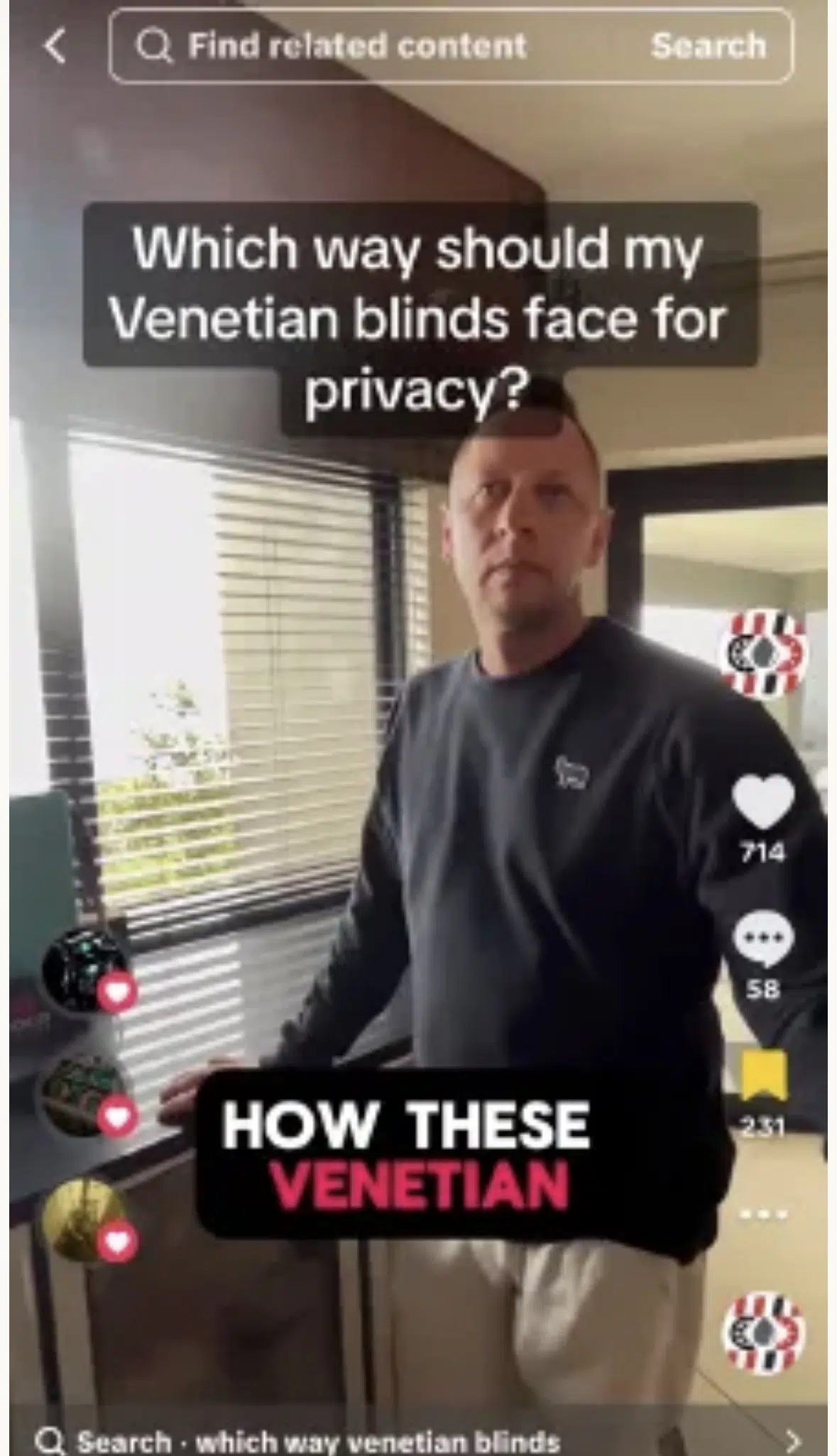
This is the question that went viral. Duncan covered it on TikTok and the response confirmed what we hear from homeowners every week. Most people are tilting their blinds the wrong way.

The rule is straightforward once you understand it.
At night (lights on inside)
Tilt slats upward. The rounded side faces you, the window-facing edge angles down. This blocks the view from street level and from anyone at eye height. If your concern is people looking down into your home from an upper floor, tilt slats down instead.
During the day
Tilt slats downward. This filters natural light gently into the room while deflecting direct sun. You get brightness without glare, and passers-by still cannot see in clearly. As Hunter Douglas recommends, downward tilt during daylight hours also helps regulate room temperature by redirecting heat away from the interior.
For a balance of both
A slight upward tilt (not fully open, not fully closed) creates diffused light while obscuring the view from outside. This works well in living rooms and home offices where you want connection to the outdoors without sacrificing privacy.
Quick rule: tilt up at night, tilt down by day. Adjust the angle to suit how much light you want.
Slat Width: What Size Venetian Blind Slat Works Best?
Slat width is not just aesthetic. It affects privacy, light control and how the blind looks on your window.
| Slat Width | Look | Privacy | Light Control | Best For |
|---|---|---|---|---|
| 16mm | Ultra-modern, tight | Tightest closure | Precise, fine adjustment | Small windows, modern offices (aluminium only) |
| 25mm | Clean, minimal | Excellent, ~42 slats per metre | Very precise | Offices, bedrooms, compact windows |
| 35mm | Balanced | Good | Good all-rounder | Any room, transitional style |
| 50mm | Bold, classic | Good | Best light shaping | Most popular in SA. Living rooms, bedrooms, feature windows |
| 63mm | Statement piece | Moderate | Dramatic shaping | Very large windows (basswood only) |
The 50mm slat is the most popular size across South African installations, and for good reason. It gives the best balance of privacy when closed, light shaping when angled, and a clean stack height when the blind is fully raised.
Why are engineered-curve aluminium slats better than flat slats?
Pick up a cheap aluminium venetian and a Hunter Douglas or Luxaflex slat. You will feel the difference immediately. The premium slat has a deliberate, engineered curve, a concave profile that serves five distinct purposes.
That curve is not cosmetic. It is doing real work.
Light shaping. A flat slat dumps light straight through or bounces it harshly. The curved profile diffuses incoming light, softens glare, and creates an even daylight wash instead of hot spots. This is why quality aluminium venetians feel calmer in a room.
Heat management. Aluminium reflects radiant heat well, but only when angled correctly. The curved profile improves solar deflection when slats are tilted outward, pushing heat back toward the window glass rather than radiating it into the room. Flat slats trap heat inward. Curved slats manage it.
Structural strength. A curved slat is far stiffer than a flat strip of the same thickness. It resists oil-canning, sagging and edge warping. It holds alignment across wider spans and over time. This is why cheap aluminium blinds look wavy after a year and properly engineered ones do not.
Privacy and closure. The curve improves how slats meet when closed. Tighter overlap, fewer light leaks, better sightline blocking. This is especially noticeable on 25mm and 50mm slats where the overlap gap is the difference between privacy and a visible stripe.
Wind and noise. Curved slats rattle less in airflow and settle back into position instead of fluttering. Subtle, but very noticeable in coastal or breezy Garden Route homes where windows stay open.
The bend is doing five jobs at once: light shaping, heat reflection, strength, privacy and stability. This is why we stock manufacturers who engineer the curve, not import flat strip.
Plaswood slats, by contrast, are thicker and flatter by design. Their rigidity comes from the composite material itself rather than the profile shape. Both approaches work. The difference matters when you are comparing aluminium products: a properly curved slat from a quality manufacturer will outperform a flat import on every measure.
Which venetian blinds work best in your area?
South Africa’s climate varies dramatically from coast to highveld. The venetian material that thrives in Sandton may deteriorate in Knysna. Here is what we recommend by region.
| Location | Best Material | Why |
|---|---|---|
| Coastal (Knysna, Plett, Mossel Bay, Camps Bay) | Plaswood or aluminium | Corrosion-resistant, humidity-proof, salt-air tested |
| Bathrooms and kitchens (any region) | Plaswood or aluwood | Non-porous surface handles steam and moisture |
| Inland bedrooms and living rooms | Basswood, aluwood or plaswood | Aesthetic choice, all perform well without coastal exposure |
| North-facing windows | Plaswood | UV 500+ rating prevents fading under direct sun |
| Budget-conscious | Aluminium | Most affordable with excellent durability |
| Eco-conscious | Bamboo or basswood | Natural, sustainable materials |
| Large windows | Aluminium or aluwood | Lighter weight for easier daily operation |
Why Custom Blinds
How are venetian blinds tested in Garden Route conditions?
Installations Since 2010
Every recommendation is backed by what we have seen on actual South African windows, not a spec sheet.
Years on the Garden Route
We know what lasts in Knysna humidity, Plett wind and George heat because we have measured, installed and maintained through all of it.
Company, Full Service
Online ordering, on-site consultation, in-house manufacturing and professional installation. Browse the full indoor range.
→
→
Frequently Asked Questions
What is a venetian blind?
A venetian blind is a window covering made of horizontal slats, typically aluminium, wood, or faux wood, connected by cords or ladders. Tilting the slats controls how much light enters the room and how much privacy you have. Venetian blinds are one of the most popular window treatments in South Africa because they suit almost any room and offer precise, instant control over glare, heat, and visibility.
What is the difference between aluminium and aluwood venetian blinds?
Aluminium venetian blinds are solid aluminium slats with a baked-on colour finish. Aluwood venetians have an aluminium core wrapped in a PVC timber-grain layer. Aluminium is lighter and cheaper. Aluwood looks like wood but handles moisture and humidity the same way aluminium does. Both are available in 25 mm and 50 mm slat widths.
Are venetian blinds suitable for bathrooms in South Africa?
Yes, provided you choose aluminium or Plaswood. Both materials are fully moisture-resistant and will not warp, swell or grow mould in humid bathroom conditions. Avoid real wood and bamboo venetians in any room with regular steam or water exposure.
Which venetian blinds are best for coastal homes on the Garden Route?
Aluminium, aluwood or Plaswood venetian blinds handle salt air and coastal humidity. Custom Blinds specifies coastal-grade components as standard for all Garden Route installations: polymer brackets, stainless-steel headrails and UV-stable coatings. Real wood should only be used at the coast in fully climate-controlled rooms.
Can I buy Hunter Douglas venetian blinds online in South Africa?
Hunter Douglas products are sold through authorised agents, not direct to the public. Custom Blinds is a Blindquip agent with access to the full Hunter Douglas and Luxaflex venetian range. Contact Duncan on 079 523 5407 for pricing on premium venetian options or visit the Blindquip online page.
How do I clean venetian blinds?
For aluminium and aluwood, wipe each slat with a damp microfibre cloth or run a venetian blind duster between them. For real wood, use a dry cloth only. Moisture damages the lacquer. For a full step-by-step guide, read how to clean blinds in South Africa.
What size venetian blind slats should I choose: 25 mm or 50 mm?
The 25 mm slat suits smaller windows, bathrooms and home offices where a streamlined look works best. The 50 mm slat suits larger windows, living rooms and bedrooms where wider slats create a calmer visual. Both sizes provide the same light and privacy control. The choice is aesthetic.
How much do venetian blinds cost in South Africa?
Venetian blind pricing depends on material, size and mechanism. Aluminium is the most affordable, followed by Plaswood and aluwood in the mid range, with real wood and Hunter Douglas products at the premium end. For an exact price, measure your window and enter dimensions on the Custom Blinds online shop. Pricing calculates instantly.
Do venetian blinds provide good privacy?
Venetian blinds offer more privacy control than any other blind type. Tilting slats upward blocks the view from outside while still allowing light and air into the room. For a detailed guide on venetian privacy settings, read our venetian blinds privacy guide.
Can Custom Blinds deliver venetian blinds anywhere in South Africa?
Yes. All venetian blinds from the Custom Blinds online shop are made to your measurements and delivered to Johannesburg, Cape Town, Durban, Pretoria, Port Elizabeth, Bloemfontein and nationwide with tracking. For Garden Route clients in Knysna, George, Plettenberg Bay, Sedgefield and Mossel Bay, Duncan offers on-site measurement and professional installation.
What is Plaswood and is it better than aluminium for venetian blinds?
Plaswood is a synthetic material that mimics the look of painted timber. It handles moisture as well as aluminium and offers a thicker, more substantial slat profile. Plaswood suits bathrooms and coastal homes where you want a wood-like look with complete moisture resistance. Aluminium is lighter and offers a wider colour range. Neither is objectively better. The right choice depends on the look you want and the room conditions.
Aluminium venetians are our most ordered product for Durban and Cape Town coastal apartments where moisture resistance matters. Johannesburg and Pretoria customers favour aluwood for the timber look without the humidity risk.
Ready to find your venetian blind?
Measure your window. Choose your material. Get an instant price online, or call Duncan for expert guidance.
Ready to order?
Product availability and specifications may vary. Pricing is indicative and calculated to your exact window size at checkout. All advice is general and based on typical South African conditions. For site-specific recommendations, contact us directly. Hunter Douglas and Luxaflex products are available through our Blindquip agency partnership.