
PVC vs Aluminium Shutters in South Africa — Which Ones Belong in Your Home?
You want shutters. The louvres, the clean lines, the way light falls in stripes across the floor in the morning. But now comes the question every homeowner on the Garden Route asks: PVC or aluminium? The right answer depends on your windows, your climate and what you need those shutters to do.
What is the difference between PVC and aluminium shutters in South Africa?
- PVC shutters are lighter, more affordable and better suited to indoor use in bedrooms, living areas and bathrooms
- Aluminium security shutters are stronger, impact-resistant and built for exterior mounting or high-security applications
- PVC handles moisture well and will not warp in humid coastal rooms like kitchens and en-suites
- Aluminium withstands hail, high wind and forced entry — tested for the Garden Route coast
- Both materials offer full louvre control for light, privacy and airflow
- Custom Blinds manufactures and installs both types across Knysna, George, Plettenberg Bay and the Garden Route
- PVC is the better choice for interior design; aluminium is the better choice for security and weather protection
Need expert advice? Call Duncan on 079 523 5407
TLDR
PVC shutters work best indoors — bedrooms, bathrooms, living rooms — where you want clean design and moisture resistance at a lower price point. Aluminium security shutters are built for exterior use, storm protection and forced-entry resistance. Most Garden Route homes benefit from both: PVC inside, aluminium where security or weather demands it. Custom Blinds installs both, manufactured in-house.
How It Feels
The morning light angled through half-open louvres. The bedroom cool without the air-conditioner running. The patio door secured without bars spoiling the view. That is what the right shutters give you — control without compromise.
Quiet Mornings. Tilt the louvres to let dawn in gently. No cords, no fuss. Just calm light and a room that feels finished.
Cool Rooms. Closed louvres block direct sun and reduce heat gain. Your rooms stay comfortable without running the air-con all day.
Secure Sleep. Aluminium shutters locked at night. No bars visible from inside. Your family sleeps soundly.
Clean Lines. PVC shutters sit flush in the frame. No curtain rails, no dangling cords. The architecture speaks.
“People ask me PVC or aluminium and I always ask the same thing back — what is the window doing for you? If it is a bedroom window facing the street, you want PVC for the look and the light control. If it is a sliding door onto the garden in an area with break-ins, aluminium every time. Most homes end up with both.”
Duncan, Custom Blinds — 20 years experience across the Garden Route
Why Custom Blinds
Built Here, Fitted Here, Guaranteed Here
We do not import shutters and hope they fit. We measure, manufacture and install ourselves — the only South African company offering online ordering, on-site consultation, in-house manufacturing and professional installation under one roof.
Installations
Blinds, shutters and awnings installed across the Garden Route since 2010
Years
Manufacturing and installing window coverings engineered for coastal conditions
Company
The only SA business with online sales, consultation, manufacturing and installation in-house
PVC vs Aluminium Shutters — Side by Side
This table covers what matters for South African homeowners. Not theory — practical differences you will notice after installation.
| Feature | PVC Shutters | Aluminium Security Shutters |
|---|---|---|
| Best placement | Indoor — bedrooms, living areas, bathrooms, kitchens | Exterior or interior — windows, sliding doors, shopfronts |
| Security rating | Visual deterrent only | ✓ Impact and forced-entry resistant |
| Weather resistance | Handles humidity and moisture well indoors | ✓ Built for hail, gale-force wind, driving rain |
| Moisture suitability | ✓ Ideal for bathrooms, kitchens, en-suites — will not warp | Suitable but primarily an exterior product |
| Weight | ✓ Lightweight — easy on hinges and frames | Heavier — requires solid mounting points |
| Design flexibility | ✓ Multiple panel configurations, bi-fold, sliding, hinged | Fixed or sliding panels, louvred or solid |
| Colour options | White (most popular), custom colours available | White, charcoal, bronze — powder-coated finishes |
| Price point | ✓ More affordable per square metre | Higher — reflects security engineering |
| Maintenance | Wipe with damp cloth | Wipe with damp cloth, occasional hinge lubrication |
| Energy efficiency | ✓ PVC does not conduct heat or cold | Good with louvre control; aluminium conducts more than PVC |
| Lifespan | 15+ years with normal use | 20+ years — powder coating protects against corrosion |
| Child safety | ✓ No cords or chains | ✓ No cords or chains |
When PVC Shutters Are the Right Choice
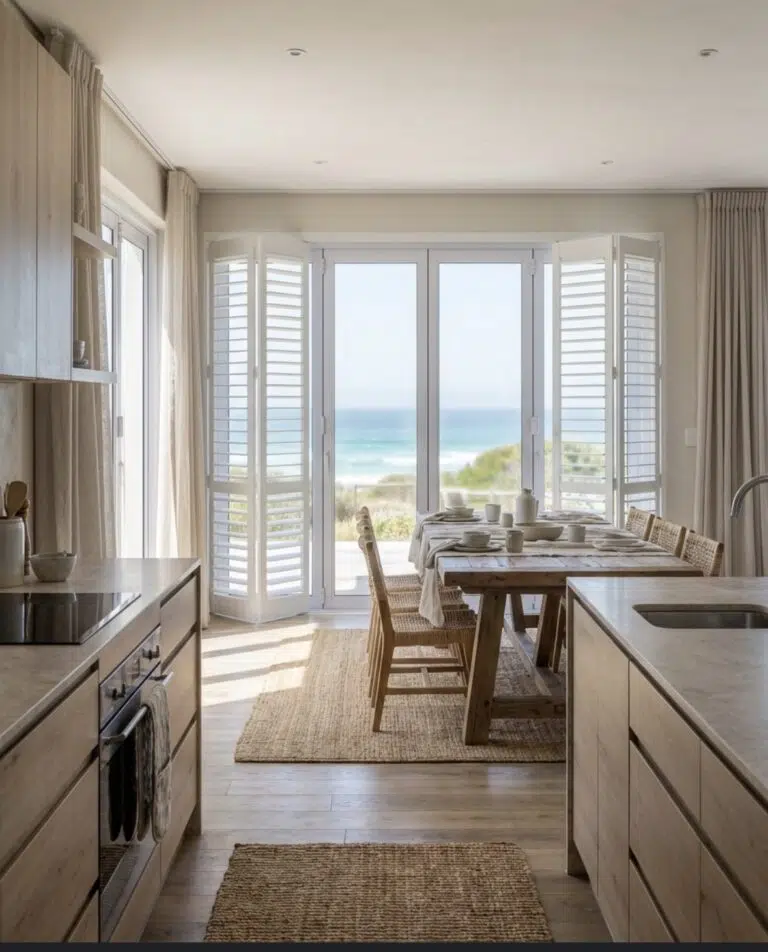
PVC shutters are what most people picture when they think of shutters. Clean white panels with adjustable louvres that tilt open for light or close flat for privacy. They work in almost every indoor room.
Choose PVC when the window is indoors, the room needs light and privacy control, and you want the classic shutter look without the cost of hardwood. PVC is particularly good in wet areas — kitchens where steam rises from the hob, bathrooms with poor ventilation, and coastal bedrooms where humidity creeps through overnight.
Unlike timber, PVC does not absorb moisture. It will not swell, crack or delaminate. Along the Garden Route where salt air and humidity are constant, this matters. We have seen timber shutters installed by other companies warp within three years. PVC installed by Custom Blinds in 2012 still operates perfectly in Knysna homes today.
Best rooms for PVC shutters
Bedrooms (light control and privacy), bathrooms and en-suites (moisture resistant), living rooms (design statement), kitchens (steam and grease wipe clean), home offices (glare control without blocking airflow).
When Aluminium Security Shutters Are the Right Choice
Aluminium shutters serve a different purpose. Yes, they control light and offer privacy. But their primary job is protection — against break-ins, storm damage and extreme weather.
If you live in an area where security matters (and on the Garden Route, that includes most suburbs), aluminium security shutters give you burglar bars without the prison look. They mount on the exterior of the window or door, lock from inside and withstand significant force.
For sliding doors leading onto a garden or patio, aluminium shutters also protect against hail, flying debris in berg winds and driving rain from the south-east. They are the product we recommend for holiday homes in Plettenberg Bay and Sedgefield where properties sit empty for weeks at a time.
Best applications for aluminium shutters
Exterior windows facing streets or public areas, sliding doors onto gardens, shopfront security, holiday homes left unattended, ground-floor bedrooms in high-risk areas, and rooms where the view matters too much for traditional burglar bars.
“I have fitted aluminium shutters on holiday homes in Plett that take a beating every winter — berg wind, hail, the lot. The owners come back in December and the shutters look the same as the day we put them up. That is what powder-coated aluminium does at the coast.”
Duncan, Custom Blinds — 8000+ installations since 2010
Most Garden Route Homes Use Both
This is not an either/or decision for most of our clients. The homes we work with across George, Knysna and Plettenberg Bay typically end up with a combination.
PVC indoor shutters in the bedrooms and living areas — where you want design, light control and that finished architectural look. Aluminium security shutters on the exterior of ground-floor windows and sliding doors — where you need protection without ruining the view.
Because Custom Blinds manufactures and installs both, we can match the louvre sizing, colour tone and panel configuration so the interior and exterior shutters feel like part of the same design. National chains that import one or the other cannot do this.

How Both Perform in South African Coastal Conditions
Salt air penetrates everything on the coast. Humidity swells timber. UV exposure bleaches finishes. If you are choosing shutters for a home anywhere between Mossel Bay and Plettenberg Bay, material performance in these conditions is not optional — it is the whole point.
PVC is inherently resistant to salt, moisture and UV. It does not rust, does not swell and does not need repainting. For indoor use at the coast, it is the most practical shutter material available in South Africa.
Aluminium is naturally corrosion-resistant, and the powder coating we use adds a further barrier against salt spray and UV degradation. For exterior use, aluminium outperforms every other shutter material in coastal durability tests.
Both materials clean easily with a damp cloth and mild detergent. Neither requires sanding, staining or repainting. For a full guide on keeping your shutters in condition, see our cleaning and maintenance guide.
The Value Case
What You Get for What You Pay
Measured and Made to Fit
We measure every window ourselves. Your shutters are manufactured to exact dimensions — no guesswork, no gaps, no returns.
One Company, Start to Finish
No subcontractors. No third-party fitters. Custom Blinds handles consultation, manufacturing and installation ourselves.
Built for the Coast
Every shutter we install is engineered for Garden Route conditions. Salt air, humidity, UV — tested in the environment where your home actually sits.
Frequently Asked Questions
Are PVC shutters waterproof enough for South African coastal bathrooms?
Yes. PVC does not absorb moisture, so it will not warp, swell or delaminate in humid bathrooms. Custom Blinds has PVC shutters installed in Knysna bathrooms in 2012 that still operate perfectly. They are the most practical choice for any wet room at the coast.
Can aluminium security shutters stop a break-in?
Aluminium security shutters are impact and forced-entry resistant. They lock from the inside and are mounted on the exterior, forming a physical barrier that standard burglar bars provide — but without obstructing your view when the louvres are open.
Which shutters are better for a holiday home on the Garden Route?
Most holiday homes benefit from both. PVC indoors for light and privacy control while you are there, and aluminium security shutters on the exterior for protection while the home sits empty between visits. Custom Blinds installs both across Plettenberg Bay, Knysna and George.
Do PVC shutters look cheap compared to real wood?
Modern PVC shutters in a matt white finish are virtually indistinguishable from painted hardwood. They hold their shape better than timber in humid conditions, require no repainting and cost significantly less. Most interior designers on the Garden Route now specify PVC over wood for coastal properties.
How long do aluminium shutters last in salt air conditions?
Powder-coated aluminium shutters last 20 years or more at the coast with minimal maintenance. The powder coating protects against salt corrosion and UV fading. A wipe-down with soapy water two or three times a year keeps them in condition.
Can I mix PVC and aluminium shutters in the same house?
This is exactly what most of our Garden Route clients do. Custom Blinds manufactures both in-house, so we match louvre sizing and colour tone across PVC and aluminium to create a consistent look throughout the property.
What is the price difference between PVC and aluminium shutters in South Africa?
PVC shutters are more affordable per square metre. Aluminium security shutters cost more, reflecting the engineering required for impact resistance and security-grade locking. For an accurate quote based on your window sizes, use our free consultation service or call Duncan directly.
Related Reading
Ready to Choose Your Shutters?
Duncan and the team will help you decide which shutter material works for each window in your home. Free consultation across the Garden Route.
Custom Blinds Shutters & Awnings™ — Garden Route’s leading independent specialist since 2010. All product recommendations based on 15 years of local installation experience. Prices and specifications may vary — contact us for a detailed quote. Custom Blinds® is a registered trademark.