
How to Choose Shutters in South Africa: Material, Type, and What Actually Matters
Shutters are a long-term investment. The material you choose determines whether they handle coastal humidity, resist UV, maintain their finish, and still operate smoothly in ten years. This guide covers the decisions that matter and skips the ones that do not.
How do you choose the right shutters for a South African home?
- PVC shutters are the most practical choice for coastal and humid areas. They resist moisture, do not warp, and require zero repainting.
- Aluminium security shutters combine security, privacy, light control, and insulation in a single product. They replace burglar bars, curtains, and blinds.
- Timber shutters suit inland homes where humidity is low. They offer the warmest aesthetic but require periodic maintenance in any environment.
- For bathrooms, kitchens, and coastal properties, avoid timber. PVC or aluminium handles moisture without degradation.
- Configuration matters as much as material: hinged, bi-fold, and bypass options suit different opening sizes and access requirements.
- Our Custom Lifestyle Shutters range is manufactured in Cape Town and installed across the Garden Route. Every installation starts with a site assessment.
Garden Route: Call Duncan on 079 523 5407 | View shutter range
Shutters do something no blind can: they become part of the architecture. When you close the louvres, the room quietens, the temperature drops, and the light softens to exactly the level you want. When you open them, they disappear into the window frame like they were always there.
What four questions determine your shutter choice?
Most shutter confusion comes from starting with aesthetics before function. The right order is: exposure first, security second, maintenance tolerance third, opening size fourth. Answer those in sequence and the material and configuration choose themselves.
1. What is your property's exposure?
Coastal or high-humidity: PVC or powder-coated aluminium only. Salt air and sustained humidity degrade timber finishes, cause swelling, and make louvres stiff within a few seasons. This rules out timber for coastal properties and for all bathrooms and kitchens regardless of location.
Inland, low-humidity: any material is viable. Timber is now on the table alongside PVC and aluminium.
2. Is security a primary requirement?
If yes: aluminium security shutters. The 3-pin locking mechanism, reinforced louvre attachments, and forced-entry-rated framing cannot be replicated in PVC or timber. Aluminium security shutters also replace curtains and burglar bars in a single installation — they provide security, privacy, light control, and insulation simultaneously. On ground-floor bedrooms, stacking doors, and any opening accessible from outside, this is the specification to consider.
If security is not the primary driver: move to question 3.
3. What is your maintenance tolerance?
Zero maintenance: PVC. Wipe-clean surface, no repainting, no sanding, no refinishing. The correct choice for holiday homes, rental properties, and any owner who wants a set-and-forget window treatment.
Willing to maintain: timber becomes viable. Periodic refinishing every few years keeps timber looking its best. If you are inland and appreciate the warmth of real wood grain, the maintenance is manageable.
4. What is your opening size and configuration?
Standard single or double window: hinged panels work well. Opening wider than 1.8m: bi-fold or bypass. Full-height stacking door: bi-fold security shutters or bypass. The configuration is driven by opening width and what furniture sits alongside the window. The material can go either way; the configuration usually cannot.
Why are PVC shutters the practical choice for South African conditions?
PVC (polyvinyl chloride) shutters are the most forgiving material for South African homes. They resist moisture, humidity, and UV without warping, cracking, or requiring repainting. For bathrooms, kitchens, laundry rooms, and any property within the coastal salt spray zone, PVC is the default recommendation.
Modern PVC shutters are visually almost indistinguishable from timber. The manufacturing process creates a smooth, consistent finish that can be produced in white, off-white, and light grey tones. They do not yellow in sun the way older PVC products did.
The practical advantage: PVC shutters are wipe-clean. A damp cloth removes dust and marks. There is no repainting, no sanding, no refinishing. For holiday homes on the Garden Route that sit closed for weeks between visits, PVC shutters resist the mould growth that can develop on timber in sealed, humid rooms. For a detailed material comparison, see our guide to PVC vs aluminium shutters.
What do aluminium security shutters offer in terms of security and light control?
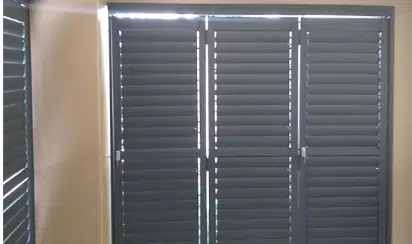
Aluminium security shutters are engineered specifically for forced entry resistance. The 3-pin locking mechanism secures top and bottom simultaneously, with pins protruding 45mm into the wall and floor. Reinforced louvre attachments grip tighter under force.
But security is only part of what they do. When the louvres are tilted, security shutters provide adjustable light control, airflow, and privacy while remaining locked. Many Garden Route homeowners remove curtains entirely after fitting security shutters because the shutter handles all four functions: security, privacy, light, and insulation.
Aluminium does not rust. Powder-coated finishes resist salt air and UV without maintenance. Custom Blinds has installed over 2,000 security shutters across the Garden Route since 2010 with zero corrosion-related warranty claims.
Where do timber shutters work best in South African homes?
Timber shutters offer a warmth and character that no synthetic material fully replicates. Real wood grain, natural colour variation, and the tactile quality of solid timber make them the premium choice for living rooms, bedrooms, and feature windows in inland homes.
The conditions: timber requires maintenance. It needs periodic repainting or refinishing to maintain its appearance and protect against UV degradation. In humid environments, timber can swell, which affects how smoothly the louvres operate and how neatly the panels close. In sustained humidity (coastal Knysna, Wilderness, parts of Sedgefield), timber shutters are not recommended unless the homeowner is prepared for ongoing maintenance.
For the timber look without the timber limitations, Plaswood (a composite material) offers a middle ground. It has a wood-like appearance and weight but handles moisture better than natural timber.
Hinged, bi-fold or bypass: which shutter configuration suits your space?
The shutter configuration determines how the panels open, how much of the window they clear, and how they look when open.
Hinged: Panels swing open on side hinges, like a door. Clean and simple. Best for standard width windows where you want full access when open. Each panel needs clearance to swing, so furniture placement near the window matters.
Bi-fold: Panels fold against each other in pairs, stacking to one or both sides. Ideal for wider openings where hinged panels would protrude too far into the room. Common on stacking doors and large feature windows.
Bypass (sliding): Panels slide on a track, overlapping when open. Suits very wide openings where folding panels would be unwieldy. The trade-off: you can never fully clear the entire opening because panels always overlap.
Why does Custom Blinds specify 89mm louvres for shutters?
Custom Blinds specifies 89mm louvres across all shutter installations. It is not a supplier constraint or a product range decision — it is an aesthetic preference that Duncan has held consistently across more than 20 years of shutter installations on the Garden Route.
The 89mm blade is the widest standard plantation louvre width. After fitting shutters across thousands of openings — bathrooms, bedrooms, feature windows, stacking doors, holiday homes, and permanent residences — Duncan's experience is that 89mm consistently produces the best-looking result. Fewer, wider blades sit more comfortably in a window frame, create a cleaner appearance when closed, and open to a less obstructed position than narrower louvre widths.
Narrower louvres are not wrong — they are a different aesthetic, and some homeowners prefer them. Custom Blinds does not offer them because Duncan does not believe they produce a better outcome, and after this many installations, that judgement is grounded in something more reliable than a product catalogue.
What should you consider room by room?
Bathrooms: PVC shutters only. Humidity and steam will eventually warp timber regardless of finish quality. PVC resists moisture completely.
Bedrooms: PVC or security shutters. Closed louvres provide excellent blockout and insulation. Security shutters add the forced entry deterrent that matters for ground floor bedrooms.
Living rooms: Any material suits living rooms depending on aesthetic preference. Timber for warmth, PVC for practicality, security aluminium for combined security and light control.
Feature windows: Shutters make the biggest visual impact on feature windows. The architectural, permanent look elevates the room in a way no blind can match. Bi-fold configurations on wide openings create a dramatic effect when fully opened.
Stacking doors: Bi-fold or bypass shutters handle the wide spans of stacking door openings. Security shutters in bi-fold configuration are increasingly popular for ground floor stacking doors where security and indoor/outdoor flow both matter.
Duncan KaneFounder, Custom Blinds. 20 years experience across the Garden Route"I always ask: what do you want the shutter to do? If it is just light and privacy, PVC is perfect. If security matters, aluminium. If you want the warmth of real wood and you are inland, timber. The material follows the function."
Choosing shutters questions
Are PVC shutters as good as timber?
For durability and maintenance, PVC is superior. It resists moisture, UV, and humidity without warping or repainting. Timber offers a warmer natural aesthetic but requires ongoing maintenance, especially in coastal or humid environments.
How much do shutters cost in South Africa?
Shutter pricing depends on material, opening size, configuration, and colour. Every shutter is custom manufactured. Custom Blinds provides itemised quotes after a free site assessment. No deposits required.
Can shutters replace curtains and blinds?
Yes. Many homeowners remove curtains entirely after fitting shutters. The louvres provide adjustable light control, complete privacy when closed, and insulation against heat and cold. One product replaces three.
Do shutters add value to a property?
Yes. Estate agents consistently list shutters as a premium feature in property descriptions. They are treated as a permanent architectural improvement rather than a removable window covering.
Which shutters are best for coastal homes?
PVC for indoor applications and aluminium for security shutters. Both resist salt air and humidity without degradation. Avoid timber in direct coastal exposure unless you are prepared for regular maintenance.
Why do Custom Blinds shutters use 89mm louvres?
It is Duncan's aesthetic preference, developed over more than 20 years of shutter installations across the Garden Route. After fitting shutters across thousands of openings, his consistent experience is that 89mm produces the best-looking result — fewer, wider blades, a cleaner appearance when closed, and a less obstructed opening when the louvres are tilted fully open. Narrower louvre widths are available from other suppliers; Custom Blinds does not offer them because Duncan does not believe they produce a better outcome.
Ready to choose shutters for your home?
Free site assessment across the Garden Route. Custom manufactured in Knysna. 7-year warranty.
Our Custom Lifestyle Shutters™ range is manufactured in Cape Town. PVC shutters, aluminium security shutters, and timber shutters available. 7-year warranty on all components. Garden Route installation across Knysna, George, Plettenberg Bay, Sedgefield, and Mossel Bay.