
Outdoor Blinds For Braai Areas | Custom Blinds® SA
@import url(‘https://fonts.googleapis.com/css2?family=Cormorant+Garamond:ital,wght@0,300;0,400;0,500;0,600;1,300;1,400;1,500&family=DM+Sans:ital,opsz,wght@0,9..40,300;0,9..40,400;0,9..40,500;1,9..40,300;1,9..40,400&display=swap’);#cb-scope { max-width:100%; overflow-x:hidden; font-family:’DM Sans’,-apple-system,sans-serif; font-size:17px; line-height:1.7; color:#3d3a35; -webkit-font-smoothing:antialiased; }#cb-scope * { margin:0; padding:0; box-sizing:border-box; }.accent-line { height:2px; background:linear-gradient(90deg,#1a1917 0%,#1a1917 40%,#bc251a 40%,#bc251a 60%,#7a7568 60%,#7a7568 100%); }#cb-scope h1 { font-family:’Cormorant Garamond’,Georgia,serif; font-size:clamp(2.2rem,5vw,3.2rem); font-weight:300; line-height:1.08; color:#1a1917; letter-spacing:-0.02em; }#cb-scope h1 em { font-style:italic; font-weight:400; color:#6b7c5e; }#cb-scope h2 { font-family:’Cormorant Garamond’,Georgia,serif; font-size:clamp(1.6rem,3vw,2.2rem); font-weight:400; color:#1a1917; margin-bottom:16px; line-height:1.2; }#cb-scope h3 { font-family:’Cormorant Garamond’,Georgia,serif; font-size:1.25rem; font-weight:500; color:#1a1917; margin-bottom:12px; }#cb-scope h4 { font-family:’DM Sans’,sans-serif; font-size:1rem; font-weight:500; color:#1a1917; margin-bottom:8px; }#cb-scope p { margin-bottom:1.4em; color:#3d3a35; font-weight:300; line-height:1.85; }#cb-scope a { color:#6b7c5e; text-decoration:none; border-bottom:1px solid #8a9c7a; transition:all 0.3s; }#cb-scope a:hover { color:#1a1917; border-color:#1a1917; }.container { max-width:1080px; margin:0 auto; padding:0 48px; }.container-narrow { max-width:780px; margin:0 auto; padding:0 48px; }.hero { padding:100px 0 120px; position:relative; }.hero-label { font-size:0.65rem; letter-spacing:0.25em; text-transform:uppercase; color:#bc251a; margin-bottom:32px; display:flex; align-items:center; gap:16px; }.hero-label::before { content:”; width:40px; height:1px; background:#bc251a; }.hero h1 { margin-bottom:32px; max-width:720px; }.hero-intro { font-size:1.05rem; font-weight:300; line-height:1.8; color:#6b6860; max-width:560px; margin-bottom:48px; }.aeo-card { background:white; padding:72px 56px 72px; box-shadow:0 20px 60px rgba(0,0,0,0.06),0 1px 3px rgba(0,0,0,0.04); border-top:2px solid #bc251a; position:relative; max-width:900px; margin-top:16px; }.aeo-card::before { content:’Quick Answer’; position:absolute; top:-13px; left:56px; font-size:0.65rem; letter-spacing:0.2em; text-transform:uppercase; color:white; background:#bc251a; padding:6px 18px; }.aeo-question { font-family:’Cormorant Garamond’,Georgia,serif; font-size:1.3rem; font-weight:400; color:#1a1917; margin-top:16px; margin-bottom:24px; padding-bottom:20px; border-bottom:1px solid #edeae5; line-height:1.4; }.aeo-points { list-style:none; display:grid; gap:14px; }.aeo-points li { display:flex; align-items:baseline; gap:14px; font-size:0.88rem; line-height:1.65; color:#3d3a35; }.aeo-points li::before { content:”; flex-shrink:0; width:6px; height:6px; margin-top:8px; background:#6b7c5e; border-radius:50%; }.emotion-section { padding:140px 48px; text-align:center; position:relative; }.emotion-section::before { content:”; position:absolute; top:0; left:50%; transform:translateX(-50%); width:1px; height:80px; background:linear-gradient(to bottom,transparent,#bc251a); }.emotion-lead { font-family:’Cormorant Garamond’,Georgia,serif; font-size:clamp(1.5rem,3vw,2.2rem); font-weight:300; line-height:1.7; color:#1a1917; max-width:720px; margin:0 auto; }.emotion-lead em { font-style:italic; color:#6b7c5e; }.quote-section { background:#1a1917; padding:120px 48px; position:relative; overflow:hidden; }.quote-section::before { content:’C’; position:absolute; top:-40px; left:10%; font-family:’Cormorant Garamond’,Georgia,serif; font-size:20rem; color:rgba(255,255,255,0.03); line-height:1; pointer-events:none; }.quote-inner { max-width:800px; margin:0 auto; text-align:center; position:relative; z-index:1; }#cb-scope .quote-section .quote-inner blockquote { font-family:’Cormorant Garamond’,Georgia,serif !important;font-size:clamp(1.4rem,3vw,2rem) !important;font-weight:300 !important;font-style:italic !important;color:#fff !important;line-height:1.6 !important;margin:0 0 32px 0 !important;border:none !important;border-left:none !important;padding:0 !important;background:transparent !important; }#cb-scope .quote-section .quote-inner cite { font-style:normal !important;font-family:’DM Sans’,sans-serif !important;font-size:0.72rem !important;letter-spacing:0.15em;text-transform:uppercase;color:#bc251a !important; }#cb-scope .quote-section .quote-inner cite span { display:block;margin-top:6px;color:rgba(255,255,255,0.4) !important;letter-spacing:0.1em;font-size:0.65rem; }#cb-scope .cta-section h2 { color:#fff !important; }#cb-scope .cta-section .cta-sub { color:rgba(255,255,255,0.5) !important; }.et-l–post .et_pb_post_content #cb-scope .quote-section,.et-l–post .et_pb_post_content #cb-scope .quote-section p,.et-l–post .et_pb_post_content #cb-scope .quote-section blockquote,.et-l–post .et_pb_post_content #cb-scope .quote-section cite,.et-l–post .et_pb_post_content #cb-scope .quote-section cite span,.et-l–post .et_pb_post_content #cb-scope .cta-section,.et-l–post .et_pb_post_content #cb-scope .cta-section h2,.et-l–post .et_pb_post_content #cb-scope .cta-section p,.et-l–post .et_pb_post_content #cb-scope .cta-section .cta-sub,.et-l–post .et_pb_post_content #cb-scope .tldr-box,.et-l–post .et_pb_post_content #cb-scope .tldr-box h4,.et-l–post .et_pb_post_content #cb-scope .tldr-box p,.et-l–post .et_pb_post_content #cb-scope .btn-primary-ed,.et-l–post .et_pb_post_content #cb-scope .btn-outline-ed { color: #ffffff !important;}.et-l–post .et_pb_post_content #cb-scope .quote-section cite { color: #bc251a !important;}.et-l–post .et_pb_post_content #cb-scope .quote-section cite span { color: rgba(255,255,255,0.4) !important;}.et-l–post .et_pb_post_content #cb-scope .cta-section .cta-sub { color: rgba(255,255,255,0.5) !important;}.et-l–post .et_pb_post_content #cb-scope .aeo-card::before { padding: 6px 18px; font-size: 0.65rem;}.et-l–post .et_pb_post_content #cb-scope .aeo-card { padding: 72px 56px 72px;}.et-l–post .et_pb_post_content #cb-scope .aeo-question { margin-top: 12px;}.content-section { max-width:780px; margin:0 auto; padding:100px 48px; }.section-rule { width:48px; height:1px; background:#bc251a; margin-bottom:36px; }.content-section > p:first-of-type::first-letter { font-family:’Cormorant Garamond’,Georgia,serif; font-size:3.2rem; float:left; line-height:0.85; padding-right:12px; padding-top:6px; color:#1a1917; font-weight:500; }.callout { margin:48px 0; padding:36px 40px; background:#f4f6f1; border-left:2px solid #bc251a; font-size:0.92rem; line-height:1.75; color:#4a473f; }.callout strong { color:#1a1917; }.table-section { max-width:960px; margin:0 auto; padding:0 48px 100px; }.table-label { font-size:0.65rem; letter-spacing:0.2em; text-transform:uppercase; color:#bc251a; margin-bottom:16px; display:flex; align-items:center; gap:16px; }.table-label::after { content:”; flex:1; height:1px; background:#edeae5; }.table-title { font-family:’Cormorant Garamond’,Georgia,serif; font-size:1.5rem; font-weight:400; color:#1a1917; margin-bottom:40px; }.editorial-table { width:100%; border-collapse:collapse; }.editorial-table thead th { font-size:0.68rem; letter-spacing:0.12em; text-transform:uppercase; color:#7a7568; font-weight:500; text-align:left; padding:0 24px 16px 0; border-bottom:2px solid #1a1917; }.editorial-table tbody td { padding:20px 24px 20px 0; font-size:0.88rem; color:#3d3a35; border-bottom:1px solid #edeae5; vertical-align:top; font-weight:300; }.editorial-table tbody td:first-child { font-weight:500; color:#1a1917; width:22%; }.editorial-table tbody tr:hover td { background:#f4f6f1; }.table-check { color:#6b7c5e; font-weight:600; }.table-cross { color:#7a7568; opacity:0.4; }.table-wrap { overflow-x:auto; -webkit-overflow-scrolling:touch; }.trust-strip { background:#f5f2ed; padding:80px 48px; border-top:1px solid #edeae5; border-bottom:1px solid #edeae5; }.trust-grid { max-width:1000px; margin:0 auto; display:grid; grid-template-columns:repeat(4,1fr); gap:48px; text-align:center; }.trust-item .trust-num { font-family:’Cormorant Garamond’,Georgia,serif; font-size:2.6rem; font-weight:300; color:#1a1917; line-height:1; margin-bottom:8px; }.trust-item .trust-unit { font-size:0.65rem; letter-spacing:0.15em; text-transform:uppercase; color:#7a7568; }.faq-section { max-width:780px; margin:0 auto; padding:100px 48px; }.faq-header { margin-bottom:48px; }.faq-header h2 { font-family:’Cormorant Garamond’,Georgia,serif; font-size:1.6rem; font-weight:400; color:#1a1917; }.faq-item { border-top:1px solid #e4e0da; padding:24px 0; }.faq-item:last-child { border-bottom:1px solid #e4e0da; }.faq-item h3 { font-family:’Cormorant Garamond’,Georgia,serif; font-size:1.1rem; font-weight:500; color:#1a1917; margin-bottom:10px; }.faq-item p { font-size:0.88rem; line-height:1.75; color:#6b6860; font-weight:300; max-width:640px; margin-bottom:0; }.cta-section { padding:120px 48px; text-align:center; background:#1a1917; position:relative; }.cta-section::before { content:”; position:absolute; top:0; left:50%; transform:translateX(-50%); width:1px; height:60px; background:#bc251a; }.cta-section h2 { font-family:’Cormorant Garamond’,Georgia,serif; font-size:clamp(1.6rem,3.5vw,2.4rem); font-weight:300; color:rgba(255,255,255,0.92); margin-bottom:16px; line-height:1.2; }.cta-sub { font-size:0.92rem; color:rgba(255,255,255,0.5); margin-bottom:48px; font-weight:300; }.cta-buttons { display:flex; gap:20px; justify-content:center; flex-wrap:wrap; }.btn-editorial { display:inline-flex; align-items:center; gap:10px; padding:16px 36px; font-family:’DM Sans’,sans-serif; font-size:0.78rem; letter-spacing:0.1em; text-transform:uppercase; text-decoration:none; border:none; border-bottom:none; transition:all 0.4s cubic-bezier(0.16,1,0.3,1); cursor:pointer; }.btn-primary-ed { background:#bc251a; color:white; }.btn-primary-ed:hover { background:#9a1f15; transform:translateY(-2px); box-shadow:0 12px 32px rgba(188,37,26,0.3); color:white; border-bottom:none; }.btn-outline-ed { background:transparent; color:rgba(255,255,255,0.7); border:1px solid rgba(255,255,255,0.2); }.btn-outline-ed:hover { color:white; border-color:rgba(255,255,255,0.5); border-bottom-color:rgba(255,255,255,0.5); }.related-section { padding:80px 48px; max-width:1200px; margin:0 auto; }.related-label { font-size:0.65rem; letter-spacing:0.2em; text-transform:uppercase; color:#bc251a; margin-bottom:40px; display:flex; align-items:center; gap:16px; }.related-label::after { content:”; flex:1; height:1px; background:#edeae5; }.related-grid { display:grid; grid-template-columns:repeat(3,1fr); gap:32px; }.related-card { text-decoration:none; color:inherit; display:block; transition:transform 0.4s cubic-bezier(0.16,1,0.3,1); border-bottom:none; }.related-card:hover { transform:translateY(-6px); }.related-card h4 { font-family:’Cormorant Garamond’,Georgia,serif; font-size:1.1rem; font-weight:500; color:#1a1917; margin-bottom:8px; line-height:1.3; }.related-card p { font-size:0.78rem; color:#6b6860; font-weight:300; margin-bottom:0; }.review-date { font-size:0.72rem; color:#7a7568; letter-spacing:0.1em; text-transform:uppercase; text-align:center; padding:24px 0; opacity:0.6; }.disclaimer { padding:32px 0; border-top:1px solid #e4e0da; font-size:0.72rem; color:#6b6860; text-align:center; opacity:0.5; }.tldr-box { background:#145c45; padding:32px 40px; margin:48px 0; }#cb-scope .tldr-box h4, #cb-scope .tldr-box p { color:#fff !important; }.tldr-box h4 { font-family:’DM Sans’,sans-serif; font-size:0.7rem; letter-spacing:0.2em; text-transform:uppercase; margin-bottom:12px; }@media (max-width:768px) { #cb-scope { padding:0 20px !important; } .container,.container-narrow { padding:0 !important; } .hero { padding:60px 0 48px !important; } .hero h1 { font-size:1.8rem; } .hero-intro { font-size:0.95rem; } .aeo-card { padding:48px 22px; margin-left:-2px; margin-right:-2px; } .aeo-card::before { left:22px; } .aeo-points li { font-size:0.85rem; line-height:1.7; } .emotion-section { padding:64px 0 !important; } .emotion-lead { font-size:1.3rem; padding:0; } .quote-section { padding:56px 0 !important; margin-left:-20px !important; margin-right:-20px !important; width:calc(100% + 40px) !important; } .quote-inner { padding:0 24px; } .quote-inner blockquote { font-size:1.1rem; line-height:1.5; color:rgba(255,255,255,0.95) !important; } .content-section { padding:48px 0 !important; } .content-section > p:first-of-type::first-letter { font-size:2.6rem; } #cb-scope h2 { font-size:1.4rem; } .content-section p { font-size:0.92rem; margin-bottom:1.2em; } .callout { padding:24px 20px; margin:32px 0; font-size:0.88rem; } .table-section { padding:0 0 48px !important; } .table-wrap { margin:0 -20px; padding:0 20px; } .trust-strip { padding:48px 0 !important; margin-left:-20px !important; margin-right:-20px !important; width:calc(100% + 40px) !important; } .trust-grid { gap:24px; padding:0 20px; grid-template-columns:repeat(2,1fr); } .faq-section { padding:48px 0 !important; } .faq-item h3 { font-size:1rem; } .faq-item p { font-size:0.85rem; } .cta-section { padding:56px 0 !important; margin-left:-20px !important; margin-right:-20px !important; width:calc(100% + 40px) !important; } .cta-section h2 { font-size:1.5rem; padding:0 20px; } .cta-sub { padding:0 20px; } .cta-buttons { flex-direction:column; align-items:center; gap:12px; padding:0 20px; } .btn-editorial { width:100%; max-width:320px; justify-content:center; padding:14px 28px; } .related-section { padding:48px 0 !important; } .related-grid { grid-template-columns:1fr; gap:24px; } .section-rule { margin-bottom:24px; } .tldr-box { padding:24px 20px; } }@media (max-width:480px) { #cb-scope { padding:0 16px !important; } .hero { padding:48px 0 36px !important; } .hero h1 { font-size:1.5rem; } .aeo-card { padding:40px 18px; } .aeo-card::before { left:18px; font-size:0.55rem; } .aeo-question { font-size:1.1rem; } .content-section { padding:40px 0 !important; } #cb-scope h2 { font-size:1.25rem; } .editorial-table { font-size:0.8rem; } .editorial-table thead th { padding:0 10px 10px 0; font-size:0.62rem; } .editorial-table tbody td { padding:12px 10px 12px 0; font-size:0.82rem; } .trust-grid { grid-template-columns:1fr 1fr; gap:20px; } .quote-section,.trust-strip,.cta-section { margin-left:-16px !important; margin-right:-16px !important; width:calc(100% + 32px) !important; } .faq-section { padding:40px 0 !important; } .table-section { padding:0 0 40px !important; } }

Outdoor Living Guide

Outdoor Blinds for Braai Areas: Use Your Patio All Year

The braai is ready. The coals are perfect. Then the wind picks up, the rain sweeps in, and everyone moves inside. Outdoor blinds solve that problem for good.

Quick Answer

What are the best outdoor blinds for a braai area in South Africa?

  • Screen mesh blinds are the most popular choice for braai areas — they reduce wind and UV while keeping airflow and views intact
  • Clear PVC blinds suit restaurants, game lodges, and entertainment areas where maximum visibility and full weather sealing are priorities
  • Canvas blinds provide privacy and total shade but block the view entirely — best for utility areas rather than entertainment spaces
  • For complete protection, combine an overhead louvre awning with drop-down side blinds — the result is an outdoor room that works in any weather
  • Custom Blinds supplies outdoor blinds nationally and installs across the Garden Route — Duncan offers free site assessments in Knysna, Plett, George, and surrounds

Garden Route install: call 079 523 5407 or request a free quote. National orders: shop online.

TLDR

Screen mesh outdoor blinds turn an exposed braai area into a year-round outdoor room. They cut wind and UV without blocking views or airflow. For most South African homes, Sheerweave is the right fabric. PVC is for restaurants and lodges that need full enclosure and maximum views. Custom Blinds delivers free nationwide or installs across the Garden Route.

Saturday afternoon on the lagoon. Coals glowing. The Outeniquas going pink behind George. Friends pulling up chairs. Then the south-easter picks up, napkins scatter across the stoep, and someone suggests moving inside. The right outdoor blinds mean you never have that conversation again.

“Most of our Garden Route braai area jobs combine a louvre awning overhead with mesh blinds on two or three sides. The louvre handles rain, the blinds handle wind. You get a room that feels open but works in any weather.”

Duncan KaneFounder, Custom Blinds. 15 years, 8,000+ installations across the Garden Route

Why do braai areas need outdoor blinds?

Wind, rain, and harsh afternoon sun are the three forces that push South African entertaining indoors. Outdoor blinds counter all three. Screen mesh fabrics block 80 to 97 per cent of UV radiation and reduce wind speed by up to 95 per cent, turning an exposed braai area into a usable outdoor room through every season.

That combination is what matters. You keep furniture dry, stop ash scattering across the table, and reduce heat buildup under corrugated roofing. And you do it without enclosing the space so completely that it stops feeling like outdoors. That balance between protection and openness is what makes outdoor blinds the most popular upgrade for South African entertainment areas.

Which outdoor blind fabric works best for a braai area?

Screen mesh is the default choice for residential braai areas in South Africa. Custom Blinds recommends and supplies Sheerweave at 5 per cent openness as the standard. At this openness, you get strong wind and UV reduction while preserving a clear view of the garden. Over 60 per cent of braai area installations by Custom Blinds use Sheerweave at this setting.

Sheerweave and Sunworker are manufactured from Dickson and Tempotest woven polyester engineered for UV stability, wind resistance, and long life in full sun. These fabrics form part of the Custom Lifestyle Outdoor Blinds™ range. Sheerweave is available in openness factors from 1 per cent (near total shade) to 10 per cent (filtered light with good airflow), but 5 per cent is the sweet spot for most braai areas.

Clear PVC is the second option. It creates a transparent, fully sealed enclosure. You see everything. Rain stays out completely. This makes PVC ideal for restaurants and hospitality venues where guests expect weather protection without losing the view, and for game farm lodges where the landscape is the experience. PVC also suits entertainment rooms where you want to close off a space entirely in winter and open it up in summer.

Canvas and acrylic fabric blinds are the third option. These provide total shade and privacy but block the view when lowered. They work well for braai areas that face a neighbouring property or a busy road where screening is more important than scenery.
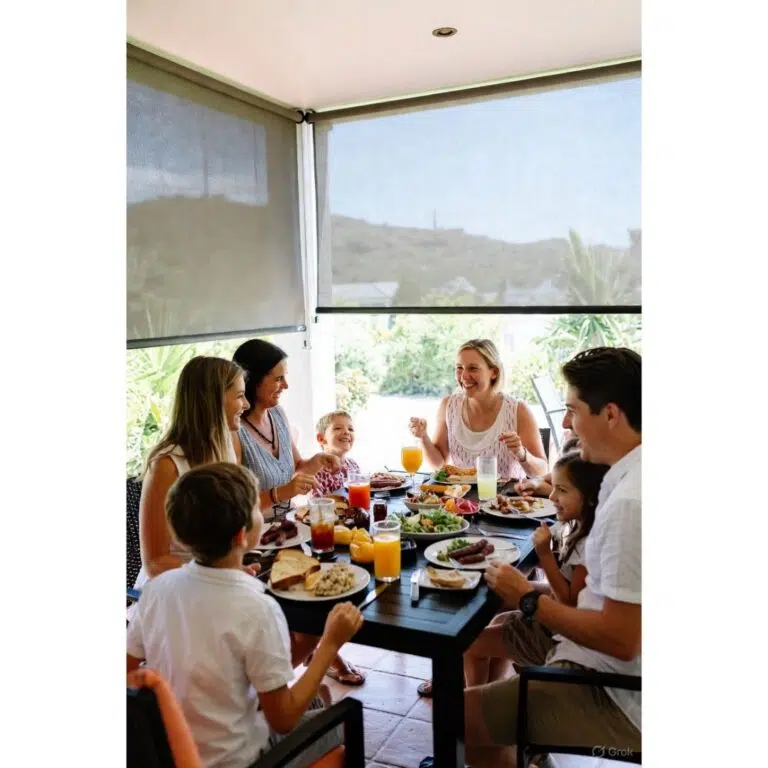
Family enjoying outdoor dining behind mesh outdoor blinds on a South African patio
Screen mesh outdoor blinds enclosing a South African braai and dining area. Wind and UV filtered, views and airflow preserved.
At a Glance

Outdoor blind fabrics compared for braai areas

Feature Screen Mesh (Sheerweave / Sunworker) Clear PVC Canvas / Acrylic
View through Filtered, maintains garden views Full transparency Blocked when lowered
Airflow Proportional to openness factor Sealed Minimal
Rain protection Partial (reduces wind-driven rain) Full waterproof seal Waterproof (coated)
UV block 80 to 97% depending on openness Minimal (clear material) 95%+ (opaque)
Wind reduction Up to 95% 100% (sealed) 100% (opaque)
Best for Homes, patios, stoeps Restaurants, lodges, game farms Privacy screens, boundary facing
Nationwide delivery Shop online Garden Route install only Garden Route install only

What openness factor should you choose for a braai area blind?

Custom Blinds recommends 5 per cent openness Sheerweave as the standard for braai areas across South Africa. At 5 per cent, the fabric blocks approximately 95 per cent of UV radiation and reduces wind substantially, while still allowing you to see the garden, the pool, and whoever is walking up the driveway.

Openness factor describes the percentage of the fabric surface that is open weave rather than solid thread. A 1 per cent blind is nearly opaque. A 10 per cent blind is more transparent, with better outward visibility but less weather protection. Five per cent sits in the middle and handles most braai area conditions well.

In practice, the choice depends on what your braai area faces. If the main opening looks onto a garden or mountain view, 5 per cent preserves that view while handling weather. If the opening faces a busy road, a neighbouring property, or direct afternoon sun, a tighter 3 per cent or even 1 per cent openness provides more screening and shade. Coastal properties exposed to sustained prevailing wind benefit from the lower openness, while sheltered inland patios can go higher if airflow and light are priorities.

The colour of the mesh also affects how the blind feels from inside. Darker fabrics (charcoal, bronze) reduce glare and improve outward visibility because the mesh sits like sunglasses across the opening. Lighter fabrics (stone, sand) reflect more heat but are slightly more visible from inside. Most Custom Blinds customers choose charcoal Sheerweave at 5 per cent openness for braai areas. It disappears visually when you look through it, and it handles the South African sun without fading.

How do outdoor blinds work with an existing braai area layout?

The blinds drop vertically from the front edge of your existing roof or pergola to enclose the open sides. A typical residential braai area needs two to three blinds: one across the main weather-facing side, one or two on the flanks. The house wall closes the fourth side naturally. Doorways and open archways provide ventilation.

In a survey of 120 Custom Blinds braai installations between 2022 and 2025, the average project involved 2.4 blinds covering a combined 14 square metres of opening. Most areas already have enough overhead structure to mount directly.

For areas without overhead cover, the first step is usually a louvre awning or patio shade awning to handle rain and direct sun from above, followed by blinds on the sides for wind. Louvre awnings with adjustable aluminium blades handle the worst of the rain and let you control shade angle throughout the day. This combination creates what Duncan calls a “three-season room” because it extends usable outdoor time from roughly six months of the year to ten or eleven.

In Johannesburg and Pretoria, summer thunderstorms are the main threat. They arrive fast, dump hard, and pass within an hour. A louvre awning overhead combined with screen mesh on the windward side keeps the braai going through all but the most severe downpours. On the Garden Route, the challenge is sustained wind and horizontal rain, which is where side-channel systems and denser mesh fabrics earn their place.

Planning tip: Measure the openings you want to cover before contacting us. Width and drop in centimetres is all we need for an initial quote. For Garden Route properties, Duncan visits every site to assess wind exposure, sun direction, and the best mounting positions.

Can outdoor blinds handle coastal weather and strong wind?

Sheerweave and Sunworker fabrics are engineered for salt air, sustained UV exposure, and coastal wind. Custom Blinds has been installing these fabrics along the Western Cape’s Garden Route coast since 2010 and sees consistent performance over 8 to 12 years before fabric replacement is needed.

Both fabrics use UV-stabilised woven polyester that resists salt corrosion, colour fade, and degradation in locations directly exposed to Indian Ocean salt spray.

For windy sites, side-channel systems lock the blind fabric into aluminium tracks on both edges, preventing flapping, lifting, or damage in gusts. Standard drop-down blinds with bottom rails and hold-down clips work well in sheltered positions. Duncan assesses wind exposure on every Garden Route site visit and recommends the right mounting for the conditions.

Custom Blinds ships Sheerweave outdoor blinds to customers throughout South Africa and across the continent. Installations include safari lodges in Mozambique, private homes in Nigeria, and hospitality projects in neighbouring countries where similar coastal and tropical conditions demand the same UV and weather resilience.
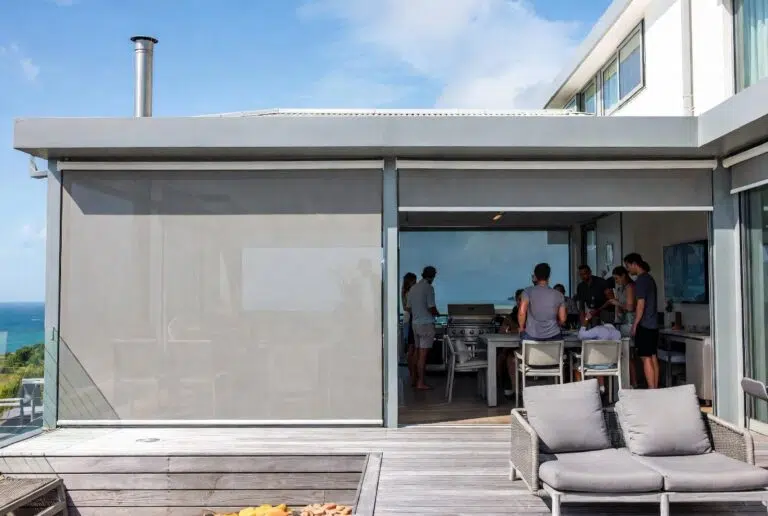
Outdoor blinds on coastal Garden Route home with ocean views and outdoor entertaining area
Outdoor blinds on a coastal Garden Route entertainment area. Salt-air resistant Sheerweave mesh protects the space while preserving ocean views.

What does it cost to enclose a braai area with outdoor blinds?

Screen mesh drop-down blinds start from approximately R350 per square metre for manual crank operation. A typical braai area enclosure covering 12 to 16 square metres falls in the R5,000 to R15,000 range depending on fabric and whether manual or motorised operation is selected.

Clear PVC and side-channel systems are higher due to materials and hardware. Somfy motorisation adds convenience and is particularly useful for large spans, high-mounted blinds, and holiday homes where ease of use matters more than saving a few hundred rand.

Every Custom Blinds outdoor blind is made to measure. There are no standard sizes. The quote includes fabric, all hardware, and delivery. Garden Route installations include professional fitting by the Custom Blinds team.

8,000+Installations since 2010
15+Years on the Garden Route
5Garden Route towns served
5 yrWarranty on all blinds

Should you motorise your braai area blinds?

Motorised outdoor blinds are operated by remote, wall switch, or smartphone app through Somfy automation. When the weather changes mid-braai, you drop the blinds without leaving the fire. Approximately 35 per cent of braai area blinds installed by Custom Blinds on the Garden Route in 2025 were motorised.

Custom Blinds is an authorised Somfy partner. Somfy systems connect to wind and sun sensors, which means your blinds respond automatically to changing conditions. This is especially valued on holiday properties that stand empty during the week.

Outdoor blinds for braai areas: residential, restaurants, and lodges

Different spaces have different demands, and the fabric choice follows the function. A private home braai needs wind and UV control with minimal visual intrusion. Screen mesh at 5 per cent openness handles this well because it protects without changing the character of the outdoor space. The blind disappears when you look through it, and the garden stays part of the room.

Restaurants and commercial entertainment venues have a different set of priorities. Diners expect to stay comfortable and dry while preserving the views that bring them through the door. Clear PVC creates a transparent, fully sealed enclosure that achieves exactly this. Guests see the landscape, feel protected from the elements, and stay longer. Game farm lodges across Southern Africa face the most extreme conditions: salt, humidity, heat, insects, and sudden storms. Sheerweave outdoor blinds from Custom Blinds are installed in hospitality properties from Mozambique’s Bazaruto coastline to private residences in Lagos, because the fabric has proven itself under the harshest conditions the continent produces.

Holiday homes and Airbnb properties on the Garden Route represent a growing segment of braai area enclosures. These properties need outdoor blinds that guests can operate without instructions, that withstand weeks of unattended coastal exposure, and that look good enough to photograph well for listing images. Motorised Sheerweave blinds with Somfy remotes are the standard recommendation for this use case because the remote sits on the table and the operation is obvious to anyone.

For restaurant and commercial braai areas, see the dedicated restaurant blinds and awnings page, or browse the full outdoor blinds range. For coastal-specific outdoor blind guidance, the coastal guide covers material selection for salt-air environments in detail.

Frequently Asked Questions

Can I buy outdoor blinds for my braai area online in South Africa?

Yes. Custom Blinds sells Sheerweave and Sunworker screen mesh blinds through the online shop with free delivery nationwide. You measure, order, and receive a made-to-measure blind at your door. Clear PVC and canvas systems require professional fitting and are available through the Garden Route installation service only.

How do I measure for outdoor blinds on a braai area?

Measure the width and drop of each opening in centimetres. Width is the distance between the mounting points (pillars, walls, or posts). Drop is from the mounting beam or roof edge to where you want the blind to stop. The measuring guide walks through every step. For Garden Route properties, Duncan measures on site at no charge.

How quickly can outdoor blinds be manufactured and delivered?

Screen mesh blinds ordered through the Custom Blinds online shop are manufactured in 7 working days with shipping in 3 to 4 days to major metros after that. Garden Route installations are scheduled directly with Duncan after the site visit. Lead times vary by season, with spring and early summer being the busiest periods.

How long do outdoor blinds last in South African coastal conditions?

Sheerweave and Sunworker screen mesh fabrics installed by Custom Blinds on the Garden Route coast consistently last 8 to 12 years before fabric replacement is needed. Hardware and mechanisms are marine-grade stainless steel and aluminium, which last significantly longer. UV stabilisation, salt-air resistance, and quality hardware are the three factors that determine lifespan.

What is the difference between Sheerweave and Sunworker outdoor blind fabrics?

Both are woven polyester screen mesh fabrics designed for outdoor use. Sheerweave is available in a wider range of openness factors and colours, making it more versatile for residential applications. Sunworker has a tighter, denser weave that performs well in high-wind and dusty environments. Custom Blinds supplies both and recommends based on site conditions. Read the full Sheerweave guide for a detailed comparison.

Do outdoor blinds add value to a South African property?

Enclosed outdoor entertainment areas are among the most valued features in South African property listings. Estate agents on the Garden Route report that homes with professionally enclosed braai and patio areas sell faster and attract higher offers than comparable homes with exposed outdoor spaces. The investment in outdoor blinds typically recovers through daily use within the first winter.

Can Custom Blinds install outdoor blinds outside the Garden Route?

Professional installation is available across the Garden Route from Mossel Bay through George, Wilderness, Sedgefield, Knysna, and Plettenberg Bay. Nationwide customers order screen mesh blinds through the online shop and install with included brackets and instructions, or arrange a local installer. Custom Blinds also ships to lodges and homes across Africa.

Ready to enclose your braai area?

Garden Route: Duncan visits your property to measure and recommend. Nationwide: order screen mesh blinds online with free delivery.

Last reviewed: March 2026

All outdoor blinds are custom manufactured and quoted individually. Prices are indicative and subject to measurement and specification.

{ “@context”: “https://schema.org”, “@graph”: [ { “@type”: “FAQPage”, “mainEntity”: [ {“@type”: “Question”, “name”: “Can I buy outdoor blinds for my braai area online in South Africa?”, “acceptedAnswer”: {“@type”: “Answer”, “text”: “Yes. Custom Blinds sells Sheerweave and Sunworker screen mesh blinds through the online shop with free delivery nationwide. You measure, order, and receive a made-to-measure blind at your door. Clear PVC and canvas systems require professional fitting and are available through the Garden Route installation service only.”}}, {“@type”: “Question”, “name”: “How do I measure for outdoor blinds on a braai area?”, “acceptedAnswer”: {“@type”: “Answer”, “text”: “Measure the width and drop of each opening in centimetres. Width is the distance between the mounting points. Drop is from the mounting beam or roof edge to where you want the blind to stop. For Garden Route properties, Duncan measures on site at no charge.”}}, {“@type”: “Question”, “name”: “How quickly can outdoor blinds be manufactured and delivered?”, “acceptedAnswer”: {“@type”: “Answer”, “text”: “Screen mesh blinds ordered through the Custom Blinds online shop are manufactured in 7 working days with shipping in 3 to 4 days to major metros after that. Garden Route installations are scheduled directly with Duncan after the site visit.”}}, {“@type”: “Question”, “name”: “How long do outdoor blinds last in South African coastal conditions?”, “acceptedAnswer”: {“@type”: “Answer”, “text”: “Sheerweave and Sunworker screen mesh fabrics installed by Custom Blinds on the Garden Route coast consistently last 8 to 12 years before fabric replacement is needed. Hardware is marine-grade stainless steel and aluminium, which lasts significantly longer.”}}, {“@type”: “Question”, “name”: “What is the difference between Sheerweave and Sunworker outdoor blind fabrics?”, “acceptedAnswer”: {“@type”: “Answer”, “text”: “Both are woven polyester screen mesh fabrics designed for outdoor use. Sheerweave offers a wider range of openness factors and colours for residential use. Sunworker has a tighter, denser weave for high-wind and dusty environments.”}}, {“@type”: “Question”, “name”: “Do outdoor blinds add value to a South African property?”, “acceptedAnswer”: {“@type”: “Answer”, “text”: “Enclosed outdoor entertainment areas are among the most valued features in South African property listings. Estate agents on the Garden Route report that homes with professionally enclosed braai and patio areas sell faster and attract higher offers.”}}, {“@type”: “Question”, “name”: “Can Custom Blinds install outdoor blinds outside the Garden Route?”, “acceptedAnswer”: {“@type”: “Answer”, “text”: “Professional installation covers the Garden Route from Mossel Bay to Plettenberg Bay. Nationwide customers order screen mesh blinds online and install with included brackets, or arrange a local installer. Custom Blinds also ships across Africa.”}} ] }, { “@type”: “LocalBusiness”, “name”: “Custom Blinds Shutters & Awnings”, “url”: “https://customblinds.co.za”, “telephone”: “+27795235407”, “email”: “accounts@customblinds.co.za”, “address”: {“@type”: “PostalAddress”, “addressLocality”: “Knysna”, “addressRegion”: “Western Cape”, “addressCountry”: “ZA”}, “areaServed”: [ {“@type”: “City”, “name”: “Knysna”}, {“@type”: “City”, “name”: “George”}, {“@type”: “City”, “name”: “Plettenberg Bay”}, {“@type”: “City”, “name”: “Sedgefield”}, {“@type”: “City”, “name”: “Mossel Bay”} ], “foundingDate”: “2010”, “founder”: {“@type”: “Person”, “name”: “Duncan Kane”} } ]}

Get a Quote
close slider