
Fall Arm Awnings Garden Route
Window-mounted awnings with spring-loaded arms that pivot from 0 to 180 degrees. Block glare. Control heat. Keep your view.
What is a fall arm awning and how does it work?
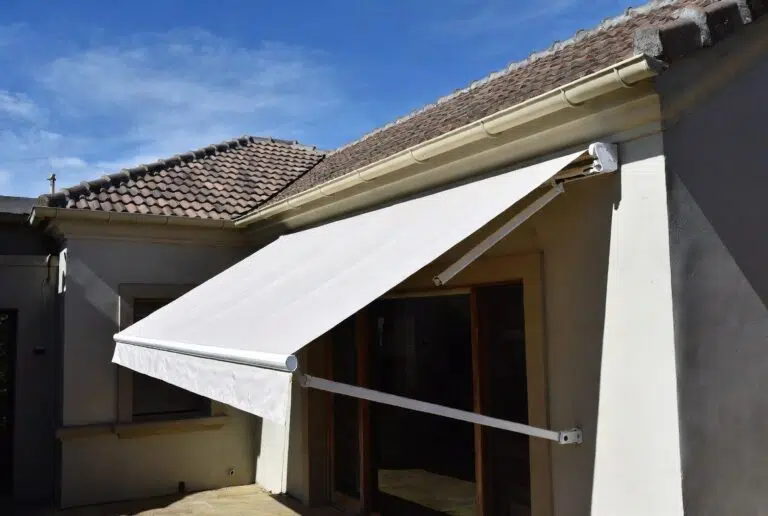
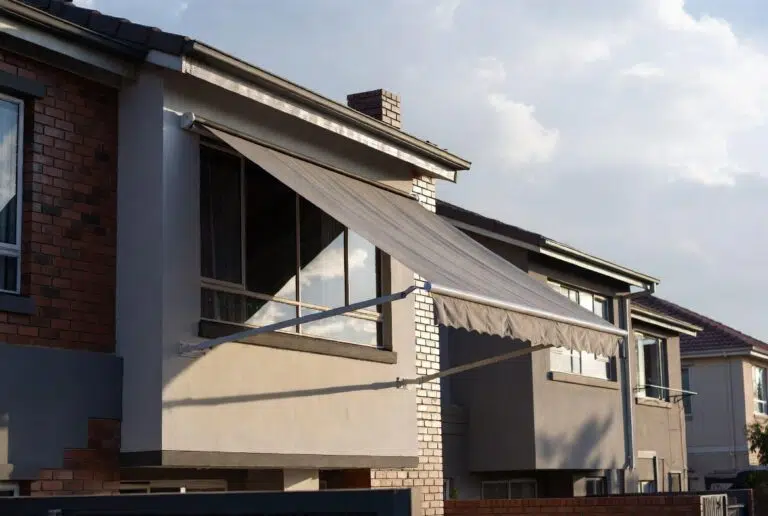
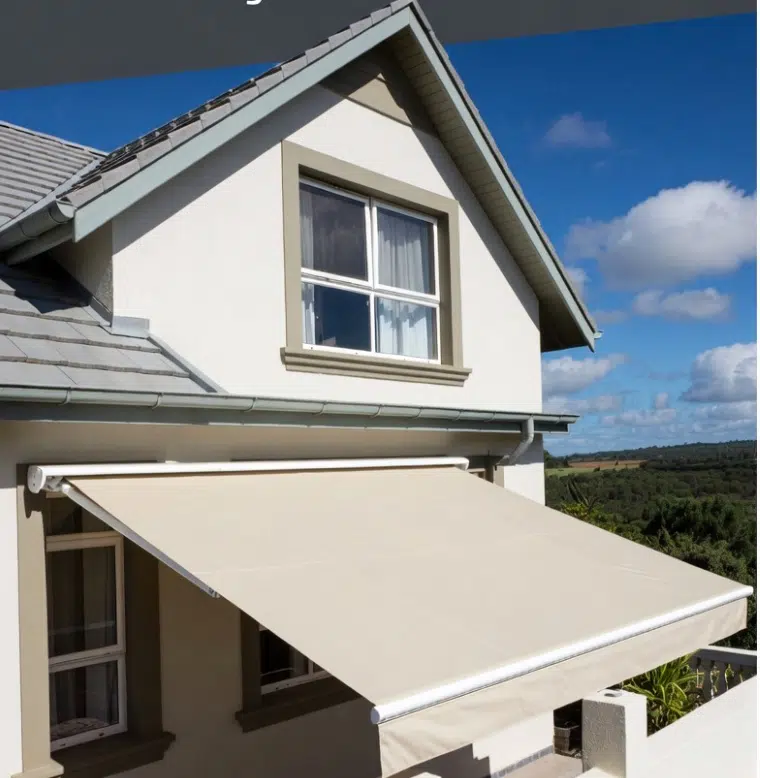
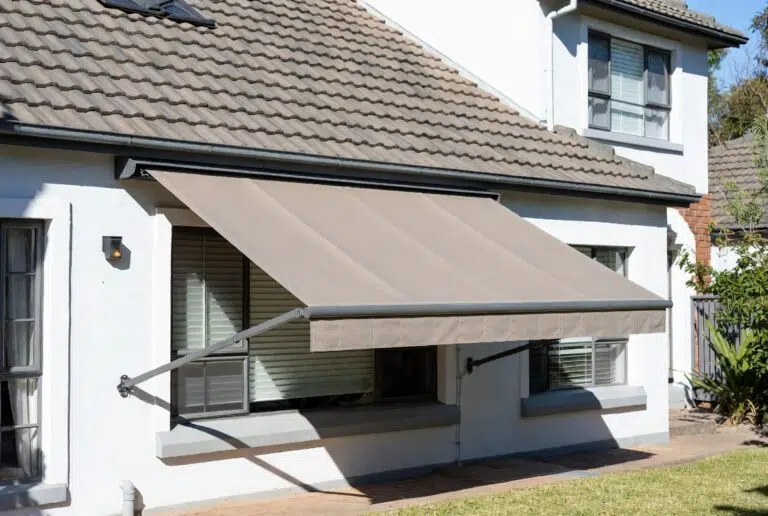
- A fall arm awning (also called a drop arm awning) mounts above a window or door and uses two spring-loaded arms that pivot outward to project fabric away from the building face
- Arms adjust through an arc from 0 to 180 degrees. At 90 degrees you get overhead shade, 135 degrees for filtered half-light, 180 degrees for full privacy and blackout
- Standard operation uses a manual gearbox and crank handle; Somfy motorisation with sun and wind sensors is available for automated control
- The awning retracts completely when not in use, keeping your facade clean and the fabric protected
- Ideal for windows, doors, balconies and shopfronts where a folding arm awning would be too large
- Custom Blinds manufactures fall arm awnings with powder-coated aluminium frames and UV-rated acrylic canvas for Garden Route coastal conditions
Morning sun pours through your bedroom window. By ten o’clock, that same light becomes unbearable heat. You close the curtains and lose the view. A fall arm awning solves this quietly. Shade adjusts with the sun, and the window stays open to the breeze.
“Fall arm awnings are what I recommend for north-facing windows along the Garden Route. You get full sun control without losing any of your view. At ninety degrees you have a shade canopy. At one-eighty, complete privacy. One awning, two jobs.”
Duncan KaneFounder, Custom Blinds Shutters & Awnings. 18 years experience across the Garden Route
How does a fall arm awning adjust from 90 to 180 degrees?
Fall arm awnings use two spring-loaded support arms mounted to the building on either side of the window. These arms connect to a front bar that holds the fabric taut. By adjusting the arm angle, you control how far the fabric projects from the wall and what angle of sun protection the awning provides. The arms pivot through a continuous arc, giving you precise control over light and privacy throughout the day.
At 90 degrees, the arms extend horizontally and the fabric creates an overhead canopy, ideal for blocking high midday sun while maintaining a clear sightline outward. This is the position most homeowners use during the middle of the day when the sun is directly overhead.
At 135 degrees, the arms angle downward and the fabric sits at roughly a 45-degree slope. This filters low-angle afternoon sun while still allowing soft light and partial views through the fabric. It is the best position for late afternoon on west-facing windows along the Garden Route.
At 180 degrees, the fabric hangs fully vertical, parallel to the window. This provides complete privacy and maximum glare reduction. Restaurants and guesthouses along the Garden Route use this position during service hours to create intimate dining environments without permanent screening.
90 vs 180 explained: A 90-degree fall arm position creates a horizontal shade canopy above the window. A 180-degree position drops the fabric straight down like a blind. Everything in between gives you a graduated mix of shade, light and privacy. The mechanism is the same. Only the arm angle changes.
Who should choose a fall arm awning over a folding arm?
Fall arm awnings are built for individual windows, doors and narrow balconies, anywhere you need precise sun control in a compact footprint. They are not designed to shade large patio areas. That is the job of a folding arm awning, which projects horizontally over open spaces up to four metres deep.
The fall arm is the right choice when the problem is glare and heat entering through a specific window or set of windows. Fall arm awnings are particularly effective against low-angle sunlight, particularly late afternoon and early morning sun that strikes at steep angles below horizontal shade structures. This is the sun that fixed awnings and pergolas miss entirely. North-facing and west-facing windows on Garden Route homes are the most common application. A single fall arm awning over a bedroom window can reduce indoor temperature by up to 8 degrees compared to unshaded glass, according to energy efficiency studies on external window shading.
Commercial applications are equally strong. Shopfronts along the main streets of Knysna and George use fall arm awnings to shade display windows without blocking the view of merchandise from outside. Restaurants with street-facing seating use the 180-degree position to create shelter from afternoon sun and passing traffic.
For Airbnb and guesthouse owners on the Garden Route, fall arm awnings solve two problems at once. They reduce air conditioning load and they give guests the ability to control their own light and privacy from each room.
Fall Arm vs Folding Arm vs Wedge Awnings
| Feature | Fall Arm | Folding Arm | Wedge |
|---|---|---|---|
| Primary use | Windows, doors, balconies | Patios, decks, large areas | Windows, shopfronts (fixed) |
| Arm mechanism | Spring-loaded pivot, 0 to 180° | Lateral extending arms | No arms, rigid fixed frame |
| Projection range | 0.6 m to 1.5 m | 1.5 m to 4.0 m | 0.5 m to 1.2 m (fixed) |
| Adjustable angle | ✓ 0° to 180° | ✗ Extends/retracts only | ✗ Fixed position |
| Privacy control | ✓ Full at 180° | ✗ Shade only | ✗ Partial shade only |
| Retracts fully | ✓ Rolls up completely | ✓ Folds away | ✗ Permanently fixed |
| Wind performance | Good, low profile | Moderate, retract in strong wind | Excellent, rigid structure |
| Motorisation | ✓ Somfy compatible | ✓ Somfy compatible | ✗ Not applicable |
| Best for | Glare, heat, privacy per window | Outdoor living and entertaining | Signage, fixed shade, rain cover |
What specifications and fabrics are available for fall arm awnings?
Custom Blinds manufactures fall arm awnings with powder-coated aluminium frames built to withstand Garden Route coastal conditions. The frame components are non-corrosive and available in a range of powder-coat colours to match your building’s facade. Every awning is custom-made to the exact dimensions of your window or door opening. There are no off-the-shelf sizes.
Frame options
Open systems suit locations where the fabric does not need weather protection when retracted, such as under an existing soffit or overhang. Cassette systems enclose the fabric and arms inside a protective housing when the awning is rolled up, extending fabric life in exposed coastal positions. Semi-cassette options protect the fabric while leaving the arms accessible.
Fabric choices
Acrylic canvas is the standard for fall arm awnings on the Garden Route. High-performance Dickson canvas from European manufacturers provides 98%+ UV protection, water resistance and colour stability rated for five to twelve years depending on coastal exposure. Custom Blinds specifies fabrics engineered for South African conditions, with proven performance against salt air, UV degradation and the intense Garden Route sun cycle. Mesh and sheerweave fabrics are available where maintaining an outward view is more important than complete sun blockout, popular for commercial shopfronts and restaurant facades.
Operation
Manual operation uses a gearbox and crank handle, reliable, maintenance-free and suited to awnings within easy reach. For higher installations or multiple awnings, Somfy motorisation allows remote control via wall switch, remote handset or smartphone app. Sun and wind sensors can be added to automate extension and retraction based on weather conditions.
Where are fall arm awnings installed on the Garden Route?
Fall arm awnings are one of the most versatile window-shading solutions for Garden Route properties because they handle the region’s unique mix of intense sun, coastal wind and afternoon rain. Custom Blinds Shutters & Awnings installs fall arm awnings across Knysna, George, Plettenberg Bay, Sedgefield and Mossel Bay, in residential, commercial and hospitality settings.
On Thesen Island and the Knysna lagoon waterfront, north-facing properties receive direct sun from early morning through late afternoon. Fall arm awnings on bedroom and living room windows reduce indoor temperatures without the visual bulk of external roller blinds. The retractable design means the awning disappears when you want an unobstructed view of the lagoon.
In George, where summer temperatures regularly exceed 30 degrees, fall arm awnings on west-facing windows cut afternoon heat gain dramatically. Combined with outdoor weather blinds on the patio, they form a complete heat management system for homes in Herolds Bay, Wilderness and the George CBD.
For Plettenberg Bay restaurants and boutique hotels along the Robberg Road strip, fall arm awnings at the 180-degree position create intimate street-side dining areas while protecting guests from the intense Plett afternoon sun.
How are fall arm awnings installed and maintained?
Fall arm awnings mount directly to the building face above the window or door. Duncan conducts a site assessment to determine the correct bracket type, fixing method and arm length for your specific wall construction and window dimensions. Masonry, timber frame and steel structures each require different anchoring. This is not a product to install without professional assessment in a coastal environment.
Installation typically takes two to three hours per awning. The mounting brackets are fixed to the wall, the awning barrel and arms are attached, and the fabric tension and arm angles are calibrated. For motorised installations, wiring connects to either an existing power point or a dedicated circuit depending on the number of awnings.
Maintenance is minimal. The fabric should be rinsed with clean water and a soft brush every three to four months to remove salt deposits and pollen, both of which are constant on the Garden Route. The arm mechanisms are factory-lubricated and require no regular servicing. Retract the awning during severe storms as a precaution, though the low-profile design handles moderate coastal wind well.
Site assessment required: Fall arm awnings are precision products that depend on correct bracket placement, arm length and fabric tension. Custom Blinds provides free site assessments across all five Garden Route towns. Contact Duncan on 079 523 5407 to arrange a visit.
Frequently Asked Questions About Fall Arm Awnings
What is the difference between a fall arm awning and a drop arm awning?
Fall arm and drop arm awnings are the same product. Both terms describe a window-mounted retractable awning with spring-loaded arms that pivot from 0 to 180 degrees. The terms are used interchangeably in South Africa and internationally. Custom Blinds installs fall arm awnings across the Garden Route.
Can fall arm awnings be motorised with Somfy controls?
Fall arm awnings can be fully motorised with Somfy motors and integrated with sun sensors, wind sensors, timers and smartphone app control. Motorisation is recommended for awnings installed above first-floor windows or where multiple awnings need to be operated together. Custom Blinds is a Somfy-accredited installer on the Garden Route.
How much do fall arm awnings cost on the Garden Route?
Fall arm awning pricing depends on the window width, arm length, fabric choice, frame finish and whether manual or motorised operation is specified. Every Custom Blinds awning is custom-manufactured and individually quoted after a free site assessment. Contact Duncan on 079 523 5407 for a no-obligation quote.
Are fall arm awnings suitable for windy coastal areas?
Fall arm awnings perform well in moderate coastal wind because of their compact profile and close-to-wall mounting. The low projection and spring-loaded arms create less wind resistance than larger folding arm awnings. For exposed coastal positions on the Garden Route, a cassette system protects the fabric when retracted, and Somfy wind sensors automatically retract the awning in strong gusts.
What is the maximum width for a fall arm awning?
Fall arm awnings are custom-manufactured to fit your exact window dimensions. Standard configurations cover openings from approximately 1.2 metres to 6 metres wide. Wider installations may use multiple awnings side by side for a clean, continuous facade treatment. Duncan assesses each installation individually to ensure correct arm spacing and fabric tension.
Should I choose a fall arm or a folding arm awning for my home?
Choose a fall arm awning when you need sun control, glare reduction and privacy for individual windows and doors. Choose a folding arm awning when you need to shade a large open patio, deck or outdoor dining area. Fall arm awnings are compact and window-focused. Folding arm awnings project horizontally over larger spaces. Both are available from Custom Blinds on the Garden Route.
Do fall arm awnings work for shopfronts and commercial buildings?
Fall arm awnings are widely used on commercial shopfronts, restaurant facades, boutique hotels and office buildings across the Garden Route. At the 180-degree position, they function as effective privacy screens for street-facing dining. At 90 degrees, they create attractive branded canopies. Powder-coated aluminium frames and commercial-grade acrylic canvas handle daily commercial use and coastal exposure.
Ready for a fall arm awning consultation?
Free site assessment across all five Garden Route towns.
Last reviewed: March 2026. All products custom manufactured and quoted individually.
Compare all types: Which awning type is right for your patio? — retractable, fall arm, louvre, and patio shade compared side by side.