
Duo Roller Blinds: Two Fabrics, One Window, Complete Control
Also called tandem roller blinds, double roller blinds, or day and night blinds. One bracket holds two separate roller blinds (typically sheer plus blockout) so you get filtered daylight and total darkness from the same window, without choosing between the two. Not to be confused with a zebra blind, which is a single fabric with alternating stripes.
What is a duo roller blind and how is it different from a zebra blind?
- A duo roller blind (also called a tandem roller, double roller, or day and night blind) mounts two separate roller blinds on a single shared headrail bracket. One blind is typically sheer, the other blockout. Each operates independently with its own chain or motor.
- A zebra blind (sometimes also marketed as a “double roller” in South Africa) is a completely different product. It uses a single fabric with alternating sheer and opaque horizontal stripes on one roller. You slide the layers to control light, but you cannot achieve full blockout.
- The confusion exists because both products use the term “double roller” in different markets. In South Africa, if a retailer says “double roller” they may mean either product. Always check whether the system uses one fabric or two separate fabrics.
- Duo rollers need a minimum recess depth of 90mm for an inside mount because the bracket holds two roller tubes. Zebra blinds need less depth because they use a single compact cassette.
- Both are available made to measure with free delivery across South Africa from the Custom Blinds online shop.
Nationwide delivery: order a duo roller online | Garden Route installation: book a consultation
Every room asks for different light at different hours. A bedroom wants soft glow at dawn and complete darkness at midnight. A living room wants an open view for morning coffee and privacy by evening. A duo roller blind answers both needs from the same window, without compromising either one.
“The duo roller is the product I recommend most for bedrooms in South African homes. People want blockout for sleeping, but they also want their bedroom to feel light and open during the day. One bracket, two fabrics, problem solved.”
Duncan KaneFounder, Custom Blinds Shutters & Awnings | 20 years experience
How does a duo roller blind work?
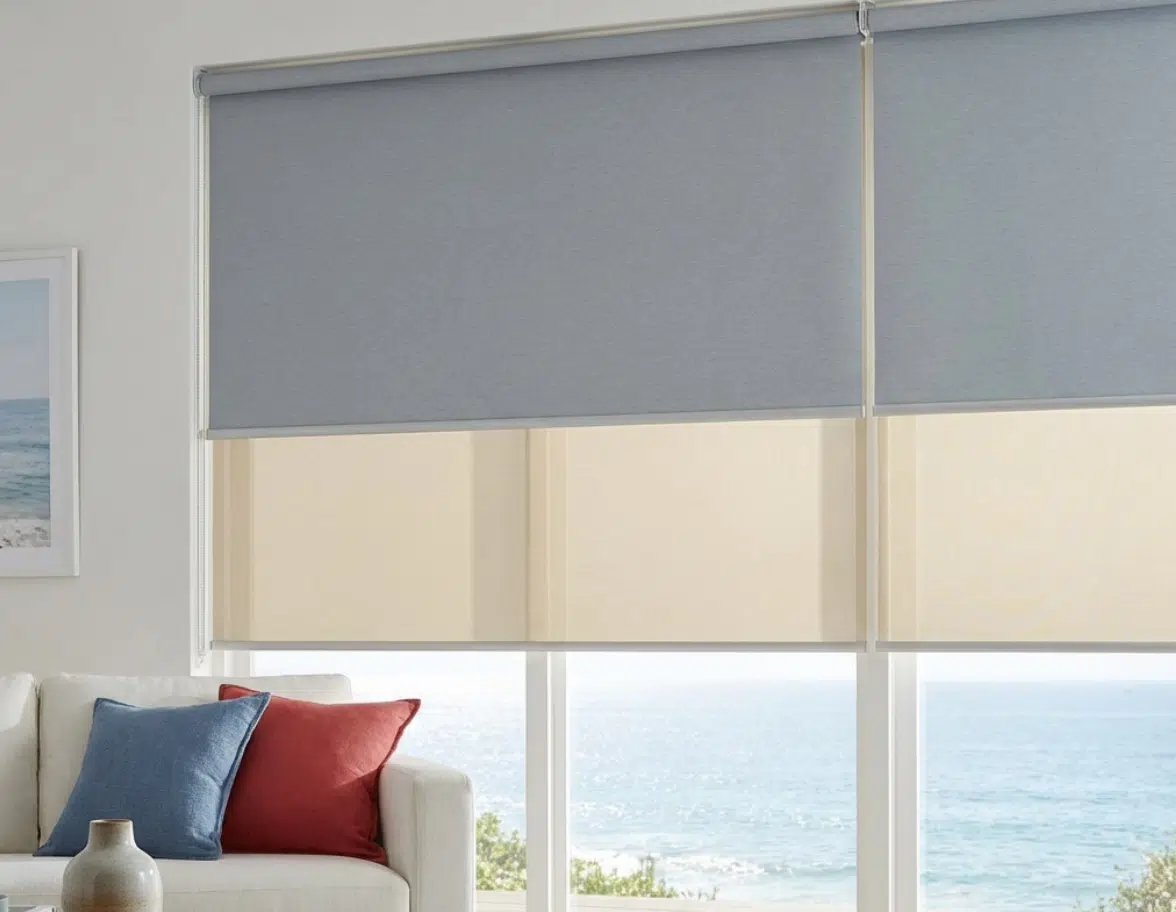
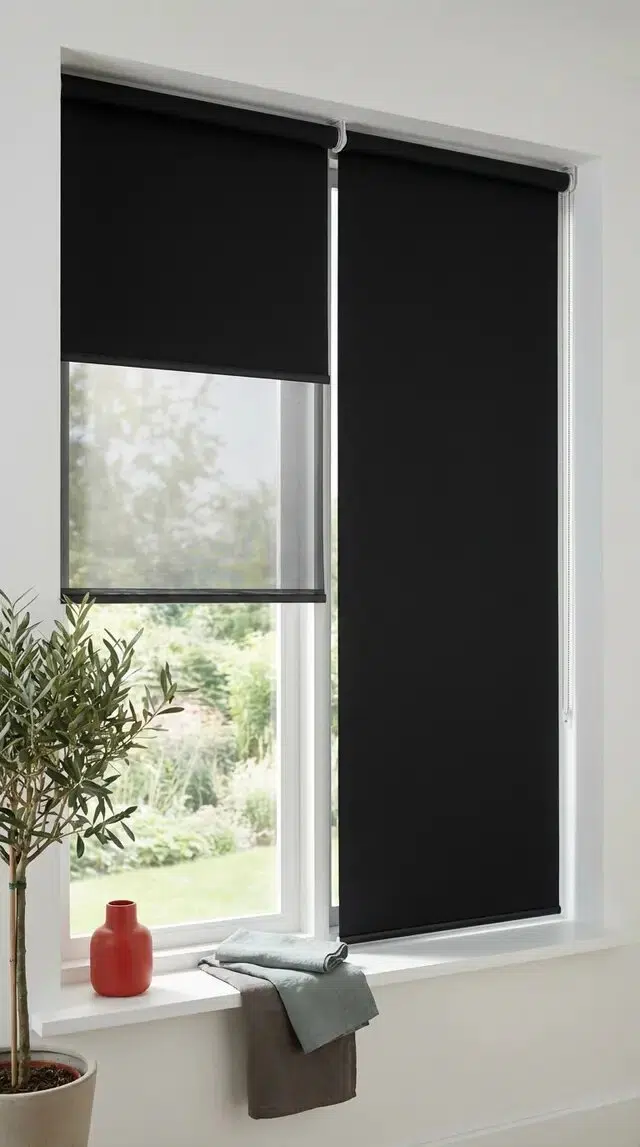
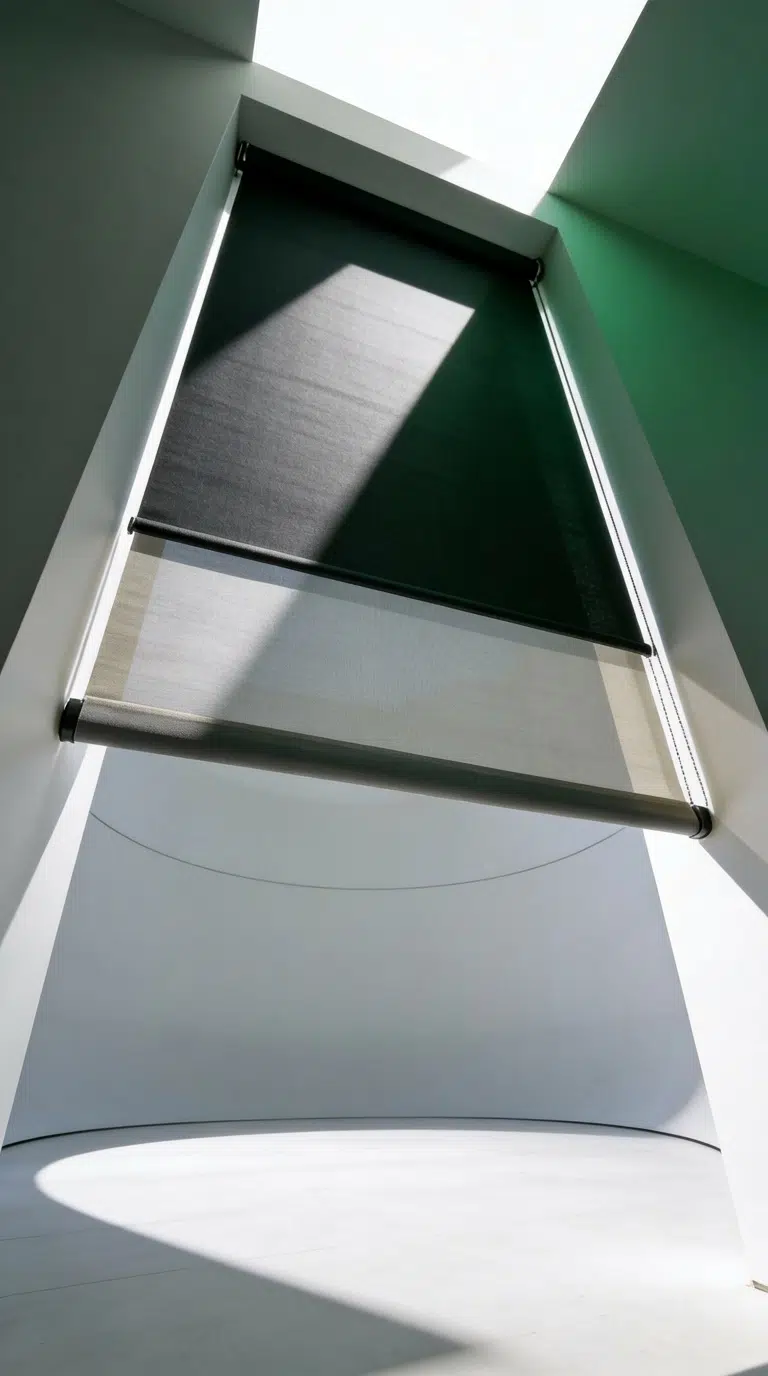
The system is straightforward. A double bracket mounts to the top of your window frame or inside the recess. This bracket holds two separate roller tubes, one positioned in front of the other. Each tube carries a different fabric. The front blind is typically a sheer or light filtering material. The rear blind is a blockout fabric. Each blind has its own chain mechanism (or motor, if you choose automation), so you raise and lower them completely independently.
During the day, you lower the sheer fabric to soften glare and filter UV while keeping the view. The blockout stays rolled up behind it, invisible. At night, you lower the blockout for complete darkness and privacy. In between, you can have both down, one down, or neither. Four distinct configurations from one set of brackets.
The fabrics do not touch each other. They operate on separate rolls with a small gap between them. This means they do not interfere with each other’s movement and the operation stays smooth over years of daily use.
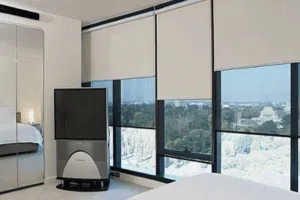
What is the difference between duo, tandem, double roller and day-and-night blinds?
This product goes by several names depending on where you look. In Australia and the UK it is most commonly called a “double roller blind.” In the US, “dual roller shade” or “day and night shade.” In South Africa, “duo roller” and “tandem roller” are the most accurate terms because “double roller” is already widely used to describe zebra blinds (the single fabric with alternating stripes). We use “duo roller” throughout this guide and on our shop to avoid any confusion.
Whatever the name, the product is the same: two separate roller blinds mounted on one shared double bracket, each with its own fabric and its own control mechanism.
How do duo roller blinds differ from zebra blinds?
These two products solve the same problem (light control plus privacy) in fundamentally different ways. Ordering the wrong one means the room does not perform the way you need it to.
A zebra blind uses a single fabric with alternating sheer and opaque horizontal bands. You slide the two layers across each other: align the sheer bands for filtered light, align the opaque bands for privacy. It is one blind, one fabric, one mechanism. The effect is elegant and the cassette is compact, but you cannot get full blockout because light leaks at the band edges.
A duo roller uses two completely separate fabrics. The sheer is a sheer. The blockout is a blockout. Each works independently. You get genuine full blockout when you need it and genuine filtered light when you want it. There is no compromise on either function.
How do duo roller, zebra and standard roller blinds compare?
| Feature | Duo Roller (Two Fabrics) | Zebra (Single Striped Fabric) | Standard Roller |
|---|---|---|---|
| Number of fabrics | Two (separate rolls) | One (alternating bands) | One |
| Light control | Full range: sheer to complete blockout | Variable: sheer to 95% block | Fixed: depends on fabric chosen |
| True blockout | Yes | No (edge light leak) | Only if blockout fabric selected |
| Independent control | Yes, each blind separate | Single mechanism | Single mechanism |
| Minimum recess depth | 90mm | 60mm | 60mm |
| Motorisation | Somfy compatible (each blind) | Somfy compatible | Somfy compatible |
| Best for | Bedrooms, nurseries, media rooms | Living rooms, kitchens, offices | Any single-function window |
| Price point | Higher (two fabrics + bracket) | Mid | Entry |
Where do duo roller blinds work best?
The rooms that benefit most from duo rollers are those where the lighting need changes dramatically between day and night.
Bedrooms
This is the primary use case. You want a bedroom that feels light and inviting during the day but achieves complete darkness for sleeping. The sheer fabric filters morning light gently. The blockout behind it drops for afternoon naps, early bedtimes for children, or shift workers who sleep during the day. A nursery is an especially strong candidate because small children need both soft daytime light and reliable blockout for sleep routines.
Media rooms and home cinemas
Total darkness is essential for a good viewing experience, but nobody wants a permanently dark room. The duo roller lets you switch from open, daylit living space to blacked out cinema in seconds.
Guest bedrooms and holiday homes
Guests arrive with different preferences. Some want early morning light. Some want to sleep late in complete darkness. A duo roller accommodates both without needing to swap fabrics or hang additional curtains. For holiday homes on the Garden Route, the low maintenance of roller fabrics (no washing, no ironing, no fading) makes them particularly practical.
Open plan living areas with bedtime transitions
Studio apartments and open plan living spaces often serve as both daytime living room and nighttime sleeping area. The duo roller handles this transition without the visual bulk of curtains.
What should you know before ordering a duo roller blind?
Recess depth
The double bracket system needs at least 90mm of recess depth for an inside mount (where the brackets sit inside the window frame for a clean, flush look). Measure the depth of your window frame from the front edge to the glass. If your frame is shallower than 90mm, you can still install a duo roller using a face mount (brackets fixed to the wall above the window), but the cassette will be visible rather than recessed.
Measuring
Measure width at three points (top, middle, bottom of the frame) and use the shortest measurement. Measure drop at three points and use the longest. Record everything in millimetres. For a detailed walkthrough, see our measuring guide or shop measuring guide.
Fabric combinations
The standard combination is sheer (front) and blockout (rear). This covers the vast majority of use cases. However, you can also pair a sunscreen with a blockout, or a light filtering with a dimout, depending on the room’s needs. If you are unsure which combination suits your space, WhatsApp our team for advice.
Motorisation
Duo rollers pair beautifully with Somfy motorisation. Each blind gets its own motor, controlled independently via remote, smartphone app, or voice assistant (Alexa, Google Home, Apple HomeKit). You can programme scenes: “Good morning” raises the blockout and lowers the sheer. “Movie time” does the opposite. For high or hard to reach windows, motorisation is not a luxury but a practical necessity.
When is a duo roller blind not the right choice?
Transparency matters. A duo roller is not the answer for every window.
If you need variable light but never full blockout, a zebra blind does the job with a slimmer profile and lower cost. If you want one simple blind for a kitchen or bathroom where light control is secondary, a standard roller blind in a suitable fabric is more practical. If you want energy insulation as the primary function, a honeycomb blind outperforms both options because its cellular structure traps air. And if you are renting and cannot drill into the window frame, no-drill blinds are designed specifically for that situation, though they are not available in a duo configuration.
Frequently Asked Questions
What is a duo roller blind?
A duo roller blind mounts two separate roller blinds (typically one sheer and one blockout) on a single double bracket. Each blind operates independently, giving you full control over light and privacy from one window fitting.
Is a duo roller the same as a double roller blind?
It depends on who is using the term. Internationally, “double roller blind” usually means the duo/tandem system (two separate fabrics on one bracket). In South Africa, “double roller” is often used to describe zebra blinds (one fabric with alternating stripes). Always check whether the product uses one fabric or two. On our site, we use “duo roller” for the two-fabric system and “zebra” or “double roller” for the single striped-fabric product.
Is a duo roller the same as a zebra blind?
No. A zebra blind is a single blind with one fabric that has alternating sheer and opaque stripes. A duo roller uses two completely separate fabrics on two separate rollers within one bracket. They solve similar problems differently. Duo rollers achieve full blockout. Zebra blinds do not.
Can a duo roller blind fully block out light?
Yes. The blockout layer in a duo roller provides genuine full blockout when lowered, unlike a zebra blind which allows some light leakage at the band edges. This makes duo rollers the better choice for bedrooms and nurseries.
How much recess depth do I need?
A minimum of 90mm recess depth for an inside mount. If your frame is shallower, you can use a face mount (brackets on the wall above the window) instead.
Can duo roller blinds be motorised?
Yes. Each blind within the duo system can be fitted with a Somfy motor, allowing independent control via remote, smartphone app, or voice assistant. This is especially useful for programming day and night scenes.
Do you deliver duo roller blinds nationally?
Yes. Made to measure duo roller blinds ship free anywhere in South Africa from our online shop. Garden Route clients can also book a professional installation consultation.
What fabric combinations are available?
The standard pairing is sheer (front) and blockout (rear). You can also pair sunscreen with blockout, or light filtering with dimout, depending on your room’s requirements.
Ready to order your duo roller blind?
Made to measure. Free delivery nationwide. Custom Fit Guarantee on every order.
Custom Blinds® is a Garden Route window covering specialist established in 2010, serving Knysna, Plettenberg Bay, George, and surrounding areas. We manufacture Custom Lifestyle Shutters™, Custom Lifestyle Awnings™, and outdoor shading systems locally, and supply roller blinds, honeycomb blinds, venetian blinds, duo roller blinds, zebra blinds, and no-drill blinds nationally via shop.customblinds.co.za. Our Custom Fit Guarantee covers every order.