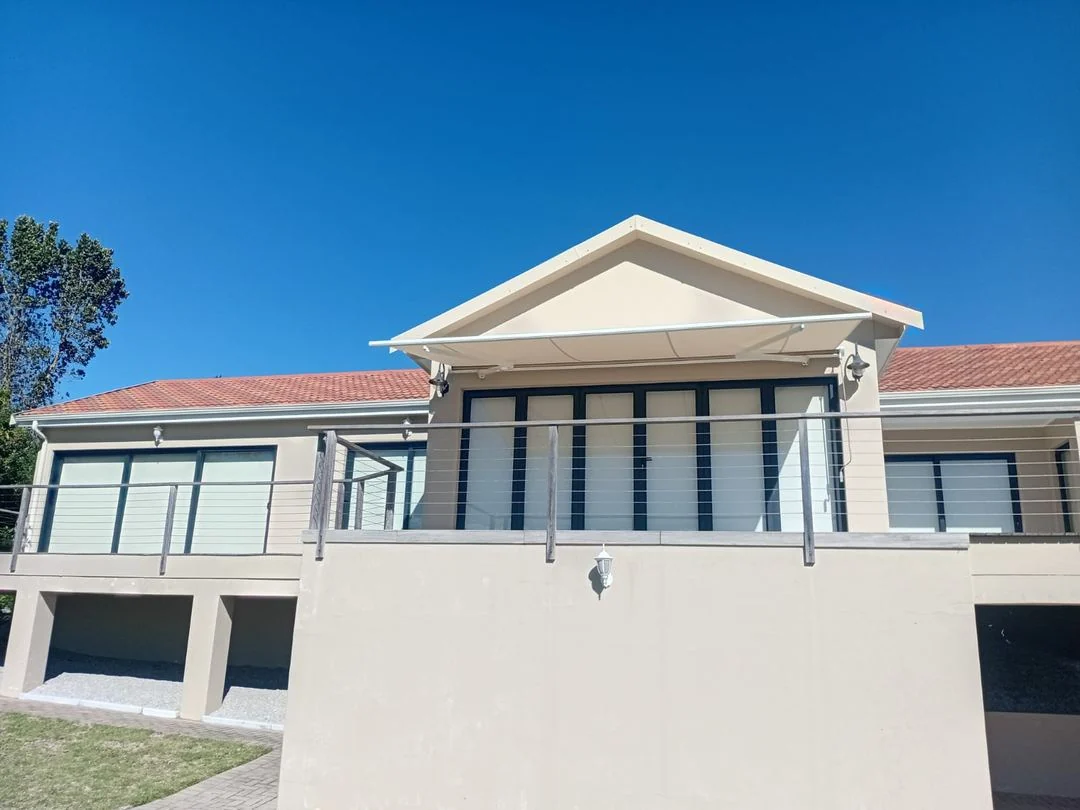
Why we estimate 80% of Garden Route outdoor awnings need a wind sensor
A coastal exposure analysis from sixteen years of Garden Route installations, cross-referenced with verified Somfy and Ziptrak specifications and the May 2026 cut-off low storm event.
Based on Custom Blinds Shutters and Awnings consultation data across the Garden Route, we estimate that around 80% of the sites we visit have an exposure that calls for a wind sensor on any retractable awning or outdoor blind. The single most-cited reason is that Garden Route winters routinely produce Beaufort 7 gusts (50 to 61 km/h) on exposed coastal patios, which sits above the safe operating threshold for an unsupervised retractable awning. Somfy Eolis sensors and Ziptrak track-fix specifications are matched to those conditions during the site visit.
- | Coastal south-easterly gusts measured at 70 to 80 km/h through The Heads, Knysna
- | Somfy Eolis Wirefree IO sensor: adjustable 10 to 80 km/h threshold, 120 km/h max wind resistance
- | Ziptrak outdoor blinds: 90 km/h standard install, 139 km/h with stainless steel rivets, 160+ km/h with Extreme Conditions fixing
- | May 2026 Garden Route storm: 80 km/h winds, 1100mm rain, Orange Level 8 warning across Knysna and Plett
How we arrived at the 80% estimate
Custom Blinds Shutters and Awnings has been specifying window treatments across the Garden Route since 2010. Duncan Kane brings over 20 years of industry experience to the consultation process, including years before the business was founded. Across that period the company has visited thousands of homes and commercial properties from Mossel Bay through to Plettenberg Bay, classifying each site by exposure to the dominant south-easterly and the secondary north-westerly wind patterns that define the region.
The 80% figure is a CB-internal estimate, not a peer-reviewed study. It is grounded in the consultation register and reflects the proportion of recent residential and light commercial sites where the position of a proposed retractable awning, folding-arm awning, fall-arm awning, louvre awning, or outdoor blind sits in a wind path that, by the manufacturers' own published specifications, exceeds the safe unsupervised operating envelope. The remaining 20% are typically heavily sheltered courtyards, north-facing patios protected by built structure, or installations in inland micro-climates such as the upper Knysna forest belt where wind exposure drops sharply.
This is a baseline observation, not a sales claim. Duncan specifies sensors based on the exposure he sees on the day. The 80% is a record of what the Garden Route actually presents to a specifier, not a target.
Garden Route wind by location and season
The Garden Route is not a single climate. Each town has a distinct exposure profile shaped by topography, coastline orientation, and proximity to lagoon water. The table below reflects typical winter gust ranges in exposed positions, drawn from CB on-site observations cross-referenced with South African Weather Service event records.
| Location | Typical winter gust | Beaufort | Dominant direction |
|---|---|---|---|
| Knysna Heads, Thesen Island, Leisure Isle | 70 to 80 km/h | 8 | South-easterly |
| Plettenberg Bay (Robberg, Beachy Head) | 60 to 75 km/h | 7 to 8 | South-easterly |
| Mossel Bay (Diaz, Hartenbos seafront) | 55 to 70 km/h | 7 | South-westerly |
| George (Heatherlands, Glen Barrie) | 40 to 60 km/h | 6 to 7 | South-easterly |
| Wilderness lagoon-front | 50 to 65 km/h | 7 | South-easterly, funnelled |
| Sedgefield (Cola Beach, Myoli) | 55 to 70 km/h | 7 | South-easterly |
Ranges represent typical exposed-position winter gusts. Storm events such as May 2026 exceed these ranges materially. Inland micro-climates can sit one to two Beaufort grades lower.
Manufacturer thresholds: Somfy and Ziptrak compared to Garden Route reality
The two components that carry the wind load on a Garden Route install are the motor sensor pairing (Somfy Eolis range) for retractable awnings, and the side-channel fixing specification (Ziptrak track system) for outdoor blinds. Both manufacturers publish verifiable wind specifications. The table below maps those specifications against the local exposure ranges in the previous section.
Somfy Eolis wind sensor range
| Sensor | Adjustable threshold | Max wind resistance | Typical Garden Route use |
|---|---|---|---|
| Eolis Wirefree IO | 10 to 80 km/h | 120 km/h | Residential awnings, holiday homes |
| Eolis 230V wired | Beaufort 5 to 10 (about 88 km/h trigger ceiling) | Manufacturer rated | Commercial louvre and patio installations |
| Eolis 3D Wirefree RTS | Three-axis vibration detection | Vibration-based, no upper km/h cap | Folding arm and fall arm awnings, roof mounted |
| Eolis RTS (legacy) | 10 to 50 km/h | Manufacturer rated | Older RTS retrofit installations |
Source: Somfy Activites SA published specifications, Eolis sensor data sheets. The Eolis IO sensor display references both km/h and Beaufort scale on the device itself.
Ziptrak outdoor blind wind ratings
| Installation method | Wind rating | Reference blind size |
|---|---|---|
| Standard install, aluminium rivets | approximately 90 km/h | 2.5m by 2.5m |
| Stainless steel rivets | approximately 139 km/h | 2.5m by 2.5m |
| Extreme Conditions Fixing Procedure | 160 km/h and above | 2.5m by 2.5m |
| PanoView, TUV SUD PSD tested | Static load equivalent to 260 km/h | 2m by 2m |
Source: Ziptrak Australia published research and innovation documentation, TUV SUD PSD test results. Ziptrak recommends raising outdoor blinds when winds exceed 50 km/h to preserve warranty regardless of installation grade. Larger blinds present larger sail area and accept lower wind loads.
When a wind sensor is necessary
The decision is not whether a Garden Route patio sees wind. It does. The decision is whether the position calls for an unsupervised automatic retract. The framework Duncan uses on site:
- 1.Beaufort 5 or below (under 38 km/h): Sensor optional. Most inland George and sheltered Plett courtyard positions. Manual operation acceptable for an attentive owner.
- 2.Beaufort 6 (39 to 49 km/h): Sensor strongly recommended. This is the threshold where a wide retractable awning begins to feel the wind in a way that flexes the arms. Lower-end Eolis RTS threshold sits here.
- 3.Beaufort 7 (50 to 61 km/h): Sensor essential on any retractable awning. Holiday-home and unoccupied-property installations require sensor by CB specification regardless of owner preference. Ziptrak warranty caution begins above 50 km/h.
- 4.Beaufort 8 and above (62 km/h plus): Sensor and storm protocol both required. Outdoor blinds need stainless steel rivet specification at minimum. Folding arm and fall arm awnings should be specified with motorised retract and three-axis Eolis 3D detection.
Garden Route storms are intensifying
Cut-off low pressure systems are a recurring Garden Route winter phenomenon and published storm severity across the region has trended upward over the past several years. The South African Weather Service has issued an increasing number of Level 6 and Level 8 warnings for the Western Cape over consecutive winter seasons.
The May 2026 event is one recent example. A cut-off low stalled over the Western Cape from 5 May 2026, prompting an Orange Level 8 warning across the Garden Route. Approximately 1100mm of rain fell over the greater Knysna area in seven days. Wind speeds in the region were reported close to 80 km/h. A second wind episode followed on 13 May. Schools, hiking trails, and water-based activities were closed across the district as a precaution. These figures are drawn from public reporting by the Knysna Municipality, SANParks, the South African Weather Service, and the regional press.
This is the kind of event the wind sensor framework on this page is designed for. A retractable awning extended at the wrong moment during a Beaufort 7 or 8 gust faces stresses that the structure was not engineered to absorb unsupervised. The sensor exists to retract the awning before that load arrives, automatically, regardless of whether the owner is on site. Outdoor blinds in tracks behave differently from awnings under wind load and are assessed separately during the site visit, with attention to fabric type, blind size, and track fixing grade.
We do not claim that every installation we have completed is invulnerable in every storm, and we do not have third-party verified data on storm-by-storm outcomes across our installed base. What we can state is that the specification framework on this page reflects how we approach the trade-off between local conditions, manufacturer-published thresholds, and the safe operating envelope of each product type.
Wind sensor questions, answered
At what wind speed does a Somfy Eolis sensor retract an awning?
The threshold is set by the installer on the sensor itself. The Eolis Wirefree IO sensor can be set anywhere between 10 and 80 km/h. For most Garden Route residential awnings CB calibrates the trigger at around 40 km/h, which is the lower end of Beaufort 6 and gives the motor enough time to fully retract the awning before gust loading approaches the manufacturer's safe operating ceiling.
What is the difference between Eolis Wirefree, Eolis 230V and Eolis 3D?
Eolis Wirefree IO is the battery-powered wireless sensor that pairs with IO-homecontrol motors and measures wind speed directly via an anemometer. Eolis 230V is the mains-wired version with a Beaufort 5 to 10 adjustable trigger and is typically specified on commercial louvre and patio installations. Eolis 3D is a three-axis vibration sensor that detects wind-generated movement from any direction rather than measuring wind speed directly, which makes it the best fit for folding arm and fall arm awnings where the awning frame transmits gust loading immediately.
What wind speed can a Ziptrak outdoor blind handle?
Ziptrak Australia publishes three wind specifications. A 2.5m by 2.5m blind installed with standard aluminium rivets holds up to approximately 90 km/h. The same blind installed with stainless steel rivets holds approximately 139 km/h. With the Ziptrak Extreme Conditions Fixing Procedure the same blind exceeds 160 km/h. Independent TUV SUD PSD testing on a 2m by 2m PanoView blind recorded static loads equivalent to 260 km/h. Larger blinds present larger sail area and accept lower wind loads. Ziptrak recommends raising blinds when wind exceeds 50 km/h to preserve warranty regardless of fixing grade.
Are wind sensors a Custom Blinds upsell?
No. Duncan specifies sensors based on exposure observed on the site visit, not as a default add-on. The 80% figure on this page reflects the proportion of Garden Route sites we visit where the exposure actually calls for a sensor. The remaining 20% are sheltered courtyards, inland micro-climates, or positions where built structure breaks the wind path. We do not recommend a sensor where it is not needed and we do not omit one where it is.
Does the wind sensor work when the power is out?
Yes, in the configurations CB specifies. The Eolis Wirefree IO sensor is battery powered and pairs directly with the awning motor. Somfy IO and RTS motors can be specified with battery or solar backup so that wind retract continues to function during a power cut. This pairing is standard on Garden Route holiday-home installations where the property is unoccupied for extended periods.
How do you specify wind protection for a Garden Route holiday home?
For an unoccupied property the wind retract has to function without human intervention. The standard CB specification on holiday-home awnings is a Somfy Eolis Wirefree IO sensor paired with an IO-homecontrol motor, with the wind threshold set to the lower end of the local Beaufort band so the awning retracts before gust loading peaks. Battery or solar backup is specified where the property loses power during storms. For outdoor blinds in tracks, the fixing grade is chosen against the manufacturer's published wind rating for the blind size in question. The site visit determines which options apply.
Can I add a wind sensor to an existing awning?
Often yes, depending on the motor. RTS motors can pair with an Eolis RTS sensor without rewiring. IO motors pair with Eolis Wirefree IO. Awnings driven by older non-radio tubular motors require a motor upgrade before a sensor can be added. Duncan assesses motor compatibility during the site visit. Retrofit installations are common across older Plettenberg Bay and Knysna holiday homes.
Site assessment from the Garden Route specialist
If your patio sits in a Beaufort 6 or above position, the sensor specification is part of the conversation from the first site visit. Duncan calibrates threshold, motor torque and storm behaviour on the day, in front of the wind path.

