
Aluwood vs Timber Venetian Blinds: The Honest Comparison
Both look like wood. One lasts. This is how they differ, and why the climate you live in makes the choice obvious.
Is aluwood or real timber better for venetian blinds in South Africa?
- Aluwood venetian blinds use an aluminium slat with a printed wood grain finish, moisture-proof, UV-resistant, and dimensionally stable in coastal climates
- Timber venetian blinds use solid basswood or similar hardwood, beautiful in dry inland rooms but vulnerable to humidity, salt air, and direct sun
- Along South Africa’s coast, timber slats warp, swell, and fade within 2–5 years under humidity and UV exposure
- Aluwood costs 20–40% less than equivalent real wood and requires no sealing, oiling, or replacement due to warping
- Custom Blinds recommends aluwood for all coastal, bathroom, kitchen, and rental applications in South Africa
- Real timber is appropriate for low-humidity inland rooms where aesthetics are the primary requirement and budget is not a constraint
Not sure which suits your space? WhatsApp Duncan on 079 523 5407 for a free recommendation.
A timber venetian blind in a Sea Point apartment, facing the Atlantic. Stunning for the first summer. By the second winter, the slats have bowed. The finish is lifting. It moves less freely. By year three, you are looking for a replacement. This is not a quality issue. It is a climate issue.
What is an aluwood venetian blind?
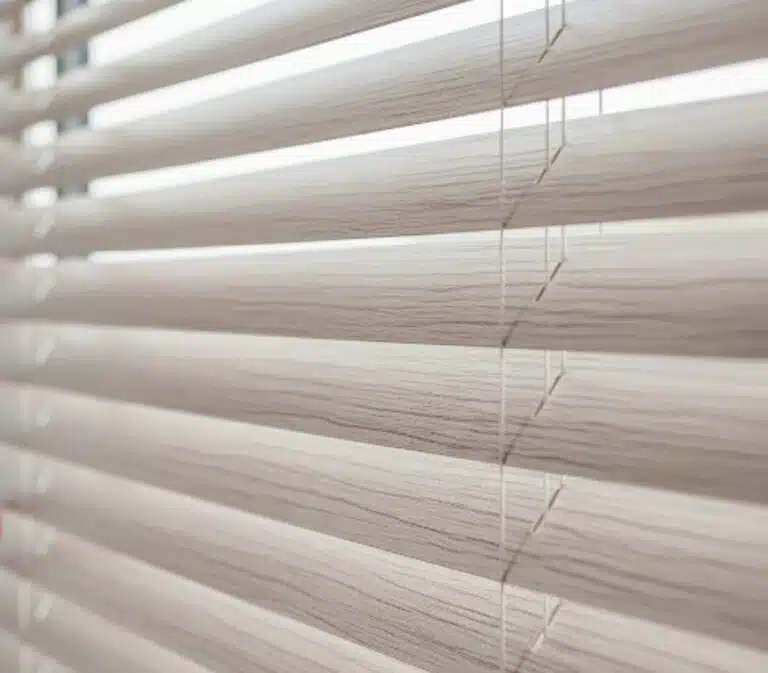
An aluwood venetian blind is an aluminium slat with a factory-applied wood grain finish, typically a photographic print sealed under a durable coating. The core is standard aluminium, identical to a plain venetian blind. The surface looks, from a normal viewing distance, like real stained timber. Slat widths are the same as aluminium: 25 mm and 50 mm. Operation, tilt, lift, cord, is identical to any aluminium venetian.
The finish is applied in the factory under controlled conditions. It does not chip or peel under normal use. Custom Blinds sources aluwood venetian blinds through Blindquip, South Africa’s largest venetian blind manufacturer, which supplies the Hunter Douglas and Luxaflex ranges nationally. Available finishes range from pale ash and light oak to dark walnut and espresso, around 12 standard options, plus custom colour matching at additional cost.
Slat dimensions: 25 mm wide (suits narrower windows, lighter visual weight), 50 mm wide (more prominent wood grain effect, better for larger openings). Both are made to measure. Minimum width: 20 cm. No maximum, wide windows use joined sections with an unobtrusive mullion bar.
What are timber venetian blinds, and what limits them?
Timber venetian blinds use solid basswood, paulownia, or similar lightweight hardwood slats, typically at 50 mm width (25 mm timber venetians are rare). The wood is sanded, stained, and lacquered in the factory. Quality manufacturers apply 3–5 coats of protective lacquer. Despite this, wood is a natural material that responds to moisture and temperature changes throughout its life.
In South Africa, the challenge is the climate range. South Africa’s coastal regions range from 80%+ humidity in winter months to very low humidity in summer. South Africa’s coastal regions sit at sustained 70–85% relative humidity year-round. Basswood absorbs moisture and expands across the grain, meaning slats widen slightly when humid, then contract when dry. Over time, this cycling causes bowing and splitting. The lacquer surface cracks along the grain, allowing deeper moisture penetration.
UV is the second problem. South African UV index regularly reaches 10–12 in summer, among the highest in the world. Timber blinds facing direct sun fade and bleach within 2–4 years, even with UV-resistant lacquer. Aluwood’s printed finish uses the same UV-stable inks used in outdoor signage, and sits under a clear protective coat rated for decades of direct exposure.
Maintenance reality: Real timber venetians installed in high-humidity or coastal South African rooms require resealing every 2–3 years and typically need full replacement within 5–8 years. Aluwood in the same conditions has an expected lifespan exceeding 15 years with only routine cleaning.
Aluwood vs Timber Venetian Blinds
| Property | Aluwood Venetian | Timber Venetian |
|---|---|---|
| Core material | Aluminium alloy | Basswood / paulownia |
| Surface finish | Printed wood grain under protective coat | Stained and lacquered real wood |
| Moisture resistance | ✓ Fully moisture-proof | ✗ Absorbs humidity, warps over time |
| UV resistance | ✓ Rated for direct sun exposure | ✗ Fades within 2–4 years in direct sun |
| Coastal suitability | ✓ Ideal, salt air has no effect on aluminium | ✗ Salt accelerates lacquer breakdown |
| Weight | Lighter, easier cord operation | Heavier, stiffer operation over time |
| Available widths | 25 mm and 50 mm | 50 mm standard only |
| Price range (SA) | R600–R1,600 per m² | R1,200–R2,800 per m² |
| Expected lifespan (coastal) | 15+ years | 5–8 years before replacement |
| Maintenance | Wipe clean with damp cloth | Annual oiling/resealing recommended |
| Recommended for | Coast, bathrooms, kitchens, rentals, all climates | Dry inland rooms, prestige applications |
Where does real timber still make sense in South Africa?
Real timber venetian blinds are not obsolete, they are right for specific conditions. A dry inland room in Johannesburg, Pretoria, or the Karoo, where humidity stays below 50% for most of the year, is a legitimate application for real wood. The material performs well when it is not subjected to repeated moisture cycling. In these environments, a well-lacquered basswood venetian can last as long as an aluwood equivalent.
There is also an aesthetic case. At close range, real timber has a tactile quality, slight grain variation, a depth under the lacquer, that a printed surface does not fully replicate. In a premium interior where a client is within touching distance of the blind and aesthetics are the primary concern, real wood has its place. Interior designers working on prestige properties in Constantia, the Atlantic Seaboard, or the Highveld sometimes specify real timber for bedrooms and formal living rooms for this reason.
The rule Custom Blinds applies: if there is any moisture source within 3 metres (bathrooms, kitchens, coastal properties, north-facing rooms with direct sun), aluwood is the professional recommendation. If the room is dry, inland, and the client wants the highest-end natural material, timber is a reasonable choice at a higher price point. For everything else, including most South African homes, aluwood venetian blinds deliver the same look at lower cost and longer lifespan.
Duncan Kane, Custom Blinds, 20 years experience across South Africa
How do aluwood and timber venetian blinds compare on price in South Africa?
Aluwood venetian blinds in South Africa cost between R600 and R1,600 per square metre, depending on slat width and blind size. A standard bedroom window at 1.2 m × 1.5 m in 25 mm aluwood typically costs R900–R1,400 supplied, with free delivery nationwide. The 50 mm slat in the same size runs R1,100–R1,600, the wider slat carries more material and has a higher price per blind.
Real timber venetian blinds in South Africa start at around R1,200 per square metre for standard basswood and run to R2,800 per square metre for premium imported hardwood ranges from Hunter Douglas. The same 1.2 m × 1.5 m bedroom window in real timber therefore costs R1,800–R3,200 supplied and installed. The price gap widens further when you factor in replacement cost, coastal timber blinds typically need full replacement within 5–8 years.
For an accurate quote on aluwood venetian blinds made to measure, you can build and price your 25 mm aluwood blind online or price the 50 mm option directly in the Custom Blinds shop. Prices update in real time based on your window measurements. Contact Duncan directly to arrange an on-site consultation and quote without obligation.
Frequently Asked Questions
Can you tell the difference between aluwood and real timber venetian blinds?
From a normal viewing distance of 1.5 m or more, aluwood and real timber venetian blinds are visually indistinguishable. The printed wood grain on aluwood slats accurately replicates the look of stained basswood. Close inspection or physical handling reveals the difference, the surface of aluwood is smoother and cooler to the touch. For most interior applications in South Africa, this distinction is not visible to visitors or guests.
Are aluwood venetian blinds suitable for bathrooms in South Africa?
Yes, aluwood venetian blinds are one of the best choices for South Africa, with delivery to Johannesburg, Cape Town, Durban, Pretoria, Port Elizabeth and Bloemfonteinn bathrooms. The aluminium core is fully moisture-proof and will not warp, swell, or corrode in a bathroom environment. Real timber venetian blinds are not recommended for bathrooms due to their moisture absorption. Custom Blinds recommends aluwood venetians for bathrooms as a standard specification.
How long do aluwood venetian blinds last compared to timber in South Africa?
Aluwood venetian blinds in South African coastal conditions last 15+ years with routine cleaning. Real timber venetian blinds in the same coastal conditions typically require replacement within 5–8 years due to humidity-induced warping and UV fading. Inland in dry climates, both materials perform comparably. The lifespan advantage of aluwood is most pronounced in South Africa’s coastal and humid climates.
What finishes are available for aluwood venetian blinds in South Africa?
Custom Blinds offers approximately 12 standard aluwood finishes through Blindquip, ranging from pale ash and natural oak to mid-toned walnut and dark espresso. Each finish replicates a specific timber species at a consistent tone. Seasonal stock additions are common, Duncan can advise on current availability and show physical samples during a consultation with Duncan. Custom colour matching is available at additional cost for larger commercial projects.
How much cheaper are aluwood venetian blinds than real timber in South Africa?
Aluwood venetian blinds typically cost 20–40% less than equivalent real timber venetian blinds in South Africa. A standard bedroom window in aluwood costs R900–R1,600 supplied and installed; the same window in real timber runs R1,800–R3,200 depending on the wood species and supplier. Over a 10-year period, the total cost difference widens further when coastal timber replacement costs are included.
Where can I buy aluwood venetian blinds online in South Africa?
Custom Blinds supplies made-to-measure 25 mm aluwood venetian blinds and 50 mm aluwood venetian blinds through the online shop at shop.customblinds.co.za (see our guide to buying blinds online in South Africa). Enter your window measurements and the price calculator gives a live quote with free nationwide delivery. Local installation is available, contact Duncan directly to arrange.
Can aluwood venetian blinds be motorised?
Yes, aluwood venetian blinds are fully compatible with motorised lift and tilt systems. Custom Blinds offers Somfy motorisation for venetian blinds, allowing smartphone, remote, or smart home control of slat tilt and blind position. Motorised aluwood venetians are popular in holiday homes where remote operation and automated scheduling are valued. Contact Duncan for a motorisation quote alongside your blind measurement.
Related guides:
Venetian blinds South Africa: the full comparison
How to clean aluwood and timber venetian blinds
Every type of blind compared
Ready to choose the right venetian blind?
Made to measure. Free nationwide delivery. Custom Fit Guarantee on shop orders.
Last reviewed: March 2026. All products made to measure and quoted individually. Prices are indicative and vary by window size, slat width, and current stock.