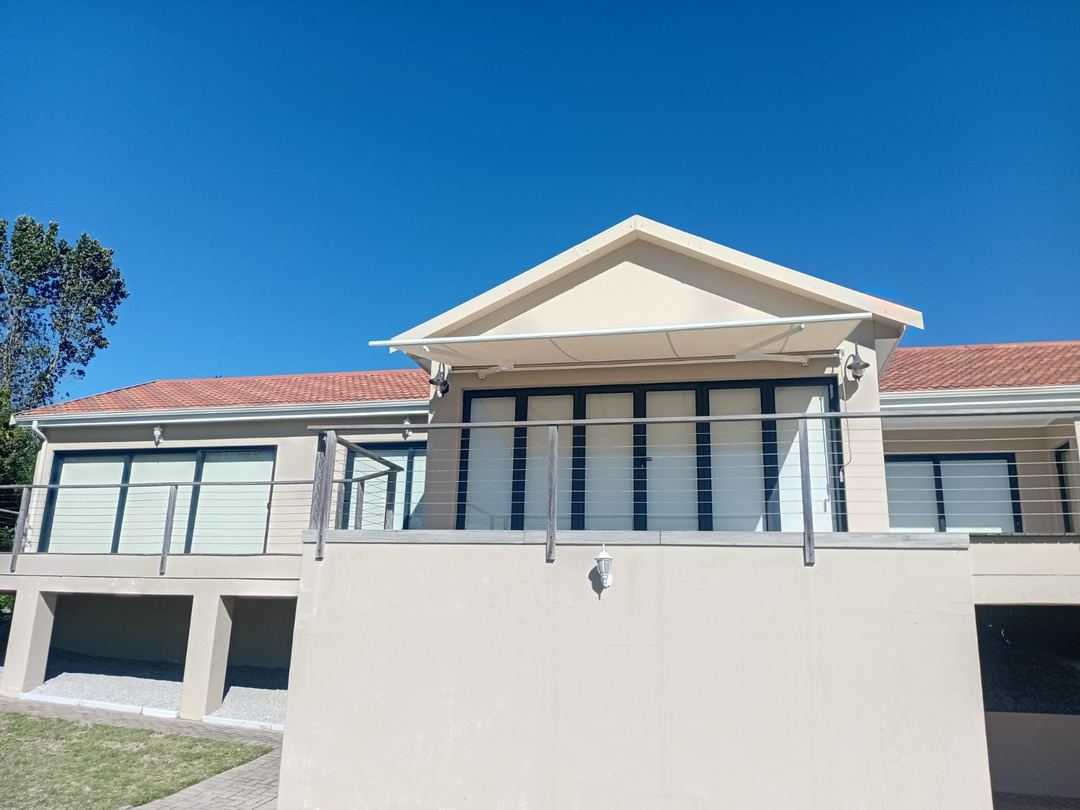
Retractable Folding Arm Awnings
Retractable awnings turn a hot patio or balcony into a calm outdoor living room without posts or heavy structures. You get deep shade when the sun bites, then a clear open sky when you want winter warmth or stargazing. Every unit is made to measure for your wall, span and projection so that it works with your architecture and Garden Route weather, not against it.
At a Glance — Retractable Folding Arm Awnings
- Wall-mounted folding arm system — no posts or vertical supports in your way
- Extends up to 4+ metres from the wall, widths of 6 metres or more
- Somfy motorised with optional wind and sun sensors for automated shade
- Solution-dyed acrylic fabrics specified for Garden Route coastal UV and salt air
- Open roll or full cassette housing to protect the fabric when retracted
- Manufactured to measure and professionally installed by Custom Blinds®
- Pairs with outdoor blinds on the sides for complete patio enclosure
What Is A Retractable Awning
A retractable awning is a folding arm system that fixes to your wall or beam and extends out to create a roof of fabric. When you wind or motor the awning out, articulated arms carry the fabric forward and stretch it under tension. When you bring it back in, the fabric rolls up neatly onto a tube and the arms fold flat against the wall.

There is no need for vertical posts on the outer edge. Your patio stays open and light, which is why folding arm awnings are the preferred shade solution for entertainment areas, balconies, decks, and restaurant patios where you still want that feeling of space. The arms are engineered to hold the fabric taut even at full extension, which prevents sagging and pooling in light rain.
Projection (how far the awning extends) typically ranges from 1.5 metres to over 4 metres depending on the arm length specified. Width can span well beyond a single opening — we regularly install awnings covering 6 metres or more across wide patios. Every unit is made to measure for your specific wall, span and projection requirements.
← View All Awnings · Patio Shade Roofs · Outdoor Weather Blinds
Why Homeowners Choose Retractable Awnings
Retractable awnings solve the fundamental problem with South African outdoor living: you want to be outside, but the sun makes it unbearable for half the day. Unlike permanent shade structures, a retractable awning gives you the choice — deep shade when you need it, open sky when you want it.
- Real temperature relief — shade on glass and paving can drop surface temperature by 10–15°C, making patios genuinely usable again on hot afternoons. This also reduces heat transfer into the house through glass doors and windows.
- No posts in the way — the arms cantilever from the wall, so there are no vertical supports on the outer edge. This keeps views, foot traffic, and furniture arrangement completely unobstructed — essential for braai areas and entertainment spaces.
- Flexible across seasons — extend for summer shade, retract for winter sun. One product, two modes. On the Garden Route, where mornings can be cold and afternoons blazing, this flexibility is invaluable.
- Made for coastal conditions — powder-coated aluminium frames, stainless steel fixings, and UV-stabilised acrylic fabrics specified for Garden Route salt air. Every component is chosen to resist the corrosion that ruins cheaper awnings within a few years on the coast.
- Clean look cassette and open roll options sit neatly against the building and keep lines simple.

For motorisation and sensor technology background see Somfy South Africa, a long term global leader in automated shading and awning controls. For broader context on energy efficient building envelopes visit the Green Building Council South Africa.
Where Retractable Awnings Work Best
- North-facing patios and decks — these take the most sun during the day and benefit enormously from adjustable shade. Extend for midday heat, retract for winter warmth.
- Entertainment and braai areas — keep guests comfortable without closing in the space. The post-free design means no obstructions around the braai or dining table.
- Balconies and apartment terraces — where permanent structures are not permitted by body corporate rules, a retractable awning provides shade without altering the building’s appearance when retracted.
- Restaurant and café patios — extend outdoor seating capacity year-round. Branded fabric valances add a professional finish. See our restaurant blinds and awnings page.
- Pool areas — shade over loungers and seating without permanent structures that restrict pool maintenance access.
- Above windows and glass doors — reduce heat gain through north and west-facing glass without blocking the view. Motorised sun sensors can automate this throughout the day.
Retractable awnings are less suited to fully exposed locations with no wind protection, or situations where you need permanent all-weather cover (consider a louvre awning or fixed awning instead).
Engineered For South African Coastal Weather
The Garden Route’s combination of salt air, UV intensity, sudden wind gusts, and temperature swings is one of the most demanding environments for any outdoor product. An awning that works perfectly in Johannesburg can fail within two years on the coast if the materials and fixings are not specified for marine conditions.
We design around real Garden Route conditions, not brochure drawings. Every specification considers the specific installation site: which direction the wall faces, how exposed it is to the prevailing wind, what the wall substrate is (brick, concrete, timber frame), and how the awning will interact with existing structures like gutters and fascias.
- Frames corrosion resistant aluminium with powder coating specified for coastal use.
- Fixings — stainless steel where appropriate, anchored into sound substrates rather than just plaster. On the Garden Route, many homes have a combination of brick, timber frame, and composite cladding. We assess the wall structure during the site visit and specify the correct anchor type for each mounting point — chemical anchors for hollow masonry, through-bolts for solid concrete, and reinforced plates for timber frames.
- Fabrics — solution-dyed acrylic that holds colour for years under intense UV. These fabrics are mould-resistant, water-repellent, and rated for South African coastal conditions. We avoid cheaper polyester fabrics that fade and degrade within 2–3 years in coastal sun.
- Pitch and projection set during design so that shade falls where you use it most while water runs off correctly in light rain.

We design for intelligent use. Any awning should be retracted in strong wind or severe weather. Sensors and motors simply make that easier and more consistent.
Control, Profiles And Combinations
Retractable awnings come in several control and housing configurations. The right combination depends on your budget, how exposed the installation is, and how often you’ll use it.

- Manual crank — a simple gearbox and handle, best for smaller spans up to about 3 metres or when budget is the priority. Reliable and requires no electrical connection.
- Somfy motorised — smooth, quiet operation at the touch of a button. Essential for larger projections and daily use. Can be controlled by remote, wall switch, smartphone app, or integrated into your smart home system (Alexa, Google Home, Apple HomeKit).
- Wind sensors — an add-on for motorised awnings that triggers automatic retraction when gusts reach a set threshold. This protects the fabric and arms when you are away from home or asleep. We recommend these for all Garden Route installations given the unpredictable coastal wind.
- Sun sensors — extend the awning automatically when UV levels rise. Combined with wind sensors, this creates a fully autonomous shade system that manages itself through the day.
- Open roll — the fabric and tube are visible when retracted. This suits installations under sheltered eaves or ceilings where the mechanism is already protected from rain.
- Full cassette — an aluminium housing that completely encloses the fabric, tube, and arms when retracted. This provides maximum protection from weather, dirt, and UV degradation. Essential for exposed wall-mounted installations and coastal properties where salt air accelerates wear on unprotected fabric.
- Layered shading — combine a retractable awning overhead with outdoor blinds or screens on the sides for complete wind, rain, and privacy control. This is the most popular configuration for Garden Route entertainment areas.
Comparison: Retractable Awnings And Other Popular Patio Options
When deciding on patio shade, homeowners often compare retractable awnings with other options. Each has trade-offs — here is how they stack up for typical Garden Route installations.
| Solution | Structure | Best For | Wind And Weather | Light Control |
|---|---|---|---|---|
| Retractable awning | Wall fixed, folding arms, fabric roof | Entertaining patios and balconies | Use in normal breeze, retract in strong wind | Good shade on doors and paving, open sky when retracted |
| Retractable patio shade roof | Guided front beam, posts or tracks where needed | Patios that need more rain cover | Stronger weather protection with fabric that moves on guides | Deep shade, still retracts when you want light |
| Outdoor weather blinds | Vertical screens on tracks or cables | Wind, drizzle and privacy on sides | Very good side protection when used with an overhead cover | Filtered light and view with clear or screen fabrics |
| Fixed roof structure | Permanent roof with posts | Full time cover and built extensions | Strong protection but no retraction, higher building impact | Constant shade, requires careful planning for winter light |
Every solution depends on site conditions, height, span and exposure. We often combine products to balance weather protection, light and views.
Pricing And How The Process Works
Retractable awning pricing depends on span (width), projection (how far it extends), fabric choice, control type (manual vs motorised), and housing (open roll vs full cassette). A motorised full-cassette awning with wind sensor costs more than a manual open-roll unit, but delivers better long-term performance and convenience.
Our process:
- Site visit — Duncan assesses the wall, span, wind exposure, and how you use the space. This determines the right arm length, fabric, and mounting approach.
- Recommendation and quote — we specify the awning configuration, fabric colour, and control options. You receive a detailed quote with no hidden costs.
- Custom manufacture — every awning is built to your exact dimensions. Lead time is typically 2–4 weeks depending on the specification.
- Professional installation — our team handles all mounting, wiring (for motorised units), and commissioning. We test the wind sensor calibration on-site.
- After-care — local Garden Route support for adjustments, fabric cleaning, and maintenance. We service what we install.
Duncan’s Fact
Retractable awnings are often the quickest way to win your patio back. When they are sized and fixed correctly they feel light to use but make a heavy difference to comfort. Clients who thought they needed a full build often find that a folding arm awning gives them what they wanted with less disruption and more flexibility.
Maintenance And Longevity
A well-maintained retractable awning on the Garden Route should give you 10–15 years of reliable service. Coastal salt air is the main enemy — it accelerates corrosion on unprotected metal parts and degrades fabric that isn’t UV-stabilised.
Our maintenance recommendations:
- Retract when not in use — especially overnight and during storms. Full-cassette models protect the fabric when retracted, but open-roll models should ideally be under an eave.
- Brush off debris — leaves, bird droppings, and pollen should be brushed off before retracting to prevent staining and mould.
- Annual fabric clean — gentle brush and lukewarm water with mild soap. No harsh chemicals or pressure washers. Allow to dry fully before retracting.
- Check arm joints — annually, especially in coastal areas. We can service the mechanism and lubricate joints as part of a maintenance visit.
- Wind sensor calibration — if your awning starts retracting in light breeze, the sensor may need recalibration. Contact us for a quick adjustment.
Why Custom Blinds For Your Retractable Awning
We have been manufacturing and installing retractable awnings across the Garden Route since 2010. Duncan personally assesses every site, specifies every unit, and oversees every installation. That means your awning is designed for your specific wall, your specific wind exposure, and your specific outdoor living requirements — not pulled off a shelf and adapted.
We manufacture Canvas and Wedge style awnings in-house, and specify premium folding arm systems from leading European and South African suppliers. Every awning carries a warranty and is backed by local after-care from the same team that installed it.
Frequently Asked Questions
Can a retractable awning handle coastal wind?
Frames and fixings are specified for coastal exposure and day-to-day wind. In strong or gusty conditions the awning should be retracted. Motorised units with Somfy wind sensors retract automatically when gusts reach a set threshold, protecting the fabric and arms even when you are away from home.
Will a retractable awning make my home dark inside?
When extended you get shade and lower temperatures, which is the goal on hot days. When you want more light, retract the awning fully. During design we look carefully at orientation and glass to balance shade and natural light. That is the beauty of retractable — you choose based on the moment.
Does a retractable awning keep rain out?
A correctly pitched awning will shed light rain and drizzle away from doors and seating areas. It is not a storm roof — in heavy rain you should retract. If all-weather cover is your priority, we may pair the awning with a retractable roof system or other structure.
How wide can a folding arm awning go?
Widths of 6 metres or more are common. Projections typically range from 1.5 to over 4 metres depending on the arm configuration. Larger spans can be handled with multiple arms and careful bracketing. This is part of the site design process — Duncan assesses the wall and specifies the right system during the site visit.
Can I add outdoor blinds later?
Yes. Many clients start with the awning for overhead shade, then add side blinds when they want more wind and privacy control. We plan bracket positions during the awning installation so that later additions look integrated, not afterthoughts.
How far can a retractable awning extend from the wall?
Standard folding arm awnings project up to about 4 metres from the wall. For deeper coverage, we can combine an awning with a secondary shade structure or specify a larger arm system. The maximum projection depends on wind exposure and the mounting height available at your site.
Open roll or full cassette — which should I choose?
If the awning mounts under a sheltered eave or ceiling, open roll is fine — the fabric is already protected. For wall-mounted installations exposed to rain, salt air, or direct sun, a full cassette is recommended. The cassette encloses the fabric and arms completely when retracted, extending the lifespan significantly. On the Garden Route coast, we specify full cassettes as standard for exposed installations.
Fabric Colours, Textures And Real Project Photos
Fabric choice affects both the appearance and performance of your awning. We specify solution-dyed acrylic fabrics as standard — these hold their colour for years even under intense Garden Route UV, resist mould and mildew in humid conditions, and are water-repellent without being waterproof (they shed light rain but are not designed to hold standing water).
Colour selection matters more than aesthetics alone. Lighter colours reflect more heat and keep the space beneath cooler, while darker colours provide better glare reduction and create a more intimate atmosphere. For north-facing patios that take full sun, lighter fabrics generally perform better. For west-facing installations where afternoon glare is the issue, darker charcoals and greens work well.
Every fabric is available in both plain and striped patterns. Striped designs are particularly popular for Canvas and Wedge style awnings and create a classic European café look that suits both residential and commercial installations.

Fabric choice is where your awning becomes yours. Coastal neutrals, deep charcoal, striped classics or bold colour, each fabric range behaves slightly differently with light and heat. We help you choose a fabric that works with your walls, roof and paving rather than fighting them.
Below is the fabric swatch gallery and project carousel you already use on this page. Keep your existing Divi modules inside this section so that everything feels like one design system.