
Which Way Should You Tilt Blinds for Privacy?
Most people are tilting their blinds the wrong way. The direction depends on the time of day, who is looking in, and the type of blind. Here is the rule that applies to venetian, horizontal and vertical blinds in any home.
Which way should blinds tilt for privacy?
- At night (lights on inside): tilt slats upward so the rounded concave side faces you and the window edge angles down. This blocks the view from street level and anyone at eye height outside.
- During the day: tilt slats downward to filter natural light into the room while deflecting direct sun. Passers-by still cannot see in clearly.
- Someone looking down from above: tilt slats downward to block the sightline from an upper floor, balcony or hillside.
- Vertical blinds: rotate vanes so the convex (outward-curving) side faces the street. This follows the same principle as tilting up on horizontal blinds.
- Quick rule: tilt up at night, tilt down by day. Adjust the angle to suit how much light you want in the room.
Need help choosing the right venetian blind? Shop online or book a free Garden Route consultation.
You tilt the slats once. Light enters, neighbours do not. The room settles into exactly the mood you wanted. No guessing. No compromise.
“People always ask which blind is best. I ask them what annoys them most about their window right now. Nine times out of ten, it is either privacy or heat, and venetians solve both with a single tilt.”
Duncan Kane
Founder, Custom Blinds Shutters & Awnings South Africa
The Tilt Direction Guide: Up, Down or Somewhere Between
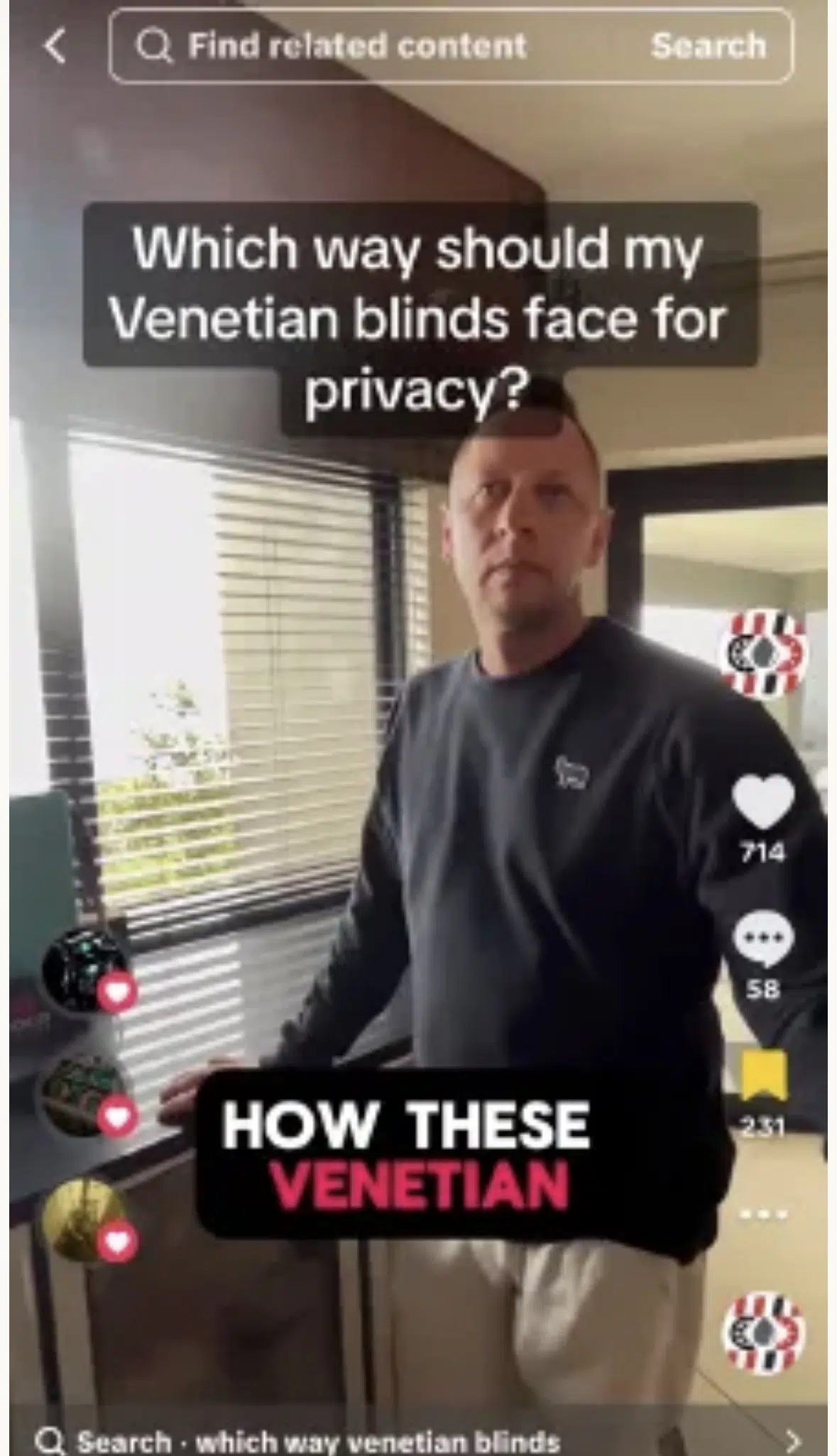
This is the question that went viral. Duncan covered it on TikTok and the response confirmed what we hear from homeowners every week: most people are tilting their blinds the wrong way.

At night (lights on inside)
Tilt slats upward so the rounded side faces you and the window-facing edge angles down. This blocks the view from street level and from anyone at eye height. If your concern is people looking down into your home from an upper floor, tilt slats down instead.
During the day
Tilt slats downward to filter natural light gently into the room while deflecting direct sun. You get brightness without glare, and passers-by still cannot see in clearly. Downward tilt during daylight hours also helps regulate room temperature by redirecting heat away from the interior.
For a balance of both
A slight upward tilt, not fully open and not fully closed, creates diffused light while obscuring the view from outside. This works well in living rooms and home offices where you want connection to the outdoors without sacrificing privacy.
What about vertical blinds?
The same principle applies, just rotated 90 degrees. Rotate the vanes so the convex (outward-curving) side faces the street. This blocks direct sightlines from outside while letting diffused light pass between the vanes. For sliding doors and large windows, vertical blinds offer practical privacy with full access when stacked open.
Does slat width affect privacy?
Yes. Narrower 25mm slats overlap more tightly and leave fewer gaps when tilted. Wider 50mm slats give bolder light shaping and a more dramatic look, but the gaps between slats are larger when partially open. The 50mm slat is the most popular size in South Africa because it balances privacy, light control and stack height.
Venetian Blind Materials: What Works in South Africa
Privacy is only half the story. A venetian blind that warps, fades or corrodes within a year gives you nothing. South Africa’s climate, with its intense UV, coastal salt air and humidity swings from the Garden Route to Gauteng, demands materials engineered for real conditions.
Aluminium Venetian Blinds
The practical workhorse. Aluminium slats in 16mm, 25mm, 35mm or 50mm widths suit offices, kitchens, bathrooms and any space that needs a clean, modern look. The material is naturally corrosion-resistant, lightweight and easy to wipe clean. See the full aluminium venetian range.
Aluwood Venetian Blinds
Aluminium core with a realistic wood grain coating. You get the warm timber look without the timber problems. Aluwood handles humidity, salt air and temperature extremes because it is aluminium underneath. Available in 25mm, 35mm and 50mm slats, with colours from white wash through to deep mahogany. View aluwood options.
Plaswood Venetian Blinds
The standout for South African conditions. A UV-stabilised PVC composite engineered specifically for this climate. The UV 500+ rating means they handle north-facing windows and direct Garden Route sun without fading. The non-porous surface is fully washable. We stock 50mm slats because that is the optimal size for South African windows. We have plaswood installations from 2010 that show no colour change. That is over 15 years of salt air, UV and humidity without a single replacement.
Basswood (Real Wood) Venetian Blinds
Beautiful. Authentic grain, natural warmth, the feel of real timber. Basswood venetians come in 35mm, 50mm and 63mm slats. They suit living rooms, bedrooms and offices inland. But real wood and high humidity do not mix. We do not recommend basswood for bathrooms, kitchens or any room where moisture accumulates. At the coast, we have seen basswood slats warp within two years.
Bamboo Venetian Blinds
Natural, sustainable and textured. Bamboo venetians in 50mm slats bring organic warmth to casual interiors. The same humidity limitations as basswood apply.
Venetian Blind Materials Compared for South African Conditions
| Feature | Aluminium | Aluwood | Plaswood | Basswood | Bamboo |
|---|---|---|---|---|---|
| UV resistance | Excellent | Excellent | Excellent (UV 500+) | Moderate | Moderate |
| Humidity / moisture | Excellent | Excellent | Excellent | Poor (warps) | Poor (warps) |
| Coastal salt air | Excellent | Excellent | Excellent | Poor | Poor |
| Slat widths | 16, 25, 35, 50mm | 25, 35, 50mm | 50mm only | 35, 50, 63mm | 50mm |
| Cleaning | Damp cloth | Damp cloth | Soap and water | Wood polish | Dry dust only |
| Coastal lifespan | 10-15+ years | 10-15+ years | 15-20+ years | 2-5 years | 2-5 years |
| Best for | Offices, budget, modern | Any room (wood look) | Bathrooms, coast | Inland bedrooms | Eco, dry rooms |
Which Venetian Blind for Which Room?
The right material depends on the room, the direction the window faces, and how close you are to the sea.
Bedrooms
Privacy is the priority. Wider 50mm slats give full blackout when closed and beautiful light shaping when tilted. Basswood or aluwood suits inland bedrooms. Near the coast, aluwood or plaswood is the safer choice. Pair with blockout roller blinds behind the venetian if you need total darkness.
Bathrooms and kitchens
Moisture is constant. Only plaswood, aluwood or aluminium belong here. Real wood and bamboo will absorb moisture and warp. Plaswood’s non-porous surface wipes clean without absorbing a thing.
Living rooms
Aesthetic choice matters most. Basswood delivers genuine timber warmth. Aluwood gives you the look without the risk. Aluminium suits modern, minimal interiors. Choose 25mm for smaller openings, 50mm for larger feature windows.
Home offices
Glare control is critical. Tilt slats downward to keep direct light off screens while maintaining brightness. Aluminium or aluwood in 25mm slats gives precise, modern control. Read our full home office window shades comparison.
North-facing windows
These take the most UV punishment in South Africa. Plaswood with its UV 500+ rating is the clear choice. We have north-facing plaswood installations across the Garden Route that have held colour for over a decade.
Frequently Asked Questions
Should venetian blinds tilt up or down for privacy?
At night with lights on inside, tilt slats upward to block the view from street level. During the day, tilt slats downward to filter light while maintaining privacy. If someone is looking in from above (an upper storey), tilt down. The direction depends on where the observer is relative to your window.
Which way should vertical blinds face for privacy?
Rotate the vanes so the convex (outward-curving) side faces the street. This blocks direct sightlines while letting diffused light through. The same up-at-night principle applies, just rotated 90 degrees.
Can people see through blinds at night when lights are on?
If slats are partially open, yes. Interior lighting creates silhouettes visible from outside. For full nighttime privacy, tilt slats fully upward so they overlap completely, or pair venetian blinds with blockout roller blinds behind them.
What are the best venetian blinds for South Africa?
Plaswood (PVC composite) and aluwood venetians are the best performers across most South African conditions. Plaswood is UV 500+ rated and moisture-proof, making it ideal for coastal areas, bathrooms and north-facing windows. Aluwood gives you a timber look with aluminium durability. Aluminium is the best budget option. Custom Blinds stocks all five materials with nationwide delivery.
What is the difference between plaswood and basswood venetian blinds?
Plaswood is a synthetic PVC composite that is moisture-proof, UV-resistant and fully washable. Basswood is real hardwood with natural grain and warmth. Plaswood lasts 15 to 20 years at the coast; basswood can warp within two to three years in humid conditions. Choose plaswood for bathrooms, kitchens and coastal homes. Choose basswood for dry, inland living rooms and bedrooms.
Does slat width affect privacy?
Yes. Narrower 25mm slats create tighter closure with less gap between slats when tilted. Wider 50mm slats give bolder light control but leave slightly larger gaps when partially open. The 50mm slat is the most popular in South Africa because it balances privacy, light shaping and a clean stack height when raised.
How much do venetian blinds cost in South Africa?
Aluminium venetians start from around R350 for a standard 600x600mm window. Aluwood starts from approximately R550. Plaswood from R699. Basswood and bamboo from R700 upward depending on size and finish. Enter your measurements into the online shop for an instant price.
Where can I buy venetian blinds on the Garden Route?
Custom Blinds Shutters & Awnings is based in Knysna and covers the entire Garden Route including George, Plettenberg Bay, Sedgefield, Wilderness and Mossel Bay. WhatsApp Duncan on 079 523 5407 for a free in-home consultation. National customers order from shop.customblinds.co.za with free delivery.
Ready to Choose Your Venetian Blinds?
Free delivery nationwide. Free site visits on the Garden Route.
Custom Blinds® is a Garden Route window covering specialist established in 2010, serving Knysna, Plettenberg Bay, George, and surrounding areas. We manufacture Custom Lifestyle Shutters™, Custom Lifestyle Awnings™, and outdoor shading systems locally, and supply roller blinds, honeycomb blinds, venetian blinds, and no-drill blinds nationally via shop.customblinds.co.za. Our Custom Fit Guarantee covers every order.