
Honeycomb Blinds Save Energy: How Much Can South African Homes Actually Save?
Your windows are the weakest point in your home’s temperature control. Up to 40 percent of heating and cooling energy escapes through glass. Honeycomb blinds put an insulating air barrier right where the heat loss happens, and the numbers make a real difference to your electricity bill.
How much energy do honeycomb blinds save in South Africa?
- Honeycomb blinds reduce heat transfer through windows by up to 35 percent, cutting the energy needed for heating and cooling
- A typical South African home can save R8,640 to R12,096 per year on electricity depending on tariff and usage patterns
- The investment typically pays for itself within 18 months through reduced aircon and heater use
- Cellular air pockets trap still air between the glass and the room, creating insulation equivalent to adding a second layer of glazing
- Light-filtering fabrics reduce daytime heat gain by up to 60 percent while still allowing natural light
- Custom Blinds supplies energy-rated honeycomb blinds online across South Africa and with installation on the Garden Route
Need expert advice? Call Duncan on 079 523 5407
TLDR
Honeycomb blinds act as thermal insulation at your windows, reducing heat transfer by up to 35%. That translates to roughly R8,600–R12,000 saved per year on electricity for a typical home, with the investment paying back in about 18 months. Fitted snug to the frame, they are one of the most effective passive energy-saving upgrades a South African homeowner can make.
The Problem
You close the curtains. The room goes dark. You open them. The room heats up. You switch on the aircon. The bill arrives. Honeycomb blinds break that cycle by controlling the heat without blocking the light.
35% Less Heat Transfer
The air pocket inside each cell insulates the glass. Less heat enters in summer. Less warmth escapes in winter.
Lower Electricity Bills
Your aircon and heater run less. That shows up on every monthly bill.
18-Month Payback
Energy savings offset the cost of the blinds in under two years for most homes.
Power Outage Resilience
When the power goes off, insulated windows hold temperature longer. No aircon needed.
“I always tell people to think of honeycomb blinds as insulation, not decoration. You would not live in a house without ceiling insulation. Your windows deserve the same treatment, they lose more heat than the walls.”
Duncan, Custom Blinds. 20 years experience across the Garden Route
How do honeycomb blinds insulate your home?
The science is straightforward. Each honeycomb cell traps a pocket of still air. Still air is one of nature’s best insulators because it resists heat transfer far more effectively than moving air or a single layer of fabric.
When that layer of trapped air sits between the glass and your room, it works like a buffer. In summer, solar heat hits the glass and is slowed before it reaches the room. In winter, warmth inside the room is slowed before it reaches the cold glass. The blind works in both directions, all year round.
This is fundamentally different from how a roller blind or curtain works. Roller blinds block light. Curtains block drafts. But neither creates a sealed air barrier at the glass surface. That air barrier is what produces the measurable energy savings. For a full explanation of how honeycomb cells are constructed, see our guide to honeycomb blinds.
How much energy do honeycomb blinds save per window?
The table below shows estimated energy savings per window per year, based on reduced electricity used to maintain comfortable room temperatures. Tariffs are calculated at R5 and R7 per kWh to reflect the range most South African homeowners pay.
| Window Size (mm) | Area (m²) | Estimated Price | kWh Saved/Year | Savings at R5/kWh | Savings at R7/kWh |
|---|---|---|---|---|---|
| 1200 × 1500 | 1.80 | ~R4,800 | 288 | R1,440 | R2,016 |
| 1500 × 1500 | 2.25 | ~R5,700 | 360 | R1,800 | R2,520 |
| 1800 × 2100 | 3.78 | ~R9,500 | 604 | R3,020 | R4,228 |
These figures are per window. A home with four to six north-facing windows fitted with honeycomb blinds can expect total annual savings of R8,640 to R12,096 depending on tariff and usage patterns. Payback on the blind investment is typically around 18 months.
Why do honeycomb blinds matter more in South Africa?
South Africa has a unique combination of factors that make window insulation especially valuable.
Extreme UV and solar gain
South Africa receives some of the highest UV levels in the world. North-facing windows in the Western Cape, Garden Route and Highveld take intense solar load for most of the year. Honeycomb blinds reduce daytime heat gain by up to 60 percent with a light-filtering fabric, without darkening the room.
Wide temperature swings
Many South African regions experience 15–20°C temperature swings between day and night, especially along the coast and on the Highveld. Homes cool rapidly after sunset because heat escapes through glass. Honeycomb blinds slow that heat loss, keeping rooms comfortable into the evening without switching on a heater.
Rising electricity costs
Eskom tariffs have increased at roughly 10–15 percent per year over the past decade. Every kilowatt-hour saved today is worth more next year. Honeycomb blinds deliver compounding savings because the energy they prevent you from using gets more expensive every year.
Power outage resilience
When the power goes off, you lose your aircon and your heater. But you do not lose insulation. A home fitted with honeycomb blinds holds its temperature longer during power outages because the windows are not haemorrhaging heat. This is passive comfort that works whether the grid is up or down.
For more on eco-friendly window covering options, see our eco-friendly blinds guide.
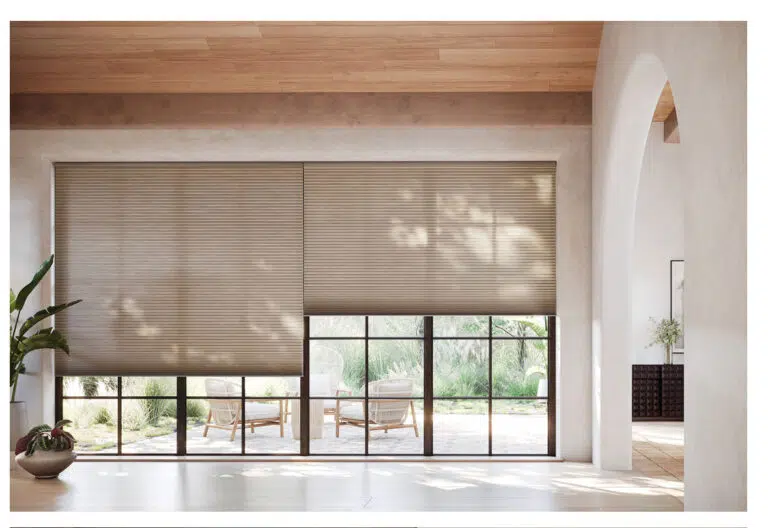
How do you maximise energy savings from honeycomb blinds?
The insulation performance of honeycomb blinds depends on three things: the fabric, the fit and how you use them.
Fabric choice
Blockout honeycomb fabrics trap more heat than light-filtering versions because the denser weave prevents radiant heat from passing through the fabric itself. For maximum energy saving in a room you also want dark, go blockout. For a room where you want light and heat control, light-filtering still delivers significant savings.
Fit quality
A snug fit inside the window recess is critical. Air gaps around the edges of a loose-fitting blind allow warm air to circulate past the cells, reducing the insulation effect dramatically. This is why on-site measurement matters, especially on older homes where window recesses are rarely perfectly square.
Usage habits
Close honeycomb blinds during the hottest part of the day in summer and before sunset in winter. The insulation works best when the blind is fully closed with no gaps. In summer, raising the blind on the shaded side of the house while closing it on the sun side gives you daylight and insulation at the same time.
For more on choosing the right opacity for each room, see our honeycomb buyer’s guide or the broader opacity selection guide.
How do honeycomb blinds compare to other blinds for energy efficiency?
| Covering Type | Heat Transfer Reduction | Insulation Mechanism | Energy Rating |
|---|---|---|---|
| Honeycomb / Cellular | Up to 35% | Trapped air pocket in cells | Excellent |
| Roller blind (blockout) | 10–15% | Reflective fabric surface | Moderate |
| Venetian blind | 10–20% | Reflected light via slat angle | Moderate |
| PVC shutters | 20–25% | Solid panel with air gap | Good |
| Curtains (lined) | 15–25% | Fabric barrier + still air behind | Good |
| No covering | 0% | None | Poor |
Honeycomb blinds outperform every other window covering for energy efficiency. The only option that comes close is lined curtains with a proper pelmet, but curtains block the view entirely and do not fold as compactly. For a complete comparison across all blind types, see types of blinds in South Africa.
“The homes I see that benefit most from honeycomb blinds are the ones along the coast with big glass facades. Beautiful views, brutal heat. Honeycomb blinds let them keep the view and lose the heat. That is the whole point.”
Duncan, Custom Blinds. On-site consultation across the Garden Route
Specifications
What are the technical performance numbers for honeycomb blinds?
For homeowners and specifiers who want the detail:
| Specification | Blockout Honeycomb | Light-Filtering Honeycomb |
|---|---|---|
| Fabric composition | Cellular polyester, aluminium-backed | Cellular polyester, semi-opaque |
| Cell type | Single cell, 20 mm | Single cell, 20 mm |
| Heat reduction (summer) | Up to 35% | Up to 25% |
| Heat retention (winter) | Up to 35% | Up to 20% |
| UV block | Up to 99% | Up to 80% |
| Sound absorption | Up to 60% | Up to 40% |
| Light transmission | 0% (full blockout) | 15–40% (diffused) |
| Moisture suitability | Dry areas only | Dry areas only |
| Operating systems | Cord, cordless, motorised | Cord, cordless, motorised |
Frequently Asked Questions
Do honeycomb blinds really save electricity in South Africa?
Yes. By reducing heat transfer through windows by up to 35 percent, honeycomb blinds lower the energy needed for aircon in summer and heating in winter. A typical home saves R8,640 to R12,096 per year depending on tariff, making them one of the most cost-effective passive energy upgrades available.
How long before honeycomb blinds pay for themselves?
Approximately 18 months for most South African homes. The exact payback depends on the number of windows fitted, your electricity tariff and how much you currently spend on heating and cooling. As Eskom tariffs rise, the payback period shortens.
Are honeycomb blinds better than double glazing for energy savings?
Double glazing and honeycomb blinds use the same principle, trapped air as insulation. Double glazing is permanent and more effective per square metre, but it costs significantly more (R5,000–R15,000+ per window). Honeycomb blinds deliver meaningful insulation at a fraction of the price and can be fitted without structural changes.
Do honeycomb blinds help during a power outage?
Yes. Insulated windows hold room temperature longer when power is off. During a power outage, a home with honeycomb blinds stays comfortable for longer without aircon or heating because the windows are not losing or gaining heat as rapidly as bare glass.
Which colour honeycomb blind saves the most energy?
White and light-coloured fabrics reflect the most solar heat and are most effective at reducing heat gain in summer. For maximum energy saving on north-facing windows, choose the lightest colour available. Blockout fabrics with an aluminium backing perform best regardless of colour.
Can I order energy-saving honeycomb blinds online in South Africa, with delivery to Johannesburg, Cape Town, Durban, Pretoria, Port Elizabeth and Bloemfontein?
Yes. Custom Blinds delivers honeycomb blinds anywhere in South Africa. Enter your window measurements for an instant price, or book a consultation for on-site measurement and installation on the Garden Route.
Are honeycomb blinds eco-friendly?
Honeycomb blinds reduce electricity consumption, which lowers your carbon footprint. The fabrics are made from recyclable polyester. By reducing reliance on air conditioning and heating, they contribute to lower household energy demand, a meaningful step for South African homes given the country’s coal-dependent grid. See our eco-friendly blinds guide for more.
Ready to start saving with honeycomb blinds?
Order online for delivery across South Africa, or book a free consultation along the Garden Route.
Energy savings are estimates based on typical South African home conditions and tariffs. Actual savings vary by home design, orientation, climate zone and usage habits. Pricing is indicative, use the online shop for exact quotes. Custom Blinds Shutters & Awnings® | Knysna, Garden Route | customblinds.co.za
Related: Honeycomb vs roller blinds compared, insulation, pricing, power resilience, and which rooms suit each type.
Related: Best blinds for estate and apartment living, privacy, heat, open plan, and indoor-outdoor flow solved room by room.
Related
For 2026 honeycomb pricing, see the honeycomb pricing guide. Browse the full indoor blinds range to compare insulation across all types.