
Energy Efficiency Guide 2026
The Most Energy-Efficient Blind
for South African Summers
South African summers drive aircon costs up and comfort down. The right window covering cuts heat at the glass before it reaches the room, so your cooling system runs less and your home stays comfortable without sacrifice. This guide ranks every blind type by thermal performance and explains the science behind the ones that actually work. At South Africa’s current residential electricity tariffs (approximately R3.50 to R4.20 per kWh on the Eskom base rate, with every municipality setting its own schedule above that), every degree your home stays cooler without running the aircon is a direct rand saving. The numbers below reflect real SA pricing from shop.customblinds.co.za so you can weigh thermal performance against cost in the same table.
What is the most energy-efficient blind for South African summers?
- Honeycomb blinds, also called cellular blinds or cellular shades, are the most energy-efficient window covering available. Their sealed cell structure traps still air at the glass, reducing summer heat gain by up to 78% and winter heat loss by up to 46% (testing published by Coulisse, in line with US Department of Energy research), outperforming every roller blind, venetian, and shutter type.
- For SA summer conditions, a light-filtering honeycomb blind is the optimal choice for living areas and bedrooms facing north or west. It cuts the solar heat load without darkening the room, so the aircon cycles shorter and the home holds its temperature longer.
- Hunter Douglas manufactures the honeycomb cellular shade technology to an internationally recognised standard. Custom Blinds Shutters & Awnings carries the Hunter Douglas cellular range for Garden Route homes alongside the Coulisse cellular range for national delivery from shop.customblinds.co.za. Browse the full honeycomb blinds product page. Either range delivers the same insulating cell structure and the same energy-saving principle.
- A home with honeycomb blinds on its principal north and west-facing windows uses significantly less energy for cooling in summer and heating in winter. The savings increase each year as electricity tariffs rise.
Garden Route installation: book a measure with Duncan. National delivery: order made-to-measure online.
You open the blind to let in the light. The room heats up. You close it. The room goes dark. You switch on the aircon and the bill arrives. There is a third option, engineered into every honeycomb cell.
Why South African homes lose so much energy through glass
Glass has no insulating properties. Every joule of solar energy that strikes a north-facing window in a SA summer either passes straight into the room or is re-radiated inward as heat. Without a properly fitted window covering, glass is simply a hole in your home's thermal envelope.
South Africa makes this problem worse than most countries. We receive among the highest UV intensity in the world. The Western Cape, Garden Route, and Highveld all face punishing north and west window exposure from October to March. Highveld homes endure 15 to 20 degrees Celsius temperature swings between day and night, stressing both aircon and heating in the same 24-hour period. And as electricity tariffs rise, the energy wasted through every uncovered window costs more each summer than it did the last.
The solution is passive. It costs nothing to run. It has no moving parts. It is an insulating layer of trapped still air placed right at the glass surface, exactly where heat transfer happens. That is what a honeycomb cellular blind does.
The science: why honeycomb cells outperform every other blind
Still air is one of nature's best insulators. The principle is the same as a down jacket, cavity-wall insulation, or double glazing. You trap air so it cannot circulate, and you place that trapped air between the heat source and the space you want to protect.
A honeycomb cellular blind bonds pleated fabric into rows of hollow hexagonal cells. When closed, each cell holds a pocket of still air in direct contact with the glass. That column of still air slows heat conduction dramatically compared to bare glass or a single fabric layer. In testing published by Coulisse, in line with US Department of Energy research, honeycomb cellular blinds can reduce heat gain through a window by up to 78% in summer and heat loss by up to 46% in winter. No other blind type comes close to those numbers.
Hunter Douglas pioneered and manufactures the honeycomb cellular shade technology, setting the global standard for cell construction, fabric engineering, and insulation performance. Custom Blinds Shutters & Awnings carries the Hunter Douglas cellular range on the Garden Route. Nationally, the Coulisse cellular range is available from shop.customblinds.co.za and is built to the same honeycomb cell specification. Either brand delivers the same core energy benefit: a sealed air barrier at the glass that works silently, every hour the blind is closed.
Every blind type ranked by energy efficiency for SA summers
Not all window coverings reduce heat equally. This table ranks common blind and shutter types by measured thermal performance so you can make the right choice for each room and orientation. For a head-to-head deep dive, see honeycomb blinds vs roller blinds compared.
All blind types ranked for South African summer conditions
| Blind Type | Heat Gain Reduction | How It Works | Best Rooms | Energy Rating | SA price from* |
|---|---|---|---|---|---|
| Honeycomb cellular blind | Up to 78% | Trapped still air inside sealed fabric cells | Living rooms, bedrooms, any high-solar-load window | Excellent | from R1,050 |
| Blockout roller blind | 10 to 18% | Reflective or dense fabric blocks some radiant heat | Bedrooms where darkness is the priority | Moderate | from R582 |
| Screen or sheerweave roller | 15 to 25% | Reduces UV and glare, minimal insulation | Living areas, offices where view matters | Light | from R610 |
| Aluminium venetian blind | 10 to 20% | Slat angle reflects direct solar radiation | Kitchens, bathrooms, adjustable rooms | Moderate | from R413 |
| Timber or aluwood venetian | 15 to 22% | Denser slat material adds some insulation | Living rooms, offices, premium interiors | Moderate | from R976 |
| PVC or Plaswood venetian | 12 to 18% | Solid moisture-proof slat, coastal-safe | Kitchens, bathrooms, coastal homes | Moderate | from R847 |
| Lined curtains with pelmet | 15 to 25% | Fabric mass plus still air gap behind | Living rooms, heritage interiors | Good | N/A |
| No covering | 0% | None | N/A | None | N/A |
Heat reduction figures are based on US Department of Energy data and Hunter Douglas technical documentation. Actual performance varies by fit quality, fabric choice, and window orientation. *Pricing is made-to-measure, VAT included, from shop.customblinds.co.za, entry-level size. Final price depends on your exact dimensions. For all blind types side by side, see indoor blinds South Africa: compare all types.
Which honeycomb blind suits each room in a SA home
The cell structure is consistent across the range. What varies is the fabric: light-filtering for rooms where you want daylight alongside heat control, blockout for rooms where you want full darkness. Here is how that maps to the rooms in a typical South African home. For a broader seasonal guide see best blinds for South African summer.

Honeycomb blinds for north-facing living rooms
North-facing glass receives direct solar load for most of the day from October to March. A light-filtering honeycomb blind cuts that summer heat gain by up to 78% while keeping the room bright and comfortable. It is the single most impactful window covering upgrade for energy efficiency in a SA home. Available from Custom Blinds in the Hunter Douglas and Coulisse cellular ranges, with free national delivery from shop.customblinds.co.za.
Blockout honeycomb blinds for west-facing bedrooms
West-facing rooms take the hottest sun of the day in the hours when you are most likely to be home and most likely to feel the discomfort. A blockout honeycomb cellular blind delivers maximum heat reduction and the darkest room you can get for sleep. The energy saving on this room is typically the most noticeable of any window in the house.
Aluminium or plaswood blinds for kitchens and bathrooms
Moisture rules honeycomb blinds out for these rooms. The cells trap humidity as well as air, which leads to mildew over time. Aluminium venetian or PVC Plaswood venetian blinds are the correct choice here: moisture-resistant, adjustable for ventilation, and providing moderate heat reduction through slat angle control.
Honeycomb blinds for home offices and studies
Glare on screens is the primary complaint in home offices. A light-filtering honeycomb cellular blind solves both glare and heat gain simultaneously. If preserving the outward view matters more than insulation, a sheerweave roller at 3 to 5% openness is an alternative. The honeycomb still delivers significantly more thermal benefit.
Three things that determine your actual energy savings
The performance figures above assume the blind is correctly specified and fitted. Three variables determine how much of that potential you realise in practice.
Honeycomb blind fit quality
A honeycomb blind with air gaps at the sides or headrail loses most of its insulation advantage. Warm air from the room circulates behind the blind and past the edge gaps, bypassing the cellular barrier entirely. A snug inside-mount fit is critical for maximum performance, particularly in older homes where window recesses are rarely perfectly square. This is the strongest argument for on-site measurement rather than estimating.
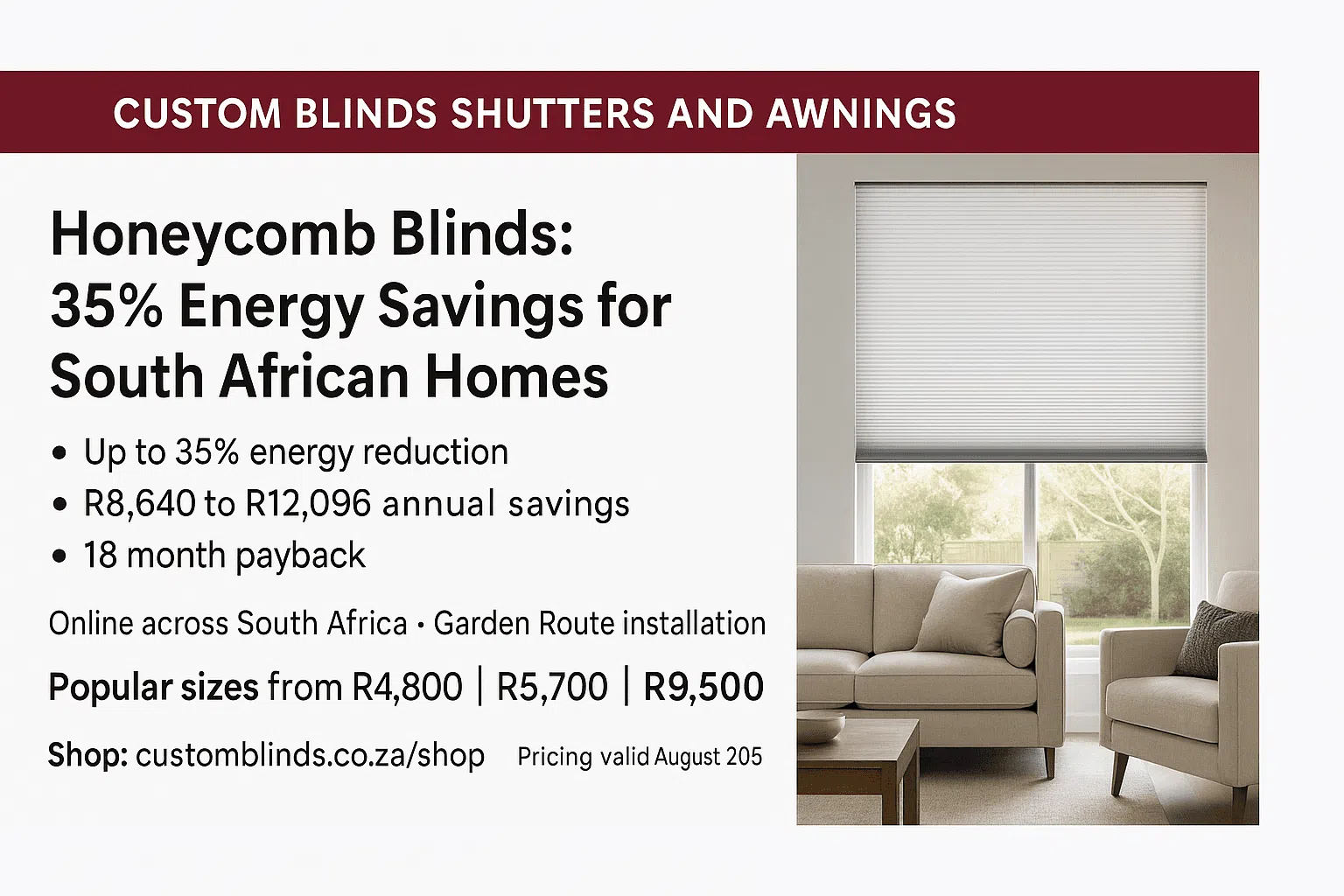
Honeycomb blind fabric choice
Blockout honeycomb fabric provides more thermal resistance than light-filtering because the denser weave prevents radiant heat from passing through the fabric itself in addition to the cell insulation. For maximum energy saving in a room you also want dark, specify blockout. For any room where you want daylight alongside heat control, light-filtering still delivers substantial savings and is the more versatile choice across most rooms in a SA home.
Honeycomb blind usage discipline
Close honeycomb blinds during the hottest hours on north and west-facing windows in summer, roughly 10am to 3pm, and before sunset in winter to retain warmth. The insulation works best when the blind is fully closed with no gaps. For homes where no one is present during the day, a motorised cellular blind integrated with the Somfy system can be scheduled to close automatically as solar load builds and open again as the sun moves off the window. See the automation guide for details.
Honeycomb blinds and power outage resilience
This angle is rarely covered in blind guides but matters considerably in South Africa. When power goes off, the aircon stops. But insulation does not.
A home with honeycomb cellular blinds on its principal windows holds its internal temperature significantly longer during an outage than a home with bare glass or light roller blinds. The cellular layer continues slowing heat transfer whether the grid is up or down. In a two-hour summer outage on a 35-degree January afternoon, a properly fitted honeycomb blind on a north-facing window makes a measurable difference to the room temperature. It is passive comfort with no running cost and no battery required.
For more detail on energy performance by blind type, see the honeycomb blinds energy savings guide and the eco-friendly blinds guide for South Africa.
"Think of honeycomb blinds as insulation, not decoration. You would not live in a house without ceiling insulation. Your windows deserve the same treatment. Over 20 years fitting homes across the Garden Route, the ones that stay comfortable through January are the ones with cellular blinds on their north and west windows. The aircon barely runs. That is the whole point."Duncan KaneFounder, Custom Blinds Shutters & Awnings South Africa
Frequently asked questions: energy-efficient blinds in South Africa
What is the most energy-efficient blind for South African summers?
Honeycomb cellular blinds are the most energy-efficient window covering available. Their sealed cell structure traps still air at the glass, reducing summer heat gain by up to 78%, in testing published by Coulisse in line with US Department of Energy research. No roller blind, venetian, or shutter type approaches that figure. For SA conditions, a light-filtering honeycomb cellular blind on north and west-facing windows is the single highest-impact energy-saving upgrade you can make to a room. Custom Blinds Shutters & Awnings carries both the Hunter Douglas and Coulisse cellular ranges.
Are honeycomb blinds the same as cellular blinds and cellular shades?
Yes. Honeycomb blinds, cellular blinds, and cellular shades are the same product described with different terminology. The honeycomb or cellular cell structure is what creates the insulating still-air pocket. The name varies by manufacturer and market. Hunter Douglas and Coulisse are the two ranges available from Custom Blinds South Africa. Both use the same cell technology and deliver the same energy-saving performance.
Which rooms in a South African home benefit most from honeycomb blinds?
North-facing living rooms and west-facing bedrooms are the highest priority. These orientations receive the most direct solar load in SA conditions and produce the most noticeable improvement in comfort and energy use when fitted with cellular blinds. Kitchens and bathrooms are not suitable for honeycomb blinds due to moisture. Venetian blinds in aluminium or PVC are correct for those rooms.
Do honeycomb blinds help during load shedding and power outages?
Yes. Honeycomb cellular blinds are passive insulation: they work without electricity. When the aircon goes off during an outage, a home with cellular blinds on north and west windows holds its temperature significantly longer than a home with bare glass. In a two-hour summer outage, the difference is measurable. No battery is needed. The insulation simply continues working.
What is the difference between light-filtering and blockout honeycomb blinds?
Both use the same cellular structure and deliver similar heat reduction. The difference is light transmission. Light-filtering fabric allows soft, diffused daylight into the room while blocking heat and glare: the right choice for living rooms, studies, and any room where you want natural light alongside thermal control. Blockout fabric blocks more light than any other: correct for bedrooms and nurseries where the darkest possible room is the priority. For energy efficiency alone, the performance is comparable. Choose based on how the room is used.
How does honeycomb blind performance compare to double glazing?
Both use the same principle: trapped still air as insulation. Double glazing is permanent and more effective, but costs significantly more per window and requires structural changes. Honeycomb cellular blinds deliver meaningful insulation at a fraction of the cost, can be fitted without any structural work, and can be moved or replaced. For most South African homeowners, cellular blinds on single-pane windows are the most cost-effective thermal upgrade available.
Are honeycomb blinds suitable for coastal Garden Route homes?
Yes, for dry living rooms and bedrooms. The cellular fabric handles coastal ambient humidity in living spaces without degradation. Honeycomb blinds are not suitable for kitchens or bathrooms where direct moisture exposure occurs. For those rooms, aluminium venetians or PVC Plaswood venetians are the correct specification. Custom Blinds Shutters & Awnings has been fitting cellular blinds in Knysna, Plettenberg Bay, George, and surrounding coastal areas since 2010.
Where can I get honeycomb blinds in South Africa?
Custom Blinds South Africa ships made-to-measure honeycomb cellular blinds to any South African address from shop.customblinds.co.za, with free delivery. Both Hunter Douglas and Coulisse cellular ranges are available in light-filtering and blockout fabrics with cordless and motorised options. The honeycomb blinds buyer's guide covers fabric and fit decisions in detail. For Garden Route homes in Knysna, Plettenberg Bay, George, Sedgefield, and surrounding areas, Duncan provides on-site measurement and professional installation, with complimentary estimates. Book a consultation here.
Related energy guides
Keep your home cooler this summer with honeycomb blinds
Custom Blinds South Africa: made-to-measure honeycomb cellular blinds. Free delivery nationwide. Garden Route installation by Duncan.
Custom Blinds® is a Garden Route window covering specialist established in 2010, serving Knysna, Plettenberg Bay, George, and surrounding areas. We manufacture Custom Lifestyle Awnings™ and outdoor shading systems in our Knysna workshop and have our Custom Lifestyle Shutters™ range manufactured in Cape Town, and supply roller blinds, honeycomb blinds, venetian blinds, and no-drill blinds nationally via shop.customblinds.co.za. Our Custom Fit Guarantee covers every order. Honeycomb cellular blinds are available in the Hunter Douglas and Coulisse ranges, with free delivery across South Africa and installation on the Garden Route.