
No-Drill Blinds vs Regular Blinds: Which Should You Buy?
You want blinds. You are not sure you want holes in your window frames. Here is how to decide between no-drill and standard drilled blinds for your South African home.
Should I choose no-drill blinds or regular drilled blinds in South Africa?
- Choose no-drill blinds if you are renting, have tiled window reveals, aluminium frames you want to protect, or plan to move within a few years
- Choose regular drilled blinds if you own your home, want the widest product range (including motorised, venetian, and honeycomb), or have very large or unusually shaped windows
- No-drill tension systems are the only reliable method in South African conditions. Adhesive fails in heat. Magnetic is unreliable long term
- Custom Blinds supplies no-drill roller blinds in every fabric (blockout, sunscreen, light-filter) through the online shop with free nationwide delivery
- Both no-drill and regular blinds are made to measure. No-drill adds a white tension bracket to the same roller blind you would otherwise drill in
- Order online at shop.customblinds.co.za with instant pricing. Manufacture 7 working days, shipping 3 to 4 days to Johannesburg, Cape Town, Durban, Pretoria, and all major metros
TLDR
No-drill blinds use a tension bracket that grips inside the window frame without screws. They are the same roller blind, same fabrics, same quality. The only difference is the mounting. If you are renting in Johannesburg, Cape Town, Durban, or anywhere in South Africa, no-drill is the obvious choice. If you own and want venetians, honeycomb, or motorised, go drilled. Many homeowners use no-drill in tiled rooms and drilled everywhere else.
You moved into the flat three weeks ago. The windows are bare. The landlord says no drilling. The morning sun wakes you at five. The neighbours can see in. You just want blinds that work, go up in minutes, and come with you when the lease ends.
Custom Blinds8,000+ installations on the Garden Route. Delivered nationwide"No-drill is not a compromise product. It is the same roller blind on a different bracket. The fabric, the mechanism, the warranty are identical. The only thing missing is the holes."
What is the actual difference between no-drill and regular blinds?
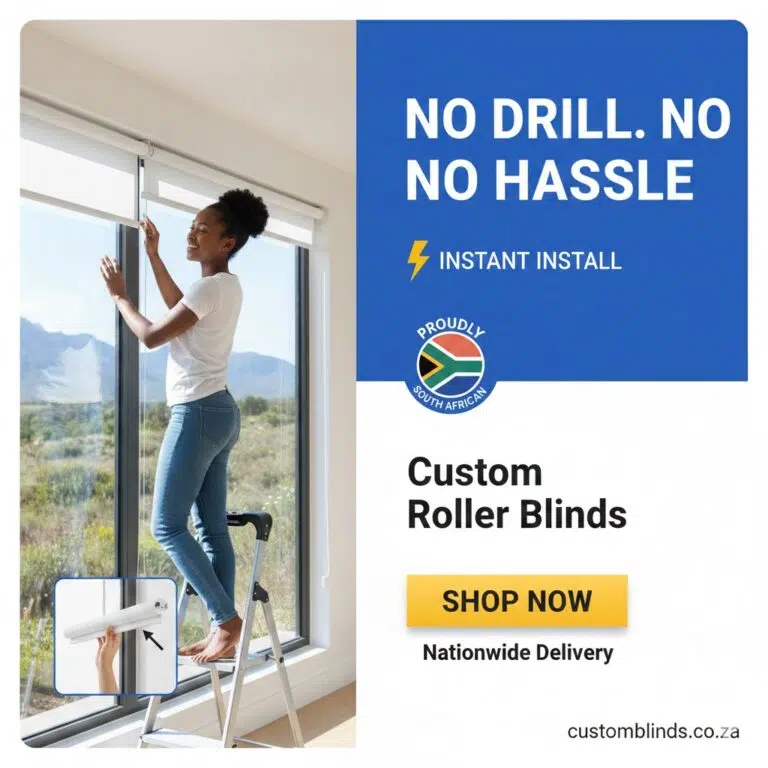
The difference is the bracket, not the blind. A regular roller blind screws into the wall or window frame with two or three brackets. A no-drill roller blind uses a spring-loaded tension bracket that expands inside the window recess and grips without screws, adhesive, or any permanent fixing.
The blind itself is identical. Same Hunter Douglas and Coulisse fabrics. Same chain or cordless mechanism. Same blockout, sunscreen, and light-filtering options. Same 3-Year Manufacturer’s Warranty. The tension bracket adds a white housing on each side inside the frame, barely visible once the blind is lowered. Custom Blinds regularly fits no-drill rollers up to 2 metres wide in blockout fabric with no slipping or sagging, even after years of daily use in Johannesburg apartments and Cape Town rentals.
When should you choose no-drill blinds?
No-drill blinds are the right choice when drilling is not allowed, not practical, or not worth the risk. In South Africa, that covers renters, student accommodation, Airbnb properties, and homeowners with tiled or aluminium-framed windows they want to protect.
Roughly 23% of South African households rent, according to Stats SA. In Johannesburg, Cape Town, Pretoria, and Durban that proportion is higher, particularly in apartment complexes and sectional title developments in areas like Sandton, Rosebank, Sea Point, Umhlanga, and Centurion. Lease agreements typically prohibit alterations, and drill holes in aluminium window frames void the frame warranty on many newer builds. No-drill blinds go up in under five minutes per window, leave no marks, and come with you when you move.
For landlords furnishing rental units, no-drill means professional window coverings that tenants cannot damage during installation or removal. For homeowners, tiled window reveals in bathrooms and kitchens are the other major trigger. Drilling through porcelain tile risks cracking. No-drill tension brackets sit inside the frame without touching the tile face. Even homeowners who drill everywhere else often use no-drill blinds in the bathroom and kitchen for this reason.

No-drill blinds vs regular drilled blinds compared
| Feature | No-Drill (Tension) | Regular (Drilled) |
|---|---|---|
| Installation | ✓ Under 5 min, no tools | 10 to 15 min, drill required |
| Wall/frame damage | ✓ Zero. No holes, no marks | 2 to 3 screw holes per bracket |
| Rental friendly | ✓ Remove and take with you | ✗ Holes remain, filler needed |
| Fabric range | All roller blind fabrics | ✓ All blind types (roller, venetian, honeycomb, vertical) |
| Max width | Up to 2.0 m reliably | ✓ No practical limit |
| Motorisation | Not available with tension mount | ✓ Somfy motorised options |
| Tiled reveals | ✓ No drilling into tiles | Risk of cracking porcelain |
| Stability | Excellent with tension system | ✓ Permanent fix |
| Child safety | ✓ Cordless standard | Chain or cordless options |
| Price | Slightly higher (tension bracket add-on) | Standard pricing |
When are regular drilled blinds the better choice?
Regular drilled blinds are the better choice when you own the property, want the full range of blind types, or need motorised operation. No-drill tension brackets work with roller blinds only. Venetian blinds, honeycomb blinds, vertical blinds, and Somfy motorised rollers all require drilled installation.
Very large windows and sliding doors wider than 2 metres also suit drilled mounting. The tension system works by pressing outward against the frame, and beyond a certain width the force needed becomes impractical. For a standard bedroom or bathroom window in a Johannesburg townhouse or Cape Town apartment, no-drill handles the size comfortably. For a 3-metre living room slider in a Durban beachfront apartment or a Pretoria estate, drill and mount properly.
Homeowners doing a full renovation or new build should specify drilled blinds throughout and get them professionally measured and fitted. The screw holes are invisible once the blind is in place, and drilled mounting opens up the full product range: honeycomb for insulation, venetians for light control, and motorised rollers for convenience.
Why does Custom Blinds only use tension systems for no-drill?
Custom Blinds supplies tension-mount no-drill blinds exclusively because it is the only system that performs reliably in South African conditions. Adhesive strips fail in heat, and South African windows get hot. Magnetic systems lose grip over time and cannot hold heavier fabrics. Tension is mechanical, not chemical or magnetic, so temperature has no effect on it.
After testing all three systems on hundreds of installations over 15 years, Custom Blinds stopped offering adhesive and magnetic options entirely. The tension bracket uses a spring-loaded dial that expands the housing until it grips the frame firmly. It works on aluminium, wood, steel, and tiled window reveals. It holds blockout roller blinds up to 2 metres wide without slipping. And it releases cleanly when you twist the dial back, leaving zero marks on the frame.
Online marketplaces like Amazon and Temu sell adhesive no-drill blinds at very low prices. These products are designed for mild European climates and consistently fail within months in South African heat. A Sandton north-facing window in January will reach surface temperatures that dissolve most adhesive bonds. Custom Blinds customers who switched from adhesive to tension report zero failures after the change.
Which rooms suit no-drill blinds and which need drilled?
The practical split in most South African homes is no-drill in the rooms where tile, moisture, or rental restrictions apply, and drilled in the rooms where you want premium products or motorised control. Custom Blinds customers nationally use both in the same house.
Bathrooms and kitchens with tiled reveals are the strongest case for no-drill. Bedrooms in rental apartments are the second. A blockout no-drill roller in the bedroom gives you complete darkness and privacy without touching the landlord's window frames. Living areas, studies, and dining rooms in owned homes are where drilled blinds earn their place, because these rooms benefit from venetians, honeycomb insulation, or sunscreen rollers on motorised tracks.
For a full rental property, no-drill throughout is the standard approach. For an owner-occupied home, the mix depends on your windows and priorities. The Custom Blinds online shop lets you select "no-drill mount" or "standard mount" for each blind individually, so you can mix and match across your order.
Can you use no-drill blinds in a home you own?
Absolutely. Roughly 40% of no-drill blind orders through the Custom Blinds shop come from homeowners, not renters. The reasons vary: protecting new aluminium frames from drill holes, avoiding tile damage in bathrooms, or simply preferring the speed and simplicity of tension mounting.
Some homeowners use no-drill blinds as a practical first step when they move into a new house. You get window coverings up immediately while you take time to decide on permanent treatments for each room. Because the no-drill blind is the same quality roller blind on a different bracket, there is no compromise in the meantime. If you later decide to upgrade to honeycomb or venetians in certain rooms, the no-drill rollers move to a guest room, garden flat, or home office.
How do you order no-drill blinds online in South Africa?
Order through shop.customblinds.co.za. Choose your roller blind fabric (blockout, sunscreen, sheer, or light-filter), enter your window dimensions in centimetres, select "no-drill mount" at checkout, and the white tension brackets are included with your blind.
Manufacture takes 7 working days. Shipping to Johannesburg, Cape Town, Durban, Pretoria, Port Elizabeth, Bloemfontein, and other major metros takes 3 to 4 days after that. Free delivery nationwide. The Custom Fit Guarantee applies: if the blind is too large, Custom Blinds trims it free. If it is too small, you receive 5% off the replacement. Every blind comes with a 3-Year Manufacturer’s Warranty.
Installation is genuinely simple. Position the bracket inside the frame, twist the tension dial until it grips, click the roller blind into the brackets. Most people complete their first window in under five minutes with no tools and no experience. A full house of 8 to 10 windows takes about an hour.
Frequently Asked Questions
Are no-drill blinds as good as regular drilled blinds?
The blind itself is identical. Same fabrics, same mechanisms, same warranty. The only difference is the bracket: tension instead of screws. No-drill roller blinds from Custom Blinds hold up to 2 metres wide in blockout fabric without slipping. The limitation is product range: no-drill works with roller blinds only, not venetians, honeycomb, or vertical blinds.
Can I buy no-drill blinds online in South Africa?
Yes. Custom Blinds sells no-drill roller blinds through shop.customblinds.co.za with made-to-measure sizing and free nationwide delivery. Select your fabric, enter your dimensions, choose "no-drill mount" at checkout. Manufacture takes 7 working days, shipping 3 to 4 days to major metros.
Do no-drill blinds work on aluminium window frames?
Yes. Tension brackets grip aluminium frames securely without damaging the powder-coated finish. This is one of the most common reasons South African homeowners choose no-drill: protecting new aluminium windows from drill holes that void the frame warranty.
Why do lesser quality no-drill blinds from Amazon or Temu fall down?
Most imported no-drill blinds use adhesive strips designed for mild European climates. South African window surfaces reach temperatures that dissolve adhesive bonds, especially on north-facing windows in Gauteng, KZN, and the Western Cape. Custom Blinds uses mechanical tension, not adhesive, which is unaffected by heat or humidity.
Can I get blockout no-drill blinds for a bedroom?
Yes. Blockout is the most popular no-drill fabric. The tension bracket holds heavy blockout roller fabric up to 2 metres wide. Cordless operation is standard, making it safe for bedrooms and nurseries. The blockout fabric provides complete darkness for shift workers, babies, and anyone who needs proper sleep.
Will no-drill blinds damage my window frame when I remove them?
No. The tension bracket releases cleanly when you twist the dial back. There are no holes, no adhesive residue, and no marks on the frame. This is why no-drill blinds are the standard choice for South African rental properties where tenants must return the property in its original condition.
Can I mix no-drill and regular blinds in the same house?
Yes. The Custom Blinds online shop lets you select the mount type for each blind individually. Use no-drill in bathrooms, kitchens, and rental bedrooms. Use drilled mounting in rooms where you want venetians, honeycomb, or motorised blinds. Both ship in the same order with the same free delivery.
Ready to order?
No-drill and regular roller blinds with instant pricing. Free delivery to Johannesburg, Cape Town, Durban, Pretoria, and everywhere in between.
Last reviewed: March 2026
All blinds are custom manufactured and quoted individually. Prices subject to measurement and specification.
Related: Best blinds for estate and apartment living — honeycomb for heat, sunscreen for privacy, no-drill for rentals. The complete guide.