
Retractable awnings for the Garden Route, folding arm, made in canvas
Custom Blinds Shutters & Awnings makes and installs retractable folding arm awnings in Knysna and across the Garden Route, motorised or manual. Extend for shade over a patio or restaurant terrace, fold flat against the wall when the weather turns. Installed across the Garden Route only. Send Duncan your dimensions and photos for an estimate.
What is a retractable folding arm awning, and why choose canvas over aluminium?
- A folding arm awning is a canvas canopy that extends horizontally from a wall cassette on articulated aluminium arms, then retracts to fold flat against the wall when not in use.
- Canvas folding arm awnings offer the widest unsupported span of any awning type, up to around 6.5 metres, without any floor-fixed posts or pergola structure.
- Custom Blinds custom designs and installs folding arm awnings with marine-grade canvas cut and made in our Knysna workshop and coastal-spec aluminium arms, engineered for Garden Route wind and salt exposure.
- Somfy motorisation with wind sensors is specified as standard on Garden Route installations, because exposed patios face Beaufort 7 gusts routinely through winter.
For Garden Route homes and restaurants: WhatsApp Duncan your dimensions or book a design consultation.
A folding arm awning is the quietest piece of shade engineering on the market. A rectangular cassette sits against a wall, a motor spins a roller, and two articulated aluminium arms swing out horizontally to pull a canvas canopy over the space below. Nothing touches the ground. No pergola. No posts. When the canvas is retracted, the cassette is barely visible against the wall.
It works because the arms are engineered like spring-loaded elbows. Each arm contains stainless steel cables running through the joints under constant tension, which keeps the canvas taut no matter how far the awning is extended. The same tension makes the awning fold flat and flush when it retracts, so nothing flaps and nothing sags.
The canvas does the weather work. Solution-dyed acrylic holds colour for 15 years on a well-specified installation, shrugs off salt air, and sheds rain at a 14-degree pitch. The aluminium arms and cassette handle the structural work, powder coated to a marine specification so the hardware matches the canvas lifespan.
Why do folding arm awnings suit Garden Route patios?
Three reasons this shape of awning has become standard on Garden Route patios over the last fifteen years.
First, the span. A folding arm awning can cover around 6.5 metres of patio width and project 3.5 metres outward without any floor-fixed support. On a deep veranda where a shadeport or pergola would block the view of the lagoon or the sea, a folding arm awning keeps the sightline clean. When you retract it, the view is untouched.
Second, the wind response. Garden Route winters produce Beaufort 7 gusts through any exposed patio. A fixed canvas awning or an outdoor blind has no option but to sit there and absorb the load. A motorised folding arm awning with a Somfy wind sensor retracts itself the moment gusts exceed a preset threshold, usually around 40 km/h. The cassette closes, the arms fold, the canvas is protected. You do not have to be home.
Third, the salt and humidity. Canvas folding arm awnings have no moving parts exposed to the outside environment once retracted. The canvas, the arms, and the motor all sit inside a closed aluminium cassette when the awning is folded flat. A well-specified installation at Buffalo Bay or Brenton on Sea can run for over a decade with only a canvas refurbishment at year 10 or 12.
What are the specifications of a canvas folding arm awning?
Every folding arm awning we design and install comes through the same specification chain. These are the defaults for Garden Route installations.
Canvas folding arm awnings: Garden Route standard build
| Component | Specification | Why this spec |
|---|---|---|
| Canvas | Solution-dyed acrylic, marine grade, UV-stable | Holds colour 15 years. Salt-air resistant. Sheds rain at 14-degree pitch. |
| Cassette | Full aluminium, powder coated, closed on all sides when retracted | Canvas is protected inside cassette when folded. No exposed mechanism. |
| Arms | Articulated aluminium, internal stainless steel cables under tension | Cables maintain constant canvas tension at any extension. No sag, no flap. |
| Motor | Somfy accredited, tubular, internal to roller | Silent operation. 5-year warranty. Replaceable as a single unit if needed. |
| Wind sensor | Somfy Eolis 3D RTS, roof-mounted | Auto retracts at preset wind threshold. Standard on Garden Route patios, not optional. |
| Maximum width | Up to around 6.5 metres unsupported | Single-motor span. Wider requires a coupled twin-cassette configuration. |
| Maximum projection | Up to around 3.5 metres outward | Covers a standard patio depth with no floor-fixed posts. |
| Control | Wall switch, remote, or Somfy TaHoma smart home app | All three can run in parallel. Scene control integrates with existing smart home. |
| Pitch | 5 to 25 degrees, set at install | 14 degrees is typical for rain runoff. Set to site conditions and eye-line. |
| Warranty | Canvas terms confirmed in writing at quote. Motor 5 years. Frame 5 to 10 years. | Coverage is specification-dependent. Exact terms go on every written quote. |
How is a folding arm awning installed on a Garden Route home?
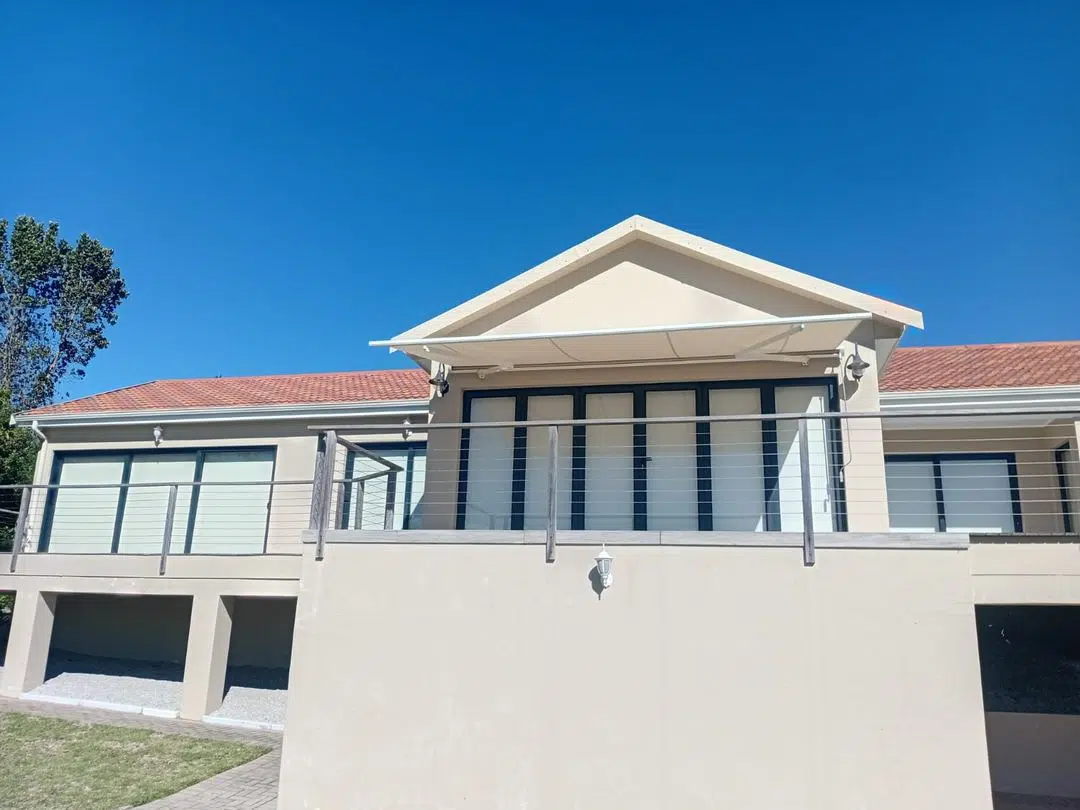
The installation process runs through five stages, which together take between 3 and 6 weeks from first enquiry to installed awning.
Site visit and structural assessment. Duncan or an installer visits the property to measure the wall, check the mounting surface, verify there is enough bracing behind the cladding or render, and confirm the width and projection that will fit the patio. Brick, concrete, and timber-framed walls all take folding arm awnings, but each requires a different fixing specification.
Design and written quote. A full written specification goes out within a few days of the site visit. Canvas colour, pitch, motor, sensor, warranty terms, and lead time are all confirmed in writing before any deposit is taken.
Supply. Canvas is cut and seamed to your specification. Cassette is powder coated. Arms are tensioned and tested. Motor and sensor are wired and paired. Lead time is typically 2 to 4 weeks depending on the specification and workshop queue.
Installation. The awning is mounted to the wall using the fixings specified at site visit stage. A single installer plus a helper takes between 4 and 8 hours for a standard folding arm awning. Wider twin-cassette configurations take a full day.
Commissioning and handover. Motor limits are set, wind sensor threshold is calibrated, remote or smart home pairing is completed, and the homeowner is walked through the controls on site.
Folding arm awnings at restaurants and guest houses
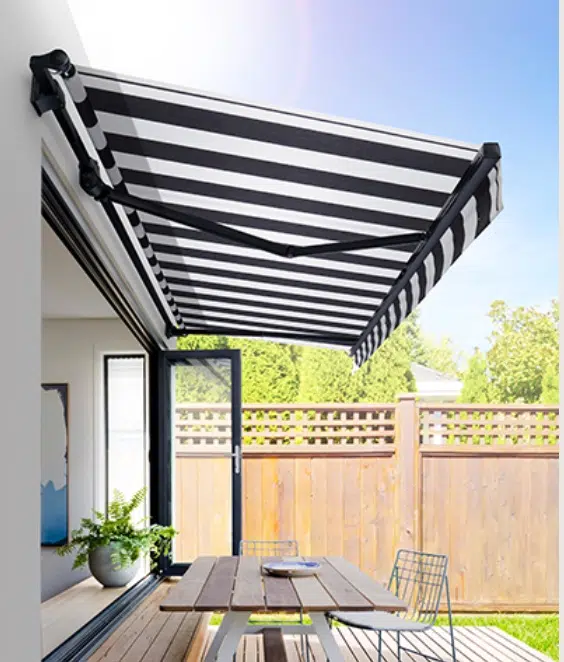
The commercial case for folding arm awnings on the Garden Route is stronger than the residential case. A restaurant terrace or guest house deck that can be shaded for lunch service and retracted for dinner or for bad weather serves twice the hours of a fixed structure. The payback from additional seated covers in high season usually covers the installation within one trading year.
The wind sensor is what makes commercial installations work. Nobody has to be on site to retract the awning when a front comes through. Sensor-triggered retraction protects the installation automatically, which means a restaurant owner can leave a Knysna lagoon terrace covered for lunch service and know that the awning will protect itself when the afternoon southeaster arrives.
Coastal restaurants at Knysna Heads, Plettenberg Bay main beach, and the Sedgefield lagoon have all specified folding arm awnings from us in the last five years. Commercial references are available at quote stage.
Is a folding arm awning a retractable awning?
Yes. A folding arm awning is a type of retractable awning, specifically, the wall-mounted, self-supporting kind. The cassette bolts to the wall, the articulated arms extend the canvas horizontally over the patio, and the whole assembly retracts flat when not in use. Nothing touches the ground. No pergola or overhead structure required.
The term retractable awning covers two distinct products. A folding arm awning projects outward from a wall on its own arms. A retractable patio shade awning runs along tracks fitted to an existing pergola or beam. Both retract. Both provide shade. The structure they mount to is what differs.
How do folding arm awnings compare to other Garden Route awning types?
A folding arm awning is one of four awning types in our range. Each solves a different problem.
A fall arm awning drops from a top-hinged frame over a window rather than extending horizontally from a wall. Better for windows and shopfronts, not for patio cover.
A louvre awning is a fixed aluminium framework with rotating blades that open and close overhead. Offers rain control and year-round coverage, but replaces a pergola rather than complementing one.
A retractable patio shade awning uses fabric tracks fitted to an existing pergola or beam structure. Requires the pergola to be there already.
The full comparison sits on our awnings hub page, with specification trade-offs and Garden Route use cases for each.
Frequently asked questions
How much does a canvas folding arm awning cost on the Garden Route?
Folding arm awning projects are quoted per specification after a site visit. There are no fabricated price ranges on this page because canvas, cassette width, arm configuration, motor, and wind sensor all affect the final number. Duncan or an installer will give a written quote within a few days of the site visit.
Can a folding arm awning handle rain?
A folding arm awning sheds rain at the installed pitch, which is typically 14 degrees. Light rain runs off the canvas. Heavy rain with strong wind should trigger a wind sensor retraction anyway. The awning is designed to provide shade and light shelter, not to replace a fixed roof over a patio. For year-round rain cover, a louvre awning is the right specification.
What is the maximum size of folding arm awning available?
A single-motor folding arm awning spans up to around 6.5 metres wide and projects up to around 3.5 metres outward. Wider coverage is possible with a coupled twin-cassette configuration, where two synchronised awnings extend together from a shared wall. Duncan confirms exact dimensions at site visit.
Do folding arm awnings need structural engineering?
On most residential walls, a folding arm awning mounts to the wall itself using fixings specified at site visit. Brick, concrete, and well-braced timber-framed walls all take folding arm awnings directly. On lightly clad walls or where the awning width exceeds 5 metres, a steel mounting bar is fabricated and fixed through to structural framing behind the cladding. This is assessed at site visit and confirmed in the written quote.
Can I motorise the awning with my smart home?
Yes. Custom Blinds is a Somfy accredited installer. Every motorised folding arm awning runs a Somfy tubular motor, which pairs with a wall switch, remote, or the Somfy TaHoma smart home app. Scene control integrates with most existing smart home systems including Google Home, Apple HomeKit, and Alexa. Wind and sun sensors run in the background regardless of which control method you use.
How long does installation take on the Garden Route?
From first enquiry to installed awning is typically 3 to 6 weeks. Site visit within a week. Written quote within a few days of the site visit. Supply takes 2 to 4 weeks depending on specification. Installation on site is usually a single day for a standard folding arm awning, with wider twin-cassette configurations taking a full day.
Do you install folding arm awnings outside the Garden Route?
No. Folding arm awnings require a site visit, structural assessment, supply to specification, and a professional fitting crew. We install across Knysna, Plettenberg Bay, George, Sedgefield, Mossel Bay, Buffalo Bay, and Wilderness only. National shipping applies to outdoor blinds, roller blinds, and indoor blinds through shop.customblinds.co.za, but awnings stay local.
What happens if the canvas gets damaged?
Canvas is replaceable as a single panel. The cassette, arms, and motor stay in place while the canvas is unrolled, unhooked, and replaced with new material. Typical replacement interval on a well-specified Garden Route installation is 10 to 12 years, and the cost at that point is a fraction of a new awning. All warranty terms are confirmed in writing at quote stage.
Do you charge for quotations?
No. Estimates and consultations are complimentary. Send through your dimensions and a few photos on WhatsApp and we will prepare your estimate, or share your building plans for larger projects. If you are happy to proceed, we come out and do the final measurements. Larger projects include a design consultation with Duncan Kane, on site anywhere on the Garden Route.
A folding arm awning for your Garden Route patio
Send through your dimensions and photos for an estimate. Final measurements once you proceed. Supplied to specification, installed by our own crews.
Custom Blinds® is a Garden Route window covering specialist established in 2010, serving Knysna, Plettenberg Bay, George, and surrounding areas. We custom design and install the full awning range, including folding arm, louvre, fall arm, wedge and patio shade, with canvas cut and made in our own Knysna workshop, and supply roller blinds, honeycomb blinds, venetian blinds, and no-drill blinds nationally via shop.customblinds.co.za. Garden Route installs include a written workmanship guarantee, confirmed on site before our team leaves.
Custom Blinds Shutters & Awnings | The Garden Route’s trusted blinds, shutters and awnings specialists since 2010.